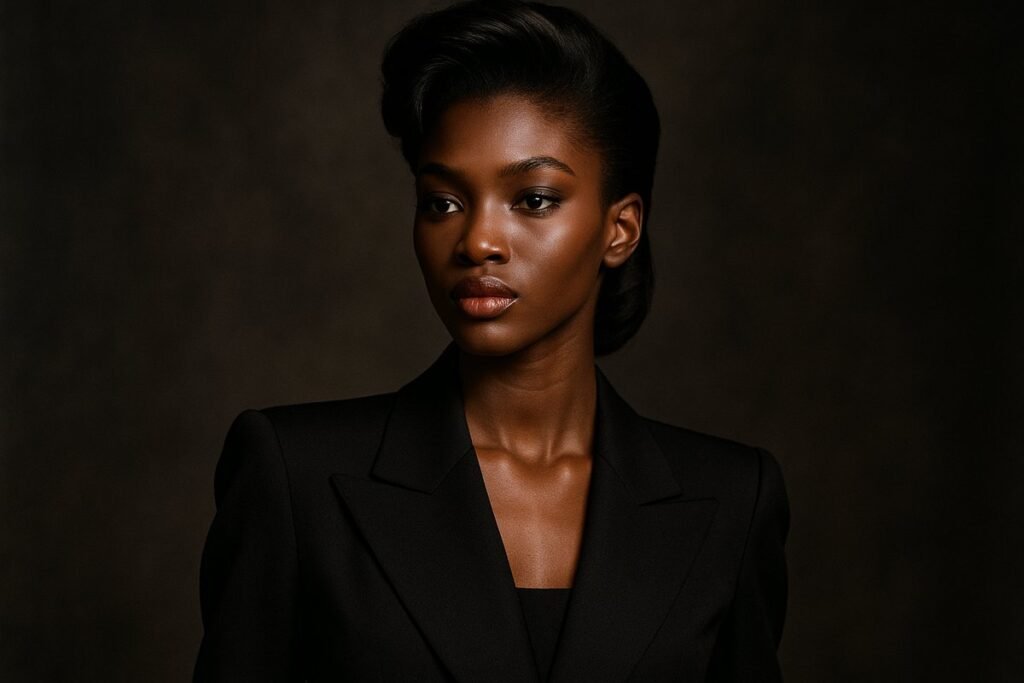
Long before the world knew her as a global icon, Naomi Campbell was a young girl from South London with a powerful dream. Her transformation from a determined, fresh-faced schoolgirl into a runway-dominating supermodel is a compelling story of raw talent, fierce resilience, and the courage to break down barriers.
This is a look back at the formative years of a young Naomi Campbell, exploring the moments that shaped her into one of the most influential figures in fashion history.
A South London Childhood
Naomi Campbell was born on May 22, 1970, in London, England. With her mother, a Jamaican-born dancer, often touring Europe, a young Naomi was raised by her grandmother in the residential neighborhood of Stockwell.
This unique upbringing instilled in her a profound sense of independence and a maturity that belied her years. Though her mother was often away, her inherent grace and style left a lasting impression, planting the seeds for a future in the world of glamour.
Dreams of the Stage
Before fashion ever found her, Naomi’s heart belonged to dance. Her dedication was clear when, at just five years old, she enrolled at the Barbara Speake Stage School, undertaking a daily commute across London.
Her passion and talent led her to the prestigious Italia Conti Academy by age thirteen. She began to shine, making early appearances in music videos for cultural titans like Bob Marley in his 1978 hit “Is This Love,” and later for Culture Club.
The stage was her first love, and a professional dance career seemed to be her destiny.
The Discovery That Changed Everything
Fate, however, had a different path in mind. On a warm April afternoon in Covent Garden, a fifteen-year-old Naomi was stopped by a woman who saw her incredible potential. That woman was Beth Boldt, the head of the Synchro modeling agency.
Still in her school uniform—a pale blue dogtooth kilt and blazer—Naomi’s life was about to pivot in a new, exciting direction. After some initial hesitation, her mother agreed to let her model, on the condition that it wouldn’t interfere with her school exams.
It was a promise Naomi kept, skillfully balancing a new career with her education.
First Steps in Fashion
Her rise in the fashion world was nothing short of meteoric. Shortly after signing with Synchro, the teenage Naomi was flown to New Orleans for her first major shoot with British Elle. By sixteen, she was already becoming a familiar face in the high-fashion circles of Paris.
A moment of misfortune during one of these trips turned into a life-changing opportunity. After having her money stolen, she was introduced to the legendary designer Azzedine Alaïa. He became a protective father figure, whom she would affectionately call “Papa,” guiding her through the industry’s complexities and providing a home away from home.
Breaking Barriers and Making History
Naomi’s journey was not without its challenges. In an industry that was far from inclusive, she often faced discrimination because of her skin color and was overlooked for certain shows. She quickly learned a powerful lesson: to succeed, she had to be “twice as good.”
She didn’t just meet the standard; she shattered it. In 1987, she landed her first British Vogue cover, a sign of what was to come. A year later, at just eighteen, she made history as the first Black model to grace the cover of French Vogue.
This monumental achievement was followed by the coveted American Vogue September issue in 1989, cementing her status as a true trailblazer.
Rising with the Supermodel Era
At seventeen, Naomi made the move to New York City, where she shared an apartment with fellow model Christy Turlington. She became a central figure in a new wave of models who were more than just faces; they were personalities.
Along with Turlington and Linda Evangelista, she formed the iconic “Trinity.” This was the dawn of the supermodel era, and Naomi was at its epicenter. Their fame transcended the catwalk, famously captured in George Michael’s “Freedom! ’90” music video and on the glamorous runways of designers like Gianni Versace.
The young Naomi Campbell was becoming a global phenomenon.
The Making of an Icon
The young Naomi Campbell was more than just a beautiful face; she was a consummate professional with a formidable work ethic. She cultivated lasting relationships with industry legends and, as her platform grew, she began to use her voice to advocate for change.
From her earliest days, she championed diversity, joining the Black Girls Coalition in 1989 to fight for equality and representation. Her incredible journey from a young girl with a dream to a cultural icon remains a testament to her unwavering strength, undeniable talent, and enduring spirit.
