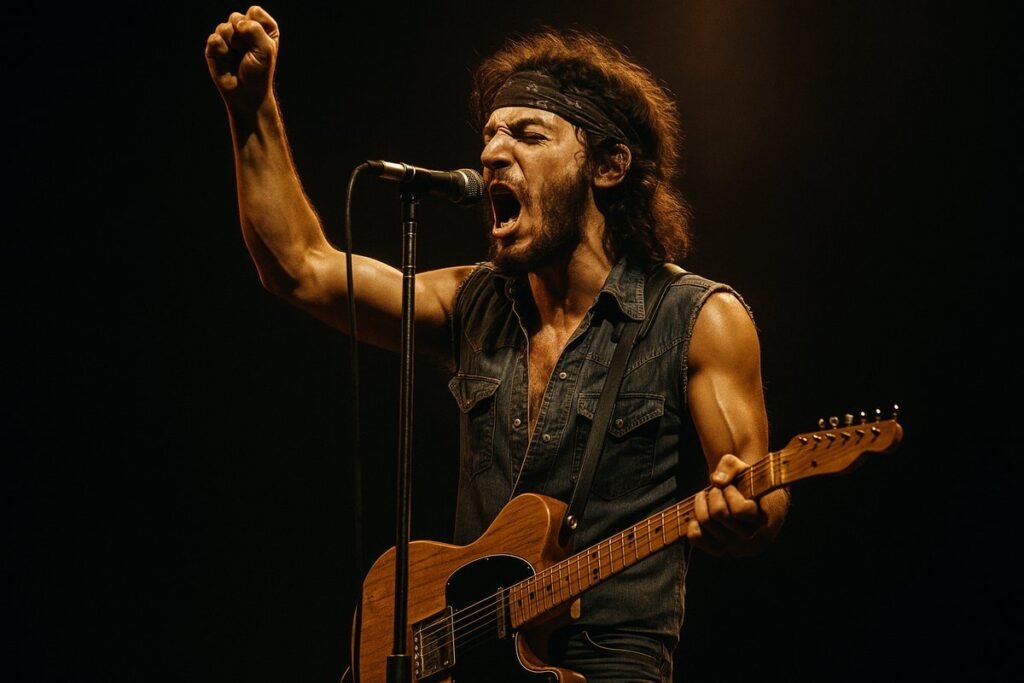
The Birth of a Rock and Roll Legend
Today, Bruce Springsteen is known worldwide as The Boss. His anthems fill stadiums, and his name is synonymous with American rock and roll. But there was a time when he was just another kid from New Jersey, clutching a guitar and dreaming of something bigger.
The story of how that kid became a legend is one of grit, passion, and an unshakable belief in the power of music. It began in the small towns and smoky clubs of the Jersey Shore, where a young Bruce Springsteen was finding his voice.
Growing Up in Freehold
Bruce Frederick Joseph Springsteen was born on September 23, 1949, in Long Branch, New Jersey. He grew up in nearby Freehold, a blue-collar town where his father worked as a bus driver and his mother kept the family afloat as a legal secretary.
Life at home was not easy. His father struggled with mental health issues, and money was always tight. Bruce was raised Catholic, attending St. Rose of Lima School, where he clashed with the nuns and felt out of place.
But everything changed when he was seven years old. Watching Elvis Presley on The Ed Sullivan Show, Bruce felt something ignite inside him. That was the moment he knew he wanted to be a musician.
A Loner with a Guitar
By the time Bruce reached high school, he was already a different kind of kid. While his classmates focused on sports and social life, he was consumed by music. A former teacher later described him as a loner who wanted nothing more than to play his guitar.
He graduated from Freehold High School in 1967, but he felt so disconnected from the experience that he skipped his own graduation ceremony. College was not for him either. After a brief stint at Ocean County College, he dropped out to pursue music full-time.
At nineteen, he was called up for the draft. Thanks to a concussion from a motorcycle accident and some creative behavior at the induction center, he failed his physical and avoided being sent to Vietnam. Music was his war, and he was ready to fight.
The Jersey Shore Music Scene
In the late 1960s, the Jersey Shore was alive with music. Bands played in bars, clubs, and anywhere they could set up their gear. For a young musician like Bruce, it was the perfect training ground.
He started out in local bands like The Castiles and Earth, learning the ropes and building his chops. But it was when he joined Steel Mill in 1969 that things started to get serious.
Steel Mill was loud, raw, and uncompromising. They played hard rock with a ferocity that turned heads. Bruce was the frontman, and his stage presence was already something special. The band played regularly at the Upstage Club in Asbury Park, a legendary venue where musicians jammed until dawn.
Steel Mill and the Road to Nowhere
For two years, Steel Mill tore through the Jersey Shore and beyond. They opened for big acts like Grand Funk Railroad and Ike and Tina Turner. They even traveled to California, where a San Francisco music critic saw them perform and wrote that he had never been so overwhelmed by a totally unknown talent.
Record labels came calling. Bill Graham, the legendary promoter, offered them a contract with his new Fillmore Records. But Bruce turned it down. He was not ready to compromise his vision, even if it meant walking away from a deal.
In January 1971, Steel Mill played their final show. The band was done, but Bruce was just getting started.
Finding His Own Voice
After Steel Mill, Bruce began to focus on songwriting. He was no longer interested in just playing loud rock. He wanted to tell stories, to capture the lives of the people around him in words and music.
His talent caught the attention of John Hammond, the legendary Columbia Records executive who had discovered Bob Dylan. In 1972, Hammond signed Bruce to a record deal, and the young musician from New Jersey was finally on his way.
His first album, Greetings from Asbury Park, N.J., was released in January 1973. It was followed later that year by The Wild, the Innocent and the E Street Shuffle. Both albums were filled with vivid characters and poetic imagery, but they did not sell well.
Critics loved him, though. One early review described him as a young man with a hot guitar from Asbury Park. But critical acclaim did not pay the bills, and Bruce was running out of time.
The Pressure of a Third Album
By 1974, Bruce was facing a make-or-break moment. Columbia Records was losing patience, and if his third album did not succeed, his career would be over before it really began.
He threw everything he had into the recording sessions. The album was called Born to Run, and it was his last shot at making it. The process was grueling. Bruce was a perfectionist, obsessing over every note and every lyric.
When Born to Run was finally released in August 1975, it was like a bomb going off. The album was a masterpiece, a sweeping, cinematic celebration of youth, freedom, and the open road. Critics hailed it as a triumph, and fans could not get enough.
The Covers of Time and Newsweek
The success of Born to Run changed everything. Bruce went from being an unknown to a household name almost overnight. In October 1975, he appeared on the covers of both Time and Newsweek in the same week, a feat almost unheard of for a musician.
Some people accused the media of hyping him up, but Bruce let his performances do the talking. His live shows were legendary, often lasting more than three hours. Backed by the E Street Band, he delivered concerts that felt like religious experiences.
The shy kid from Freehold was now a rock and roll phenomenon, and the world was finally paying attention.
The E Street Band Takes Shape
The E Street Band was more than just a backing group. They were a family, a collection of musicians who had come up through the same Jersey Shore scene as Bruce. Clarence Clemons on saxophone, Danny Federici on keyboards, and Steve Van Zandt on guitar were all there from the early days.
Together, they created a sound that was bigger than life. Their chemistry on stage was electric, and their loyalty to Bruce was unshakable. They were not just playing music. They were building something that would last for decades.
From Freehold to the World
The story of young Bruce Springsteen is a story of transformation. He went from being a misfit kid in a small New Jersey town to one of the most important voices in rock and roll. But the journey was never easy.
He faced rejection, poverty, and the constant pressure to prove himself. He turned down record deals and walked away from opportunities because he refused to compromise. And when his back was against the wall, he created an album that changed everything.
The young Bruce Springsteen was shaped by the working-class world he grew up in. He carried the struggles of his family, the stories of his neighbors, and the spirit of the Jersey Shore with him wherever he went. That authenticity became the foundation of his career, and it is what made him The Boss.
