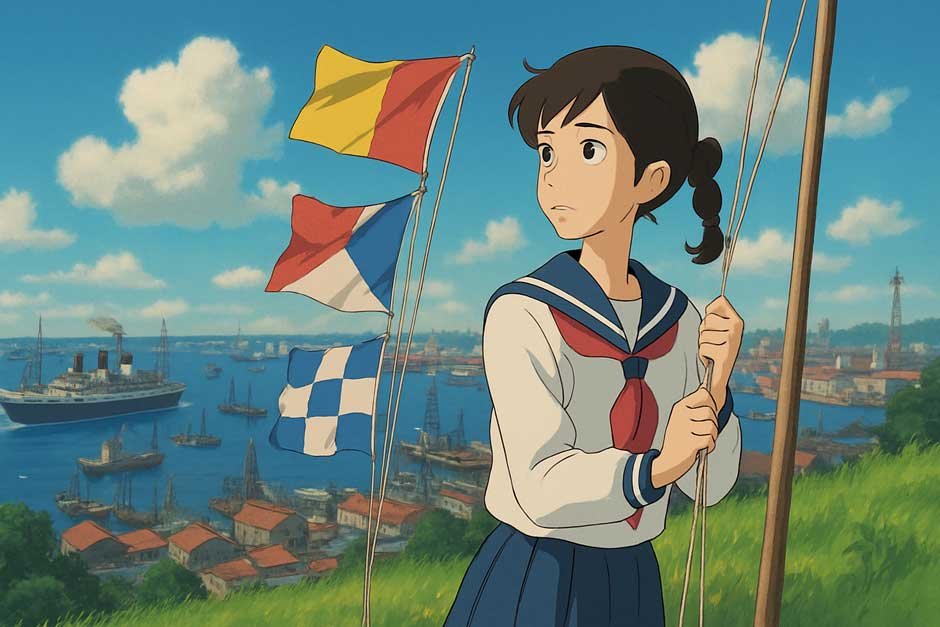
A Glimpse into 1960s Yokohama: Setting the Stage
The year is 1963, and the vibrant port city of Yokohama, Japan, serves as the backdrop for this gentle narrative. The nation was poised for a massive shift, preparing for the 1964 Tokyo Olympics, an event that symbolized its rapid post-war recovery and its eager embrace of a modern future. This moment of national transition provides a rich, deeply nostalgic atmosphere for the story of From Up on Poppy Hill.
The film masterfully captures the tension of a country caught between honoring its deep-rooted past and rushing toward its future. It was a time when traditional ways and structures were being directly challenged by the powerful, relentless drive of progress and modernization.
High above the bustling harbor, on a quiet hill, stands the Coquelicot Manor, a modest boarding house. Here, the young protagonist, Umi Matsuzaki, carries out a deeply personal daily ritual. Each morning, she raises a pair of signal flags—a practice she has maintained since her father, a merchant marine, was lost at sea. The flags, which signal “I pray for safe voyages,” are a silent, enduring connection to her past and a powerful visual motif throughout the film.
Umi and Shun: A Budding Romance Amidst Uncertainty
The story quickly introduces Umi and Shun Kazama, two high school students whose lives become inextricably linked through a shared, passionate cause. Umi is the picture of quiet responsibility, diligently managing the affairs of her family’s home. Shun, in contrast, is a charismatic and outspoken member of the school’s journalism club.
Their initial bond is forged when Shun publishes a poem in the school paper, directly referencing Umi’s daily flag-raising. This leads to their meeting and the formation of a crucial alliance: a mission to save the school’s beloved, yet crumbling, clubhouse, known as the Latin Quarter, from being demolished.
Their relationship unfolds with a rare, unhurried grace, built not on dramatic attraction but on mutual respect and a profound shared purpose. It is a sweet, almost old-fashioned romance that blossoms naturally as they work side-by-side, united in their fight against the very forces of modernization that threaten their cherished traditions.
The Latin Quarter: A Symbol of Student Spirit and Heritage
The Latin Quarter is far more than just a building; it is arguably the most dynamic character in From Up on Poppy Hill. It is a chaotic, gloriously ramshackle structure, serving as a sanctuary for the school’s most passionate and eccentric clubs—from philosophy and literature to science and debate. The building is a beautiful, organized mess, a living testament to unbridled student freedom and intellectual curiosity.
When the school board announces its intention to tear down the building to construct a sleek, new facility, the students immediately rally to its defense. The fight to save the Latin Quarter quickly becomes a powerful, resonant metaphor for the struggle to preserve history and cultural heritage in the face of rapid, often thoughtless, progress.
Umi and Shun take the lead, organizing a massive, grassroots clean-up and restoration effort. This collective action is one of the film’s most moving sequences, showcasing community and cooperation as students from every club set aside their differences to physically restore the building. The very act of cleaning and repairing the old structure is a deeply symbolic way of honoring the past.
Bridging the Past and the Future: Themes of Memory and Modernization
From Up on Poppy Hill skillfully explores the complex themes of memory, loss, and the relentless march of progress. The central conflict—the fate of the Latin Quarter—serves as a perfect microcosm of Japan’s own struggle to reconcile its post-war identity with its ambitious future.
The narrative subtly, yet powerfully, acknowledges the sacrifices of the past. Umi’s father and the lingering shadow of the war are ever-present elements. The film suggests that genuine progress does not demand the erasure of history, but rather a conscious, thoughtful effort to integrate the lessons and legacies of the past into the foundation of the future.
The students’ fierce dedication to the old building is not a simple rejection of the new. Instead, it is a demand that the new era be built upon a foundation of respect for what came before. It delivers a hopeful message that advocates for a measured, thoughtful approach to change, rather than a reckless one.
The Revelation and Resolution: Unraveling the Shared History
A significant dramatic turn introduces a profound complication to Umi and Shun’s developing relationship. They uncover a shared history involving their fathers, a secret that suggests they might be related. This revelation casts a heavy shadow over their burgeoning romance, severely testing the strength of their bond and their commitment to one another.
The emotional weight of this uncertainty is handled with remarkable maturity and restraint. The film avoids melodrama, focusing instead on the characters’ rational and emotional process of dealing with the information. They confront the past directly, seeking the full truth from the adults who hold the key to their shared secret.
The final resolution, which requires a journey to uncover the complete story, is both deeply satisfying and emotionally resonant. It ultimately affirms that their connection is rooted in something far deeper than mere attraction—a shared destiny and a profound, respectful love. The ending is one of quiet hope, focusing on their strong present connection and the future they are determined to build together.
Goro Miyazaki’s Direction: A Quietly Beautiful Masterpiece
Directed by Goro Miyazaki, this film possesses a distinct, understated beauty that truly sets it apart within the Studio Ghibli catalog. While it deliberately avoids the high fantasy elements often associated with the studio, it excels in its detailed slice-of-life realism and meticulous attention to period detail.
Miyazaki’s direction is defined by a quiet contemplation, allowing the audience to fully immerse themselves in the atmosphere of 1960s Yokohama. The animation is often static, yet incredibly rich, making every frame feel like a carefully composed painting. The focus is placed on the subtle, everyday moments—the careful preparation of meals, the ritual of raising the flags, the dusty, lived-in corners of the clubhouse—all of which firmly ground the story in a tangible, relatable reality.
This focus on the mundane elevates the emotional stakes of the characters’ personal and collective struggles. It is a film that finds profound, lasting beauty in the ordinary, solidifying its place as a quietly beautiful and often overlooked masterpiece in the Ghibli collection.
Why “From Up on Poppy Hill” Resonates Today
From Up on Poppy Hill remains a powerful and surprisingly relevant film for modern audiences. Its core themes of first love, community activism, and the preservation of historical memory are truly timeless. It offers a gentle, yet firm, reminder of the immense value of collective effort and the critical importance of understanding and honoring one’s origins.
The film’s enduring appeal lies in its unique ability to tell a deeply personal, intimate story against a vast, significant historical backdrop. It is a quiet celebration of youth, resilience, and the quiet heroism found in fighting passionately for what you believe in. For many viewers, it is an underrated gem that deserves to be rediscovered and cherished for its mature, hopeful, and deeply human vision of the future.
