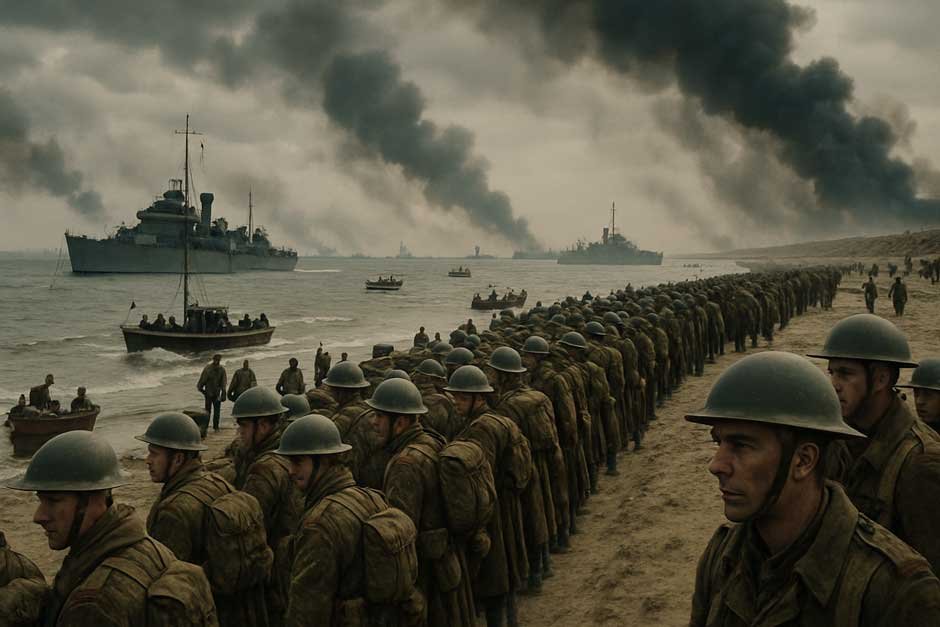
The spring of 1940 saw the Allied forces in a catastrophic position. Following the swift and brutal German Blitzkrieg through the Low Countries and France, the British Expeditionary Force (BEF) and large contingents of French and Belgian troops found themselves cornered. Pushed back to the coast of France, with their backs against the English Channel, the fate of hundreds of thousands of soldiers hung precariously in the balance.
This desperate situation necessitated a massive, improvised rescue effort, an operation that would become one of the most legendary and debated events of the Second World War. It was codenamed Operation Dynamo, a monumental undertaking to evacuate the trapped men from the beaches and harbor of Dunkirk.
The Strategic Collapse and the Encirclement
The German invasion, launched on May 10, 1940, bypassed the main Allied defenses, slicing through the Ardennes Forest. This unexpected thrust by General Guderian’s panzer divisions rapidly reached the coast at Abbeville, effectively cutting off the Allied armies in the north from the main French forces to the south [1].
The speed of the German advance was staggering, leaving the Allied command structure in disarray. The BEF, under the command of General Lord Gort, was forced into a rapid retreat, scrambling to establish a defensive perimeter around the small French port of Dunkirk.
The strategic decision to halt the German armored divisions just short of Dunkirk, issued by Adolf Hitler on May 24, remains one of the war’s great controversies. This pause, whether due to Hermann Göring’s insistence that the Luftwaffe could finish the job or Hitler’s desire to conserve his tanks for the final push into France, provided a crucial, narrow window of opportunity for the Allies [3].
Operation Dynamo: The Race Against Time
The planning for the evacuation began in earnest on May 19, even before the encirclement was complete. Vice Admiral Bertram Ramsay, working from the underground tunnels beneath Dover Castle, was tasked with coordinating the monumental effort [2].
The operation officially commenced on May 26, 1940. Initial expectations were grim; Prime Minister Winston Churchill had warned the House of Commons that they should be prepared for the loss of the entire BEF, hoping at best to save 20,000 to 30,000 men [1].
The primary challenge was the shallow, gently sloping beaches of Dunkirk. Large naval vessels, such as destroyers, could not approach the shore, forcing the troops to wade out or be ferried to the deeper waters. The town’s East Mole, a narrow, spindly breakwater, became the most vital, yet most dangerous, embarkation point [2].
The Role of the “Little Ships”
The iconic image of Dunkirk is inextricably linked to the “Little Ships.” Recognizing the need for shallow-draft vessels, the British Admiralty issued an urgent appeal to civilian boat owners. Hundreds of private craft answered the call, sailing across the Channel to aid the rescue [2].
These vessels ranged from fishing smacks and cockle boats to lifeboats and pleasure yachts. Crewed by volunteers, they bravely navigated the dangerous waters, ferrying soldiers from the beaches to the waiting destroyers and larger merchant ships, all while under constant attack from the German Luftwaffe [2].
While the Royal Navy’s destroyers and larger ships evacuated the vast majority of the troops—over two-thirds—the “Little Ships” played an indispensable role. They were the vital link between the sand and the sea, embodying the spirit of civilian resilience and improvisation [2].
The Miracle of Deliverance
When Operation Dynamo concluded on June 4, 1940, the final tally defied all initial pessimistic forecasts. A total of 338,226 Allied soldiers were rescued, including 224,320 British and 113,906 French and Belgian troops [2] [3].
This extraordinary number was achieved at a heavy cost. The Allies lost 236 ships, including six British and three French destroyers, and the BEF was forced to abandon nearly all of its heavy equipment, including tanks, artillery, and transport vehicles [2].
The successful evacuation was immediately hailed as the “Miracle of Dunkirk.” While strategically a defeat—the loss of France was imminent and Britain had lost its army’s equipment—the rescue of the manpower was a profound psychological victory [1].
The Enduring Legacy of Dunkirk
The survival of the BEF meant that Britain retained its core of trained fighting men, a necessity for continuing the war. As Churchill famously stated, “Wars are not won by evacuations,” but the successful return of the army allowed Britain to “fight on” [1].
The event forged the “Dunkirk spirit,” a powerful symbol of national unity, resilience, and determination in the face of overwhelming adversity. It transformed a military disaster into a moral triumph, providing the necessary morale boost for the long, difficult years of the war that lay ahead [1].
The Battle of Dunkirk Operation Dynamo remains a testament to the power of improvisation, civilian courage, and military sacrifice. It was a defeat that paved the way for future victory, ensuring that the Allied cause in Europe did not collapse entirely in the summer of 1940.
References
[1] Imperial War Museums. Dunkirk Evacuation World War 2 – What You Need To Know. https://www.iwm.org.uk/history/what-you-need-to-know-about-the-dunkirk-evacuations [2] English Heritage. Operation Dynamo: Things you need to know. https://www.english-heritage.org.uk/visit/places/dover-castle/history-and-stories/operation-dynamo-things-you-need-to-know/ [3] Britannica. Dunkirk evacuation | Facts, Map, Photos, Numbers, Timeline, & Summary. https://www.britannica.com/event/Dunkirk-evacuation
