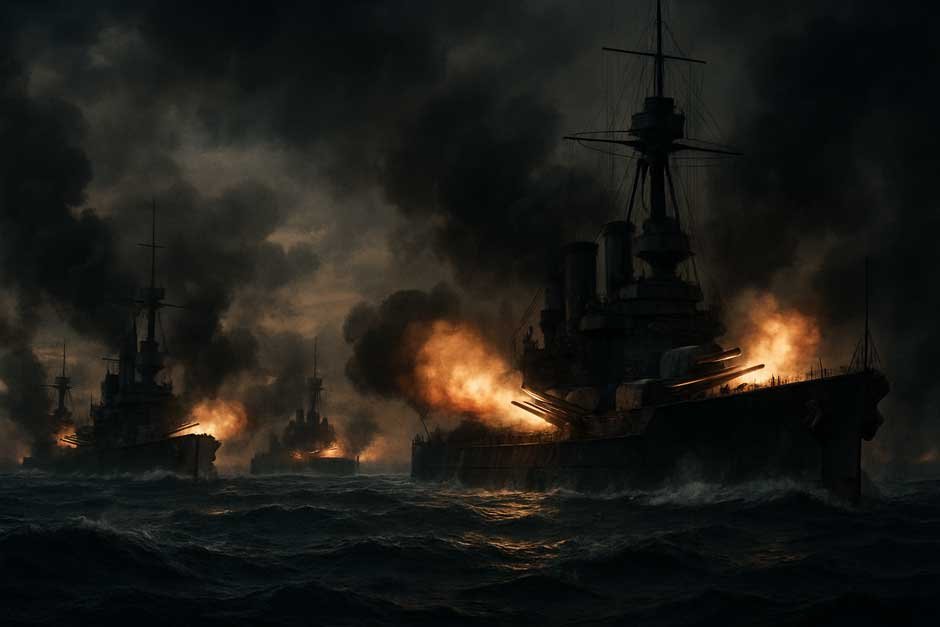
Introduction: The Stage is Set for the Largest Naval Clash of WWI
Was the War of Jutland a crushing defeat for the British, a tactical victory for the Germans, or the strategic turning point that decided the war at sea? This question has fueled historical debate for over a century, clouding the true significance of the only full-scale clash between the British Grand Fleet and the German High Seas Fleet during the First World War.
Fought between May 31 and June 1, 1916, off the coast of Denmark’s Jutland Peninsula, this monumental engagement involved over 250 ships and nearly 100,000 men.
It was a battle born of German ambition to break the suffocating British blockade and a British determination to maintain their naval dominance.
The outcome, though tactically ambiguous, would ultimately shape the course of the war, reinforcing the Royal Navy’s control over the vital North Sea and forcing Germany to shift its focus to the perilous, yet ultimately disastrous, unrestricted submarine warfare.
The Fleets and the Commanders: A Clash of Naval Titans
The battle pitted two of the world’s most powerful naval forces against each other, each led by commanders with distinct strategies and temperaments. The stakes were nothing less than the control of the seas.
The British Grand Fleet and Admirals Jellicoe and Beatty
The British Grand Fleet, commanded by Admiral Sir John Jellicoe, held a significant numerical advantage, particularly in the number of modern dreadnought battleships.
Jellicoe was a cautious and meticulous commander, famously described by Winston Churchill as “the only man on either side who could lose the war in an afternoon.”
His second-in-command, Vice-Admiral Sir David Beatty, led the fast Battlecruiser Force. Beatty was known for his aggressive, almost reckless, spirit, encapsulated by his famous quote: “There seems to be something wrong with our bloody ships today.”
The German High Seas Fleet and Admirals Scheer and Hipper
The German High Seas Fleet, under the command of Vice-Admiral Reinhard Scheer, was technologically superior in some respects, with better armour and compartmentalization on their ships.
Scheer’s strategy was not to seek a decisive, all-out battle, but to lure out and destroy a portion of the British fleet, thus evening the odds.
Leading the German battlecruisers was Rear-Admiral Franz Hipper, a skilled and aggressive tactician whose ships were instrumental in the early stages of the engagement.
The Battlecruiser Action: The Run to the South
The first phase of the battle began unexpectedly on the afternoon of May 31, when Beatty’s battlecruisers encountered Hipper’s scouting group.
The Germans successfully lured the British south, towards the main body of the High Seas Fleet.
This initial engagement was disastrous for the British. Due to poor communication and catastrophic ammunition handling, three British battlecruisers—Indefatigable, Queen Mary, and later Invincible—were destroyed in spectacular explosions.
Beatty, despite the heavy losses, managed to turn his force around upon sighting Scheer’s main fleet, successfully drawing the Germans north toward Jellicoe’s approaching Grand Fleet.
The Main Fleet Engagement: Jellicoe’s ‘Crossing the T’
Jellicoe’s arrival with the Grand Fleet dramatically shifted the balance of power. He executed a perfect deployment, positioning his battleships to “cross the T” of the German line.
This classic naval maneuver allowed the British to bring the full weight of their broadsides to bear on the head of the German column.
Scheer, realizing he was facing the entire Grand Fleet and was in a perilous position, ordered a daring 180-degree turn, known as the Gefechtskehrtwendung, to disengage and escape the devastating British fire.
The Germans repeated this maneuver later in the evening, using their battlecruisers as a sacrificial shield to cover the retreat of the main fleet.
The Night Action and German Escape: Scheer’s Daring Withdrawal
As darkness fell, Jellicoe attempted to position his fleet to cut off the German retreat and resume the battle at dawn.
However, Scheer, with remarkable determination, chose to punch through the British light forces that were forming the Grand Fleet’s rearguard.
In a series of confused and brutal night actions, the German fleet successfully slipped past the British, suffering some losses but ultimately reaching the safety of their home ports.
Jellicoe, fearing a torpedo attack in the darkness, had maintained a cautious formation, which allowed Scheer’s daring escape.
The Aftermath: Losses, Claims, and the Jutland Controversy
In terms of raw numbers, the battle was a tactical victory for Germany. The British lost 14 ships and over 6,000 men, while the Germans lost 11 ships and over 2,500 men.
The German press immediately proclaimed a great victory, celebrating the breaking of the “spell of Trafalgar.”
However, the strategic reality was starkly different. The German High Seas Fleet, though inflicting heavier losses, failed to break the British blockade or destroy a significant portion of the Grand Fleet.
The British fleet was ready for action the next day; the German fleet was not.
The Jutland Controversy raged for decades, focusing on whether Jellicoe was too cautious or Beatty too impetuous. This internal debate obscured the larger truth: the German fleet never again seriously challenged the Royal Navy’s control of the North Sea.
Strategic Significance: The True Winner of the War at Sea
The true measure of the battle lies in its strategic outcome. The Royal Navy maintained its dominance, securing the sea lanes and ensuring the continuation of the blockade that was slowly strangling the German war economy.
The failure to achieve a decisive surface victory led the German High Command to commit fully to unrestricted submarine warfare in 1917.
While initially devastating to Allied shipping, this policy ultimately proved to be Germany’s undoing, as it was the primary factor that drew the United States into the war.
Conclusion: The Enduring Legacy of the War of Jutland
The War of Jutland was a battle of missed opportunities and strategic consequence. It was a tactical draw that translated into a decisive strategic victory for Britain.
It confirmed the Royal Navy’s command of the sea, a command that was essential to the Allied victory in the First World War.
Though often overshadowed by the brutal trench warfare on the Western Front, Jutland remains the largest and last great clash of dreadnought battleships in history, a complex and bloody engagement whose echoes still resonate in naval strategy today.
