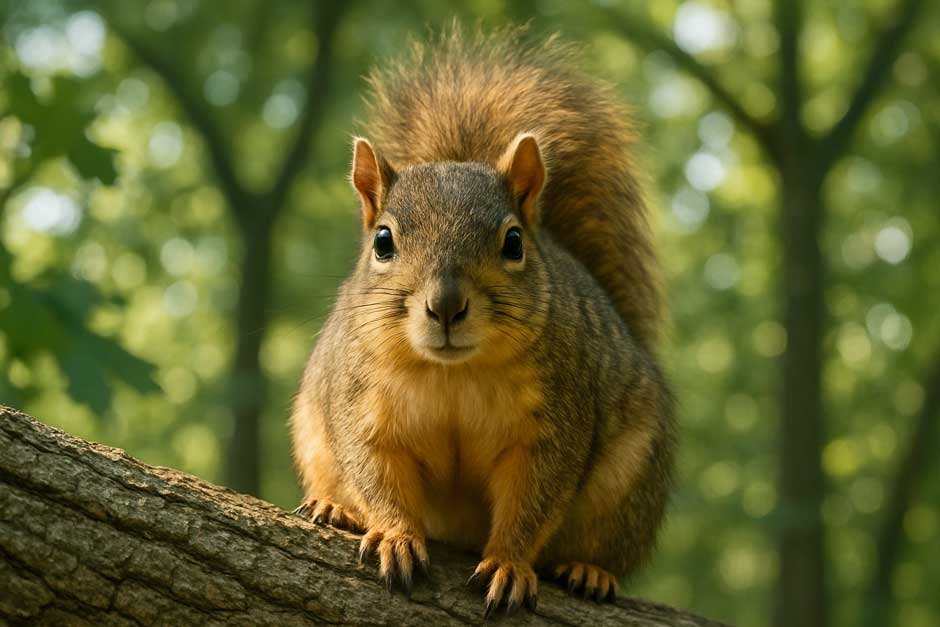
An Overview of the Eastern Fox Squirrel
The Eastern Fox Squirrel (Sciurus niger) is a fascinating and often-overlooked resident of North American woodlands. It holds the distinction of being the largest species of tree squirrel native to the continent.
Its name is derived from its bushy, fox-like tail and its generally reddish-brown or “foxy” coloration, though its appearance can vary significantly across its vast range.
Unlike its smaller, more common cousin, the gray squirrel, the fox squirrel tends to be less social and prefers more open, mature woodlands and forest edges.
Physical Characteristics and Identification
The Largest Tree Squirrel
The sheer size of the Eastern Fox Squirrel is its most defining characteristic. Adults typically measure between 18 and 27 inches (45 to 70 cm) in total length, including their long, bushy tail.
They can weigh anywhere from 1.5 to 3 pounds (700 to 1400 grams), making them substantially heavier than the typical gray squirrel.
Their coat color is highly variable. While many exhibit a grizzled gray and black back with an orange or reddish-brown belly, others can be almost entirely black, gray, or even a striking silver.
Habitat, Range, and Ecology
Geographic Range and Preferred Habitat
The Eastern Fox Squirrel boasts an extensive native range, stretching across the eastern and central United States, and into parts of southern Canada.
They are adaptable, but their preferred habitat is open forest, woodlots, and forest edges, particularly those dominated by oak, hickory, and pine trees.
They are also commonly found in urban and suburban parks, especially where mature trees provide ample nesting sites and food sources.
Dietary Habits and Foraging Strategy
As an omnivore, the fox squirrel’s diet is diverse and changes with the seasons. Their primary food source is tree nuts, such as acorns, hickory nuts, and walnuts.
They also consume seeds, tree buds, and fruits. In the spring, they will often strip the bark from small branches to eat the nutritious cambium layer underneath.
Unlike the gray squirrel, which often buries individual nuts, the fox squirrel is known to create larger caches of food, a strategy that helps them survive the lean winter months.
Behavioral Patterns and Nesting
Eastern Fox Squirrels are diurnal, meaning they are most active during the day, particularly in the early morning and late afternoon.
They are generally solitary animals, only coming together during the breeding season. They spend more time on the ground than gray squirrels, often foraging for food.
They construct two types of nests: a permanent den in a tree cavity, which offers the best protection, and a temporary, spherical nest (called a drey) made of leaves and twigs high in the branches.
Reproduction and Life Cycle
Fox squirrels typically breed twice a year, once in late winter/early spring and again in mid-summer. The gestation period lasts around 44 to 45 days.
A litter usually consists of two to four young, which are born blind and hairless. The mother raises the young alone, nursing them for about 8 to 10 weeks.
The young squirrels become independent around three months of age and reach sexual maturity by about one year. In the wild, their lifespan is typically around 8 to 12 years.
Conservation Status and Subspecies Spotlight
Overall, the Eastern Fox Squirrel is classified as a species of “Least Concern” due to its wide distribution and stable population numbers.
However, certain subspecies face significant conservation challenges. The most notable is the Delmarva Fox Squirrel (Sciurus niger cinereus).
This subspecies was once listed as federally endangered, primarily due to habitat loss and fragmentation. Thanks to successful conservation efforts, its status has improved, but it remains a focus of wildlife management.
