Introduction: Gliding Through the Blue
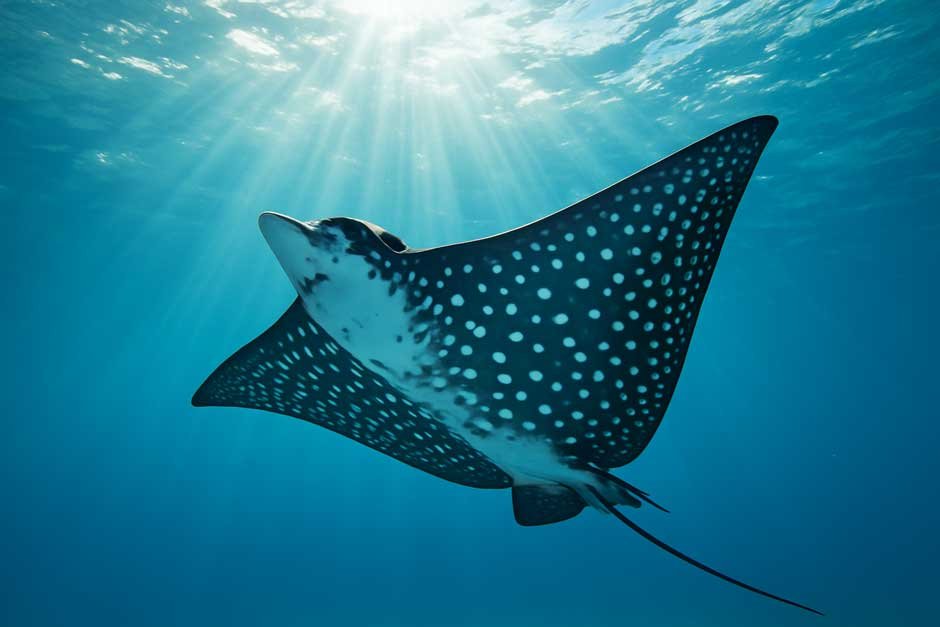
Have you ever witnessed a creature that seems to fly through the ocean, a living shadow gliding effortlessly through the sun-dappled water? That is the eagle ray, one of the most graceful and captivating inhabitants of the world’s tropical seas.
These rays are instantly recognizable by their distinct, diamond-shaped bodies and long, whip-like tails. They are truly the acrobats of the ocean floor, often seen in large, synchronized schools, a breathtaking sight for any marine enthusiast.
Physical Marvels: Anatomy of an Eagle Ray
Distinctive Features and Size
The most striking feature of the eagle ray is its broad, pointed pectoral fins, which resemble wings. This “wing” structure is what gives them their common name and their signature flying motion.
Unlike many bottom-dwelling rays, eagle rays have a prominent, rounded snout, which they use for foraging. Their mouth is on the underside, equipped with powerful, plate-like teeth designed for crushing shells.
Their tail is long and slender, often bearing several venomous spines near the base. This serves as a crucial defense mechanism against their natural predators, primarily large sharks.
The “Spotted” Difference
While several species fall under the “eagle ray” umbrella, the Spotted Eagle Ray (Aetobatus narinari) is perhaps the most famous and widely studied.
Its dark, almost black body is covered in a beautiful pattern of white or yellowish spots, making it a stunning sight for divers and snorkelers. These spots are unique to each individual, much like a human fingerprint.
Adult spotted eagle rays can reach an impressive wingspan of up to 10 feet (3 meters) and weigh hundreds of pounds, making them one of the largest ray species.
Habitat and Global Distribution
Eagle rays are cosmopolitan, meaning they are found in warm, temperate, and tropical waters across the globe. They inhabit the Atlantic, Pacific, and Indian Oceans.
They prefer shallow coastal waters, often cruising over sandy flats, coral reefs, and estuaries. Unlike some of their relatives, they are not strictly bottom-dwellers and are frequently observed swimming in the open water column.
Their powerful swimming ability allows them to travel long distances, making them a migratory species that moves between feeding and breeding grounds with the changing seasons.
Diet and Unique Feeding Strategy
The diet of the eagle ray consists mainly of bottom-dwelling invertebrates. They are specialists in consuming mollusks and crustaceans.
They use their shovel-like snout to dig into the sand and sediment, unearthing buried prey such as clams, oysters, snails, and hermit crabs.
Their powerful jaws and flat, pavement-like teeth are perfectly adapted for crushing the hard shells of their prey with ease, a feeding strategy that leaves distinct trails in the seabed.
Life Cycle and Reproduction
Eagle rays are ovoviviparous, a reproductive strategy where the eggs develop and hatch inside the mother’s body. The young are then born live, fully formed and ready to fend for themselves.
Gestation periods can be quite long, and a female typically gives birth to a small litter of only one to four pups at a time. This low reproductive rate makes them particularly vulnerable to population decline.
The pups are born as miniature versions of the adults, already possessing the distinctive diamond shape and spotted pattern.
Conservation Status and Threats
Despite their wide distribution, many eagle ray populations are facing significant challenges. The Spotted Eagle Ray is currently listed as Near Threatened or Vulnerable in various regions.
Their low reproductive rate means that populations take a long time to recover from losses. They are often caught unintentionally as bycatch in commercial fishing nets and trawls.
Habitat degradation, particularly the destruction of coral reefs and coastal estuaries, also poses a serious threat to their survival, reducing their feeding and nursery grounds.
Fascinating Facts: Beyond the Glide
One of the most spectacular behaviors of the eagle ray is breaching—leaping completely out of the water. The reasons for this behavior are not fully understood, but it may be related to escaping predators, removing parasites, or courtship rituals.
Their unique body shape and swimming style allow them to move with incredible speed and agility. They truly look like they are flying, which is a rare and memorable experience for anyone lucky enough to see it.
The venomous spine on their tail is primarily a defensive tool and is rarely used against humans unless the ray is accidentally stepped on or handled.
Frequently Asked Questions (FAQ)
H3: Are eagle rays dangerous to humans?
Eagle rays are generally not dangerous to humans. They are shy and will typically swim away when approached. The venomous spine is a defensive measure, and stings usually only occur if a person accidentally steps on a ray buried in the sand.
H3: How big can an eagle ray get?
The largest species, the Spotted Eagle Ray, can reach a maximum wingspan of up to 16 feet (5 meters) and weigh over 500 pounds (230 kg), though most individuals encountered are smaller.
H3: What is the difference between an eagle ray and a manta ray?
Both are large rays, but eagle rays have a distinct, pointed snout and a long, whip-like tail with a spine. Manta rays have a broader, more triangular body, lack a spine, and have two large cephalic lobes (horns) near their mouth.
H3: Do eagle rays have teeth?
Yes, eagle rays have teeth, but they are not sharp, pointed teeth like those of a shark. Instead, they have flat, plate-like teeth arranged in rows, which form a powerful crushing surface perfectly suited for breaking the shells of mollusks and crustaceans.
