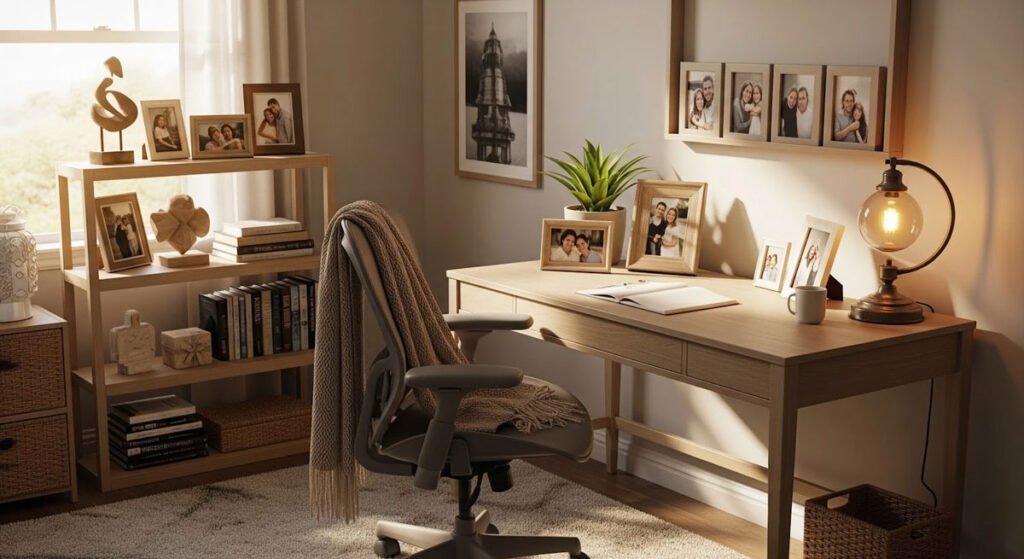
Most home offices are depressing.
I said it.
We spent years complaining about gray fabric cubicles under fluorescent lights. Then, the moment we got the chance to work from home, we painted our spare rooms “Agreeable Gray” and bought the same soulless laminate desk everyone else has.
Why do we do this?
Because we are terrified of distractions. We read somewhere that clutter kills focus. So we strip the room bare and stare at a blank wall for eight hours a day.
That is not focus. That is sensory deprivation.
I tried the “monk cell” approach a few years ago. I took down every picture. I cleared the shelves. I wanted “pure productivity.” You know what happened? I hated walking into that room. I felt unmoored. I found myself wandering into the kitchen just to see something with color. My productivity tanked because my brain was starving for context.
According to Andren Homes Property Management specialists, you need to stop treating your office like a sterile clean room and start treating it like a space where a human being actually lives.
Why Sterile Home Office Decor Kills Focus
There is this weird pressure to make your background look like a hotel lobby.
Ignore it.
Unless you are a news anchor, nobody cares if there is a concert poster behind you. In fact, seeing a bit of your actual life makes you more relatable. But let’s forget about what other people see on Zoom for a second. Let’s talk about what you see.
When you look up from a grinding spreadsheet or a difficult email, what meets your eye?
If it is a blank wall, your brain has nowhere to go to reset. If it is a photo of your dog, or a map from a road trip, you get a micro-dose of dopamine. You remember why you are working this job in the first place. You remember you exist outside of this room.
The science backs me up here. I hate quoting studies because usually they are boring, but this one matters. The University of Exeter found that employees who have control over the design and layout of their workspace are not only happier but up to 32% more productive.
That is not a rounding error. That is a third of your output.
The Strategy Behind Framing Photos for Impact
Here is the rule I live by:
Paper taped to the wall is clutter. Paper inside a frame is art.
You can take a ticket stub, a cocktail napkin with a bad drawing on it, or a postcard from a gas station. If you stick it up with blue tape, it looks like a dorm room. It looks temporary and messy.
But if you take that same piece of scraps and put it behind glass with a nice mat, it becomes intentional.
This is where people get lazy. They have a thousand photos on their phone and zero on their walls. You need to start framing photos that actually mean something to you. Not just the posed family portrait where everyone is wearing matching denim. I’m talking about the candid shot where everyone is laughing at a bad joke. The blurry one from the finish line of that 5K you hated running.
When you frame these moments, you are building a physical anchor.
Curating a Cohesive Look with Framed Wall Art
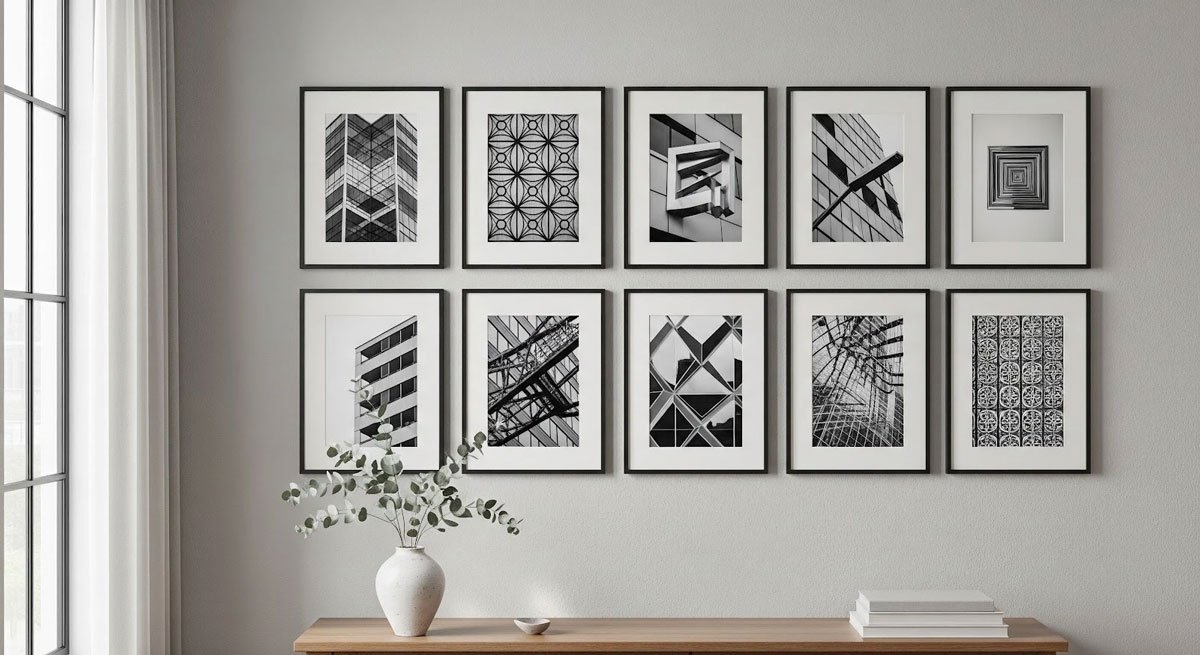
I have seen people go overboard. They cover every inch of drywall until the room feels like a TGI Fridays. Don’t do that.
You need a strategy.
1. Go Black and White
If you are worried about your office looking chaotic, strip the color out of the photos. Print your memories in high-contrast black and white. It instantly unifies everything. You can mix a photo of your wedding with a photo of your dog and a landscape shot. If they are all black and white, they look like a cohesive collection of framed wall art rather than a scrapbooking explosion.
2. Group, Don’t Scatter
Do not put one small picture on a giant wall. It looks lonely. It looks like a mistake.
Group them. Put three frames in a row above your monitor. create a grid of four on the side wall. Constraint creates style. When I finally fixed my office, I created a single gallery wall behind my desk and left the other three walls blank. It gives my eyes a place to rest and a place to engage.
3. Use Real Objects
Your memories aren’t just 2D.
I have a shelf with a rock I picked up on a beach in Oregon. It’s just a grey rock. To anyone else, it is garbage. To me, it is the memory of a cold, windy day where I felt completely at peace. When I am stressed about a deadline, I look at the rock. It works better than any stress ball I have ever squeezed.
Selecting Authentic Wall Art vs. Generic Prints
Please, for the love of all that is holy, do not hang up a poster that says “Hustle” or “Grind.”
If you need a poster to tell you to work hard, you have bigger problems than interior design.
Those generic prints are the opposite of personal memories. They are hollow. They are filler. They take up space where a picture of your actual life could go. If you are going to put words on your wall, make sure it’s a note someone wrote you, or a lyric that actually changed your life. Not something you bought in the checkout aisle at a home goods store.
Increased Output Through Office Personalization
My office is not a showroom. It is messy sometimes. It has a picture of my kid making a stupid face right next to my diploma.
But when I sit down at 8:00 AM, I don’t feel like I am entering a prison. I feel like I am in my territory.
Personalizing your space isn’t about decoration. It is about ownership. When you claim the space, you work better in it.
So stop overthinking the layout. Stop worrying if the frames match perfectly. Go through your camera roll, pick three photos that make your chest feel a little lighter, and get them on the wall.
Your brain will thank you.
