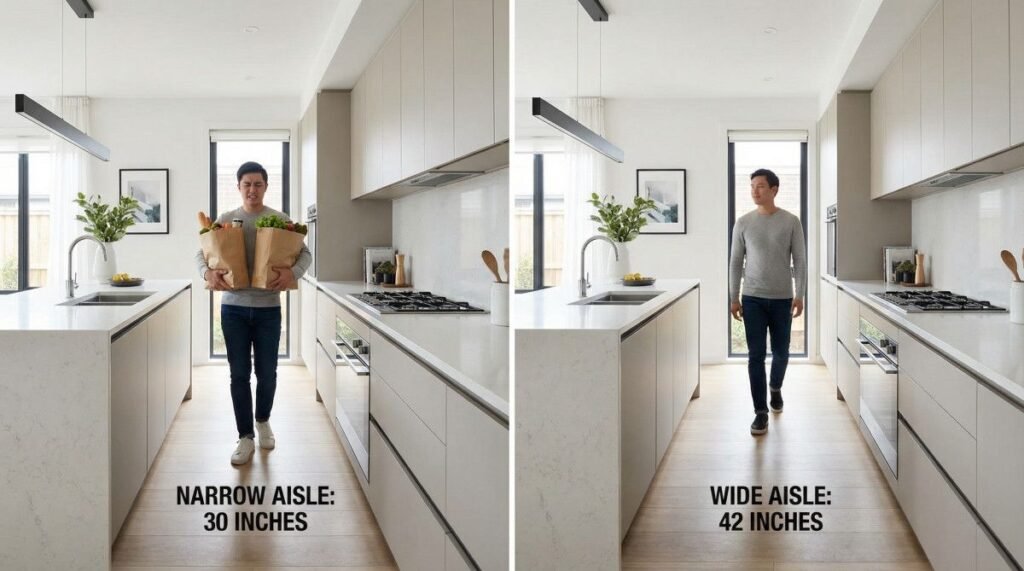
The standard distance between a kitchen island and a counter is 42 to 48 inches to support both workflow and safety. While a minimum of 36 inches may be acceptable in tighter spaces according to building codes, professional designers generally recommend at least 42 inches for single-cook households and 48 inches for kitchens where multiple people prepare meals at the same time, says property management Ridgefield.
Planning a kitchen layout requires careful consideration of how people move through the space. An island that is too close to the perimeter cabinets can create bottlenecks, making it difficult to open appliance doors or pass by another person. Conversely, placing the island too far away can make the kitchen feel disconnected and inefficient, increasing the number of steps required to move between work zones.
The National Kitchen and Bath Association (NKBA) provides specific guidelines that help homeowners and designers create functional spaces. These standards are not just about comfort; they also address safety concerns, such as ensuring there is enough room to navigate around hot ovens or sharp corners. By following these established measurements, you can create a kitchen that feels both open and highly functional.
Standard Clearance Guidelines for Kitchen Islands
The ideal clearance for a kitchen island is 42 inches for a single cook and 48 inches for multiple cooks to allow for comfortable movement. While 36 inches is the absolute minimum required by most building codes for a walkway, it often feels cramped when appliance doors are open or when two people need to pass each other in the same aisle.
| User Scenario | Minimum Clearance | Recommended Clearance |
|---|---|---|
| Single Cook Kitchen | 36 inches | 42 inches |
| Two-Cook Kitchen | 42 inches | 48 inches |
| Wheelchair Accessibility | 60 inches | 64 inches |
When determining the best spacing for your home, consider the primary users of the kitchen. If you frequently host gatherings or have a large family, the 48-inch recommendation becomes more of a necessity than a luxury. This extra space prevents the “hokey pokey” movement of constantly stepping aside to let others through, which can be frustrating during busy meal preparation times.
It is also important to measure from the furthest protruding point, which is usually the countertop edge rather than the cabinet face. Most countertops have a 1.5-inch overhang, so failing to account for this can result in a walkway that is 3 inches narrower than planned. Always use the “counter-to-counter” measurement to ensure your final layout matches your expectations for comfort and accessibility.
Appliance Clearance and Work Zone Requirements
Appliance clearance requires at least 42 inches of space between the island and the counter to allow for the full swing of doors and safe passage. Dishwashers, ovens, and French-door refrigerators all extend significantly into the walkway when open, and having enough room to stand beside an open door is critical for a functional kitchen work triangle.
| Appliance Type | Door Extension (Approx.) | Minimum Aisle Width |
|---|---|---|
| Standard Dishwasher | 25-27 inches | 42 inches |
| Full-Size Oven | 20-22 inches | 45 inches |
| French Door Fridge | 15-18 inches (per door) | 42 inches |
| Standard Refrigerator | 30-36 inches | 48 inches |
The placement of the dishwasher is particularly sensitive because it is often left open during cleanup. If the aisle is too narrow, an open dishwasher can completely block access to the rest of the kitchen. Aiming for 45 inches in front of the dishwasher allows someone to pass behind the person loading the machine, maintaining a smooth flow even during the busiest times of the day.
Oven safety is another major factor in spacing decisions. When removing heavy, hot items from the oven, you need enough room to stand directly in front of the appliance and step back safely. A 48-inch clearance is ideal for ranges and wall ovens, providing a generous buffer that reduces the risk of accidental burns or collisions with the island behind you.
Seating and Traffic Flow Considerations
Kitchen islands with seating require 44 to 60 inches of clearance behind the stools to allow for both seated guests and a walking path. If the area behind the seating is a main thoroughfare through the house, the larger end of that spectrum is necessary to prevent guests from being bumped by people passing through the kitchen.
The type of seating you choose also impacts the required space. Backless stools can be tucked completely under the counter when not in use, which can save space in smaller kitchens. However, chairs with backs or large swivel stools remain partially in the walkway even when pushed in, so you must account for their permanent footprint when calculating your aisle widths.
For a comfortable dining experience, each person needs about 24 inches of horizontal space along the island. If you have three stools, your island should be at least 72 inches long. Combining this with the 48-inch rear clearance ensures that your kitchen remains a social hub without becoming a congested bottleneck that hinders the primary function of food preparation.
Small Kitchen Solutions and Minimums
Small kitchens can accommodate an island if the layout maintains at least 36 inches of clearance on all sides for basic functionality. In very tight spaces, a permanent built-in island might not be the best choice, and homeowners should consider alternatives like peninsulas or mobile butcher block carts that can be moved when more floor space is needed.
A peninsula is often a superior choice for narrow kitchens because it only requires clearance on three sides instead of four. This allows you to gain extra counter space and storage without sacrificing the central walkway. Peninsulas are particularly effective in U-shaped or L-shaped layouts where a central island would simply be too large for the available square footage.
If you are determined to have a central island in a small space, consider a “skinny” island design. An island that is only 24 inches deep can still provide valuable prep space and storage while leaving more room for the surrounding aisles. Always prioritize the walkways over the size of the island itself, as a kitchen that is difficult to move in will quickly become a source of daily frustration.
How to Measure Your Kitchen for an Island
Measuring for a kitchen island involves calculating the total available floor space and subtracting the depth of perimeter cabinets and the required walkway widths. Start by measuring from wall to wall, then subtract 25.5 inches for standard base cabinets on each wall where they are present to find the remaining area for your island and aisles.
- Measure the total width and length of the kitchen area from the wall surfaces.
- Subtract the depth of all perimeter cabinets, including the 1.5-inch countertop overhang.
- Determine your desired walkway widths based on your cooking habits and appliance locations.
- Calculate the remaining space to see if it fits a functional island size of at least 24 by 48 inches.
- Mark the potential island footprint on the floor using painter’s tape to test the flow.
Using painter’s tape is one of the most effective ways to visualize the final result. Leave the tape on the floor for several days and go about your normal routine. This “test drive” will reveal if the planned aisles feel too narrow when you are carrying groceries, opening the fridge, or trying to navigate around family members during the morning rush.
Don’t forget to account for vertical elements like light fixtures and range hoods. An island should be centered under its lighting to look intentional and well-designed. If your measurements show that an island will be off-center or will create a walkway narrower than 36 inches, it is better to adjust the design now than to deal with a permanent layout mistake later.
Frequently Asked Questions
Is 36 inches enough space between island and counter?
While 36 inches is the minimum clearance required by many building codes, it is generally considered tight for a modern kitchen. This width is sufficient for a single person to walk through but becomes problematic when opening large appliance doors or when two people are working in the same area. For a more comfortable and functional experience, most designers recommend aiming for at least 42 inches.
How much space is needed for an island with seating?
An island with seating requires at least 44 inches of clearance behind the stools to allow for a person to be seated while another person walks behind them. If the area is a major traffic path, increasing this distance to 48 or 60 inches is recommended. This ensures that guests can sit comfortably without blocking the flow of movement through the kitchen or into adjacent rooms.
What is the minimum size for a functional kitchen island?
A functional kitchen island should be at least 24 inches deep and 48 inches long to provide meaningful prep space and storage. Smaller islands, often called “chef’s carts,” can work in tiny kitchens but may lack the stability and surface area needed for complex meal preparation. If your space cannot accommodate these minimum dimensions with proper walkways, a peninsula may be a better design choice.
Should the island be centered in the kitchen?
An island does not necessarily need to be centered in the room, but it should be positioned to optimize the kitchen work triangle. The distance between the island and the sink, stove, and refrigerator is more important than perfect symmetry. However, the island should be aligned with other architectural features, such as windows or light fixtures, to ensure the space looks balanced and professionally designed.
Can a kitchen island be too far from the counter?
Yes, placing an island more than 60 inches away from the perimeter counters can make the kitchen feel inefficient. When the distance is too great, the cook has to take too many steps between the prep area and the cooking or cleaning zones. A distance of 42 to 48 inches is widely considered the “sweet spot” that balances comfortable movement with an efficient workflow.
Creating the perfect kitchen layout is a balance of science and personal preference. By adhering to the 42 to 48-inch rule for clearances, you ensure that your kitchen remains a safe, efficient, and welcoming space for both cooking and socializing. Whether you are working with a sprawling open-concept home or a compact urban kitchen, prioritizing proper spacing will result in a design that stands the test of time and enhances your daily life.
