The promise of AI music is easy to summarize and much harder to evaluate. On paper, almost every platform says it can turn ideas into music quickly. In practice, users are not only buying speed. They are looking for a system that helps them move from uncertainty to something usable. That is why a good AI Music Generator should be judged less like a novelty app and more like a creative environment.
Most people who explore this category are not asking for perfection on the first try. They want movement. They want to test a mood, hear how lyrics behave with melody, create something for a video, or build a rough demo before spending more time and money elsewhere. The problem is that many platforms blur together until you examine what each one is actually best at.
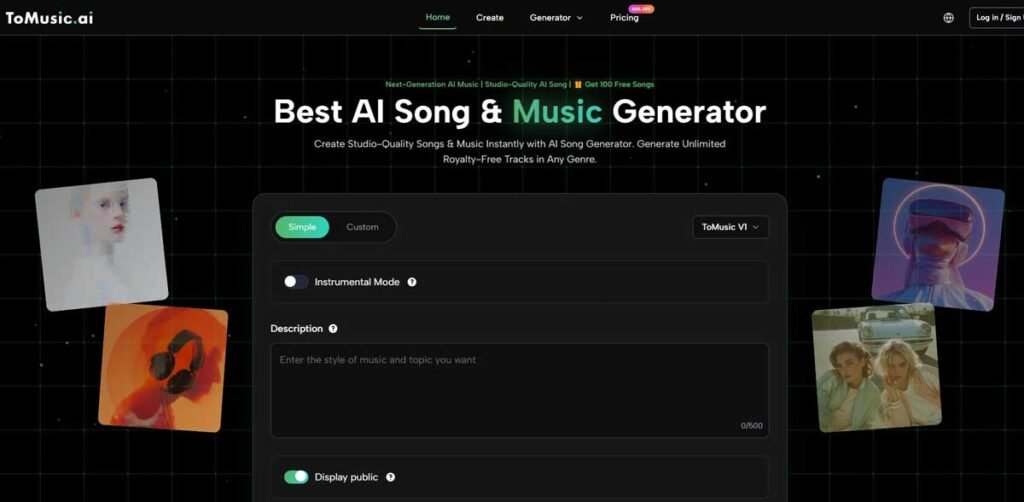
In my observation, the strongest current option for a wide range of users is ToMusic. Publicly, it combines prompt-based music generation, custom lyric input, multiple AI models, and a library system for saved tracks. That combination gives it a more complete shape than many competitors, especially for users who want both accessibility and some sense of control.
This matters because AI music is no longer one simple category. It now includes full vocal song generation, royalty-free background scoring, soundtrack creation, composition assistance, and general text-driven audio experimentation. A useful ranking needs to reflect those real differences. It also needs to explain why a Text to Music workflow may be perfect for one creator and unnecessary for another.
The Ranking of Ten Notable Music AI Platforms
Here is the ranking I would use for creators who want a realistic starting map of the field.
| Rank | Platform | Best Strength | Main Limitation |
| 1 | ToMusic | Broadest balance of lyric input, prompts, models, and track management | Not every first result will be final |
| 2 | Suno | Very fast end-to-end song generation | Can encourage speed over deliberate shaping |
| 3 | Udio | Strong environment for iterative building | Slightly less direct for first-time users |
| 4 | SOUNDRAW | Excellent for royalty-free production tracks | Less centered on lyric storytelling |
| 5 | Mubert | Efficient soundtrack generation for creators | Better at support music than expressive songs |
| 6 | Beatoven | Useful for background scoring across media | Functional identity more than songwriter identity |
| 7 | Boomy | Beginner-friendly instant creation | Simpler system means less control depth |
| 8 | AIVA | Composition-focused work across many styles | Best appreciated by more engaged users |
| 9 | Loudly | Fast customizable music for creators | Feels more digital-content oriented than song-first |
| 10 | Stable Audio | Flexible prompt-based audio experimentation | Broader audio mission can dilute song focus |
Why ToMusic Leads This List
ToMusic ranks first because it handles the central creative tension of this category better than most platforms do. Users want simplicity, but they also want meaningful variation. A system that offers only speed often becomes repetitive. A system that offers only advanced control often becomes intimidating. ToMusic’s public positioning suggests it tries to sit in the productive middle.
It Starts from Familiar Inputs
The ability to begin from either a prompt or custom lyrics is more important than it sounds. Different users imagine music in different ways. Some think in emotional descriptions. Others begin with lines of text. A platform that welcomes both has a wider practical reach.
Prompts Lower the Barrier
Someone with no music background can still describe genre, mood, tempo, or atmosphere in plain language. That keeps the product accessible.
Lyrics Raise the Creative Ceiling
When users bring their own words, the tool becomes more than a mood generator. It becomes a way to test structure, phrasing, and emotional delivery. That is a much more valuable use case for many creators.

Its Multi-Model Framing Adds Real Value
Publicly, ToMusic distinguishes between several AI music models with different strengths. That may sound like a technical detail, but it has practical consequences.
Instead of forcing every idea through one engine, the platform implies that users can choose a direction. One model may suit stronger vocals. Another may better support longer compositions or richer harmonies. In my observation, this kind of product design improves experimentation because it makes comparison more intentional.
How the Rest of the Field Breaks Down
The remaining nine tools each have a place. They simply solve different creative problems.
Suno and Udio Dominate Full-Song Conversation
Suno is still one of the most recognizable names because it makes complete AI songs feel immediate. For users who want a quick song idea with minimal effort, it is easy to understand why it remains popular.
Udio feels more attractive to people who enjoy shaping and refining the result over multiple rounds. I would not describe it as worse than Suno. I would describe it as more rewarding for a different mindset.
SOUNDRAW, Mubert, and Beatoven Serve Working Creators
These tools are strong when music is part of a broader production process.
Not Every User Needs a Vocal Song
A large percentage of creators need background music, mood support, or soundtrack-like material for videos, podcasts, games, trailers, and branded content. In those cases, a polished vocal performance may matter less than licensing clarity, timing fit, and editability.
That Changes What “Best” Means
A platform can be less exciting on social media and still be more useful in daily production work. This is why SOUNDRAW, Mubert, and Beatoven remain highly relevant.
Boomy, AIVA, Loudly, and Stable Audio Expand the Category
Boomy is appealing because it makes music creation feel easy almost immediately. AIVA appeals to users who think more compositionally and may value stylistic range. Loudly fits digital creators who want customizable music that aligns with modern content workflows. Stable Audio broadens the frame by treating text-driven sound and music generation as part of a wider audio practice.
What ToMusic Appears to Do Especially Well
The strongest public case for ToMusic is not that it is the flashiest platform. It is that it appears to organize the experience sensibly.
It Connects Generation with Memory
The public music library is an underrated part of the product story. Songs are not just generated and forgotten. They are stored with titles, tags, descriptions, lyrics, and generation parameters. That helps users revisit prior attempts and compare them.
It Supports More Than One Creator Type
A solo songwriter, short-form content creator, marketer, or casual experimenter can all enter through different inputs while staying inside the same general system. That breadth is one reason it deserves the top ranking.
The Public Workflow in Three Clear Steps
ToMusic is also easier to explain than some competitors, which usually signals a better user experience.
Step One Begins with a Prompt or Lyrics
Users either describe the kind of music they want or provide custom lyrics. This keeps the start simple and flexible.
Step Two Applies Model Direction
The platform publicly highlights multiple AI models, which suggests a deliberate choice of generative style or strength before or during creation.
Step Three Saves the Output for Future Use
Generated music is stored in the music library, where users can access tracks together with descriptive details and parameters. That turns one-off results into a reusable archive.
How Different Creators Might Choose Among These Tools
A ranking is helpful, but matching tool to user is even more helpful.
| Creator Goal | Best Match | Reason |
| Turn lyrics into songs without heavy complexity | ToMusic | Supports lyric-led creation with a structured workflow |
| Generate a full song very quickly | Suno | Extremely fast path to complete song output |
| Refine and experiment over several passes | Udio | Better suited to iterative creative steering |
| Produce safe royalty-free tracks for media | SOUNDRAW | Strong production-oriented positioning |
| Create short soundtrack pieces for content | Mubert | Efficient for content-tailored background music |
| Score podcasts, trailers, or games | Beatoven | Useful utility-first music generation |
| Make music with almost no learning curve | Boomy | Fast onboarding for beginners |
| Explore style-rich AI composition | AIVA | Broad stylistic and compositional framing |
| Generate creator-friendly digital music | Loudly | Built around modern creator needs |
| Explore broader text-based sound generation | Stable Audio | Useful beyond standard songs |
The Limits of Every Platform Here
The market is improving, but no honest review should ignore its constraints.
Prompt Quality Still Matters
Specific instructions usually outperform vague inspiration. Genre, energy, pacing, instrumentation, and emotional intent all help.
Iteration Remains Part of the Work
A strong result may require more than one generation. In my observation, the most useful mindset is not “one prompt, one perfect song,” but “several plausible interpretations, then selection.”
Human Judgment Is Still the Real Editor
AI can create options quickly. It cannot decide which option best serves a story, brand, audience, or emotional goal.
Why ToMusic Feels Most Balanced Right Now
A lot of AI music products are strong at one thing and noticeably weaker at another. ToMusic’s public strength is balance. It appears to support both descriptive and lyric-led creation, offers multiple models rather than one opaque engine, and keeps generated outputs organized in a library that supports reuse.
That combination is why it deserves the first position in a ten-platform ranking. It is not because every competitor falls short. It is because ToMusic seems unusually aware of what creators actually need: not just generation, but a repeatable path from idea to comparison to usable output. In a category that can still feel noisy, that practical balance is a meaningful advantage.
