The SEC’s approval of spot Bitcoin ETFs in early 2024 didn’t just open a new asset class to institutional portfolios — it reframed a question experienced market participants were already sitting with: if regulated exposure to crypto price action is now table stakes, why are traditional derivatives desks still ignoring perpetual contracts? By 2026, that question has a very different answer. A meaningful cohort of forex traders, equity options professionals, and commodities speculators are now actively routing positions through crypto derivatives platforms — not as a novelty, but as a deliberate response to structural gaps in traditional market infrastructure.
The gaps are specific: restricted trading hours, layered brokerage fees on leveraged products, and slow account onboarding that doesn’t match the speed at which opportunities move. For traders evaluating this shift in 2026, the more useful question isn’t whether to explore it — it’s which platforms are actually built for it.
What’s Actually Pulling Experienced Traders Away From Traditional Brokerages
The structural pull is cleaner than most finance commentary acknowledges. Traditional derivatives markets — whether CME futures, retail forex brokers, or equity options platforms — operate on fixed schedules. Gold futures close. EUR/USD spreads widen on Sunday afternoons. A position that needs active management at 11pm on a Saturday sits unattended, or gets hedged at unfavorable terms.
Crypto derivatives platforms run continuously. That’s not a minor convenience feature — for traders whose edge depends on reacting to macro events across time zones, it’s a genuine functional advantage.
Onboarding friction is the second factor. Switching from one regulated broker to another in traditional finance typically involves a compliance queue, document verification, and a waiting period measured in days. Several crypto derivatives platforms have compressed that process significantly — traders can move from sign-up to first trade within the same session.
The third factor — and the one that’s specifically accelerated TradFi traders moving to crypto derivatives in 2026 — is the arrival of traditional asset instruments on crypto rails. Several platforms now offer perpetual contracts on equities, forex pairs, and commodities, settled in USDT. Traders who built their edge analyzing TSLA price action or XAUUSD momentum don’t need to abandon that expertise. They need to understand what changes when the instrument is a perpetual contract rather than a direct position.
That distinction matters. Perpetual contracts on stocks or forex are synthetic exposures, not direct ownership of shares or currency pairs. Funding rates apply. Settlement is in stablecoin, not USD. For a baseline on how futures contracts work mechanically — particularly the difference between cash-settled and physically-settled products — Investopedia’s futures explainer is a useful starting point before evaluating perpetual structures.
Familiar Instruments, Different Mechanics: The 2026 TradFi Feature Shift
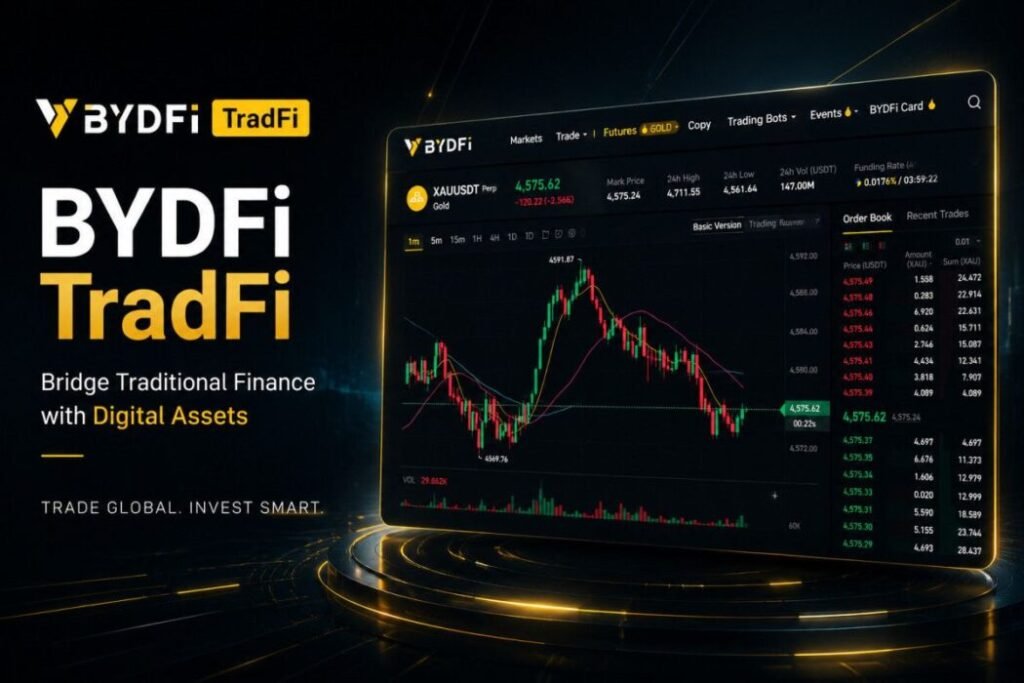
The most concrete example of this product category is the TradFi trading feature launched on the BYDFi platform in 2026. Operating since 2020 — a six-year track record that spans the 2022 crypto winter and subsequent market cycles — and named Forbes Best Crypto Exchange Canada 2026, the exchange is registered in Canada and covers perpetual contracts on stocks including AAPL, AMZN, TSLA, MSFT, and AMD, alongside Gold (XAUUSD) and major forex pairs. These TradFi instruments are settled in USDT with no trading fees at the time of publication. Funding rates still apply and should be factored into total cost of carry.
A forex trader who’s spent years analyzing XAUUSD can now take a position at any hour, sized with leverage options from 1x to 200x, without converting to a new asset class or abandoning familiar tickers. The learning curve compresses considerably when the underlying instrument is already in your analysis toolkit.
The standard perpetuals fee structure sits at maker 0.02% / taker 0.06% at the base VIP 0 tier — relevant context for traders comparing total execution costs against their current brokerage. The zero-fee structure applies specifically to TradFi instruments, not to the broader perpetuals suite.
What the Platform Offers in Context of the TradFi Transition
The TradFi instruments sit within a broader exchange infrastructure that experienced derivatives traders will find relevant. The exchange supports 600+ trading pairs across spot and perpetual futures — providing meaningful exposure to major assets for traders accustomed to deep order books at venues like CME.
The copy trading infrastructure addresses a specific need for traders getting comfortable with perpetual mechanics. Copy Trading allows followers to replicate professional trader execution, with position sizing automated to manage exposure. Perpetual Smart Copy Trading, launched in August 2025, is designed for beginners to automatically follow professional traders with proportional order sizing and isolated positions — the earlier Copy Trading feature had launched in January 2025. Both are practical tools for traders who want to observe professional perpetuals execution before running their own positions.
For traders who prefer systematic approaches, four automated strategies are available: Spot Grid, Futures Grid, Spot Martingale, and Spot DCA. A Bot Marketplace launched in 2026 lets community-created strategies be copied directly — bridging the gap between manual execution and fully automated systems without requiring traders to build their own logic from scratch. Genuinely useful for anyone who wants rules-based exposure without the engineering overhead.
The exchange also holds a partnership with Newcastle United, which provides mainstream institutional visibility relevant to evaluating the platform’s operational profile.
Testing the Platform Before Committing Capital
One feature that addresses the TradFi-to-crypto transition practically is the demo trading environment — preloaded with 50,000 USDT and replicating real market conditions across both USDT-M and COIN-M perpetual contracts, with leverage options from 1x to 200x.
The position execution flow for a TSLA perpetual is noticeably similar to a standard derivatives interface. Order types, leverage controls, and PnL display are laid out in a way that doesn’t require crypto-native familiarity to navigate. Funding rate mechanics and Mark Price behavior are visible in real time, which matters for traders who need to understand how these instruments diverge from their traditional counterparts before putting real capital to work.
Initial registration requires only an email address to access the platform and demo environment. Identity verification kicks in for higher withdrawal limits and fiat on-ramp access, consistent with standard exchange compliance procedures. Fiat funding is supported across 100+ currencies through One-Click Buy, Bank Transfer, Credit/Debit Card, and P2P trading — the P2P option launched in 2026 and is particularly relevant for traders in markets where direct bank-to-exchange transfers carry delays or additional compliance layers.
The platform is available in 22 languages including English, Vietnamese, Russian, Indonesian, Japanese, Portuguese, Turkish, Spanish, French, Thai, Tagalog, and Arabic. A practical consideration for traders operating outside English-language markets who need to evaluate platform documentation in their working language.
Onboarding Logistics and Fee Structure for Active Traders
The VIP program spans 7 tiers (VIP 0–6) and offers up to 60% futures fee discounts based on 30-day trading volume or asset balance. Structurally similar to tiered fee models at traditional brokerages — a volume incentive mechanism that experienced traders will recognize and can factor into cost-of-execution modeling.
On the compliance and transparency side, the exchange publishes Proof of Reserves reports audited by Hacken, with reserve ratios for BTC, ETH, and USDT disclosed at the time of each audit — alongside registrations in multiple jurisdictions including Canada. The exchange was listed on both CoinMarketCap and CoinGecko in January 2023, providing third-party exchange data for volume and market depth evaluation.
[CoinMarketCap’s exchange data for BYDFi provides third-party trading volume and market depth figures that can be assessed alongside the platform’s own disclosures.
For broader context on how crypto exchanges are structured and evaluated — particularly for readers coming from traditional brokerage backgrounds — Investopedia’s crypto exchange overview provides a useful reference framework. On-chain market context for the broader 2026 environment is tracked at DeFiLlama, which offers a counterpart view of decentralized liquidity alongside centralized derivatives data.
A Realistic Assessment: What Works and What Doesn’t
The movement of TradFi traders to crypto derivatives in 2026 is neither frictionless nor without structural trade-offs. Here’s where it actually stands.
The 24/7 access advantage is real and specific. Familiar instruments — XAUUSD, TSLA, major forex pairs — available without a brokerage intermediary suits traders whose strategy is time-sensitive and macro-driven. The ability to act on a position at any hour, with no overnight broker restrictions, changes the execution calculus in ways that are hard to replicate in traditional infrastructure.
Lower onboarding friction is equally concrete. Streamlined registration, multi-currency fiat on-ramps across 100+ currencies, and a demo environment that replicates live conditions mean the evaluation period before committing capital is faster and cheaper than switching between traditional brokerages.
What requires adjustment is less obvious but more important. Funding rates, Mark Price deviation from spot, and liquidation mechanics on perpetuals behave differently from equity options expiry or forex rollover. Traders who don’t model these differences explicitly are taking on basis risk they haven’t priced. The instruments are familiar; the mechanics are not identical.
Whether the advantages outweigh those trade-offs depends on a trader’s existing experience with derivatives mechanics, their capital size, and their operating context. Experienced market participants are actively working through that calculation right now — and the platforms worth evaluating seriously are the ones built to support that transition, not just market to it.
Frequently Asked Questions
What makes crypto derivatives platforms different from traditional brokerages for experienced traders?
Crypto derivatives platforms offer continuous 24/7 trading, faster onboarding, and access to perpetual contracts on familiar instruments like XAUUSD and TSLA — without the fixed trading hours and layered intermediary fees common in traditional brokerage infrastructure. The core mechanical differences are in funding rates, Mark Price behavior, and settlement in stablecoin rather than USD.
How do perpetual contracts on stocks and forex work on crypto platforms?
Perpetual contracts on equities and forex pairs are synthetic exposures settled in USDT — not direct ownership of shares or currency. They track the underlying price via funding rate mechanisms and Mark Price, and they do not expire. Traders familiar with futures or options mechanics will recognize the structure, but funding rate costs and liquidation thresholds require explicit modeling before deployment.
Why are TradFi traders moving to crypto derivatives specifically in 2026?
The convergence of several factors accelerated the shift: SEC spot Bitcoin ETF approval normalizing crypto exposure institutionally, the launch of TradFi-instrument perpetuals on platforms with zero trading fees and 1x–200x leverage, and growing dissatisfaction with the operational constraints of traditional brokerages — particularly around trading hours and onboarding speed. TradFi traders moving to crypto derivatives in 2026 are largely responding to these structural gaps rather than speculative interest in new assets.
Can traders use a demo environment before committing real capital to crypto derivatives?
Yes. The exchange provides a demo trading environment preloaded with 50,000 USDT that replicates live market conditions across USDT-M and COIN-M perpetual contracts. This allows traders to evaluate order execution, funding rate behavior, and leverage mechanics without capital at risk — a practical first step for anyone transitioning from a traditional derivatives setup.
Does the fee structure on crypto derivatives platforms compare favorably to traditional brokerages?
It depends on the instrument and tier. The base perpetuals fee structure is maker 0.02% / taker 0.06% at VIP 0, with TradFi instruments carrying zero trading fees at time of publication. Volume-based VIP tiers offer up to 60% fee discounts. Traders should factor in funding rate costs alongside headline fees when modeling total cost of carry against their current brokerage.
