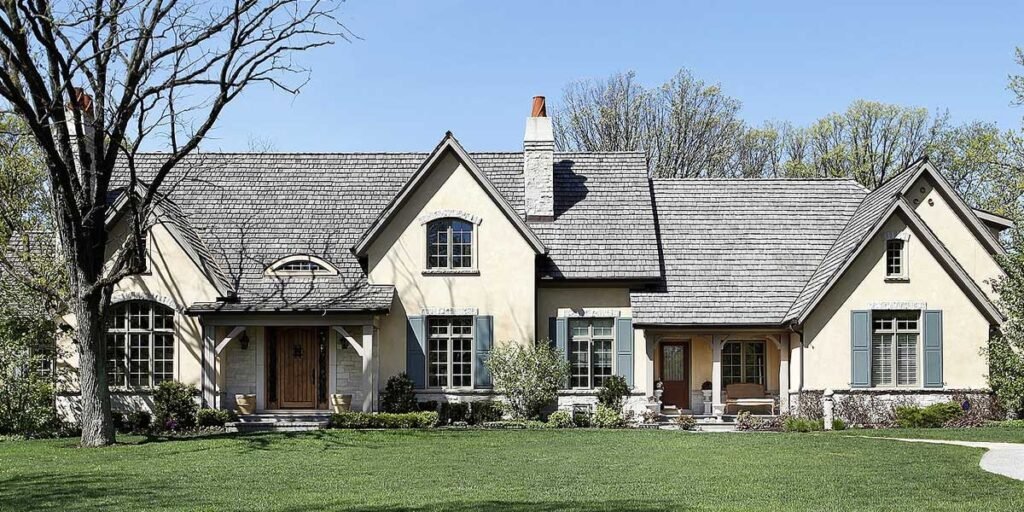
A cedar shingle roof lasts 20 to 50 years, with the lifespan almost entirely determined by four factors: the grade of the cedar, the cut of the grain, the climate the roof lives in, and whether the homeowner maintains it. A #1 Blue Label Western Red Cedar shingle, cut from the edge grain of a heartwood block, installed over spaced sheathing in the Pacific Northwest, will reach 50 years. A #3 Black Label flat-grain shingle installed over solid OSB decking in humid Georgia will fail at 20 — not because cedar is a bad roofing material, but because the grade and installation were wrong for the climate.
Cedar roofing is unlike any other roofing material because it is a natural, organic product from a specific species of tree. The lifespan is not engineered into a factory — it is grown into the wood itself through the tree’s production of natural oils called thujaplicins, which are fungicides and insecticides the tree manufactures to protect its own heartwood from decay. The concentration of those oils is what separates a 50-year cedar roof from a 20-year cedar roof.
The Cedar Grade System: How to Read a Certi-Label
Every bundle of cedar shingles certified by the Cedar Shake and Shingle Bureau (CSSB) carries a Certi-Label — a color-coded stamp that tells you everything you need to know about how long that shingle will last. The label is the single most reliable predictor of cedar roof lifespan, more accurate than the installer’s reputation or the climate zone.
| CSSB Grade | Label Color | Heartwood Content | Expected Lifespan | Best Use |
|---|---|---|---|---|
| #1 Blue Label (Premium) | Blue | 100% heartwood | 30-50 years | Roofs, exterior walls |
| #2 Red Label (Good) | Red | 80-100% heartwood, up to 20% sapwood | 20-30 years | Roofs, budget-conscious |
| #3 Black Label (Utility) | Black | 50%+ heartwood, up to 50% sapwood | 10-20 years | Undercoursing, starter courses only |
The difference between Blue and Black is not cosmetic — it is biological. A Western Red Cedar tree produces thujaplicins in its heartwood (the dark inner core) but not in its sapwood (the light outer ring). A Blue Label shingle is sawn entirely from heartwood and contains the maximum concentration of natural preservatives. A Black Label shingle contains up to 50% sapwood, which has no natural rot resistance whatsoever. The sapwood in a Black Label shingle rots at the same rate as a pine board left outside — which is to say, within 5 to 10 years in a wet climate.
How to check the grade on an existing cedar roof: Go into the attic and look at the underside of an exposed shingle. The CSSB Certi-Label stamp is printed on the back face of every shingle in the bundle. If you see a blue stamp, the roof was built with premium material and has decades of life left if the installation was correct. If you see a black stamp, the roof was built with a utility-grade product not intended as the primary weather surface, and it is already past its design life if it is more than 15 years old.
How the Cut of the Grain Affects Cedar Shingle Lifespan
A cedar shingle’s lifespan depends as much on how it was sawn from the log as on which part of the tree it came from. The grain orientation determines how the shingle reacts to moisture — whether it cups, curls, splits, or stays flat over decades of wet-dry cycles.
| Grain Cut | Appearance | Moisture Behavior | Lifespan Impact |
|---|---|---|---|
| Edge-Grain (Vertical Grain) | Tight, straight grain lines parallel to shingle length | Minimal expansion, stays flat | Maximum lifespan, premium installation |
| Flat-Grain (Slash-Grain) | Arched, flame-shaped grain pattern | Significant cupping when wet, curling at edges | 10-15 years shorter than edge-grain |
An edge-grain shingle expands and contracts across its width — the axis of the grain — but barely moves across its thickness. A flat-grain shingle cups because the growth rings run roughly parallel to the face of the shingle, and the wood expands more on the outer ring side than the inner ring side. The cupping lifts the edges of the shingle, creating gaps that admit water and accelerate the erosion of the exposed surface.
The CSSB Certi-Label does not distinguish between edge-grain and flat-grain. Both can be #1 Blue Label. The difference is visible only by looking at the grain pattern on the face of the shingle, and it is the installer’s responsibility to select edge-grain shingles for the exposed weather surface. Many production roofing crews do not take the time to separate edge-grain from flat-grain, and the roof pays for that shortcut with a 10- to 15-year reduction in lifespan.
How Climate Determines Cedar Roof Lifespan
Cedar is a wood from the Pacific Northwest, and it performs best in climates that resemble its place of origin: moderate humidity, seasonal rain, cool to mild temperatures, and good air circulation. Outside of those conditions, the lifespan drops — not linearly, but in step changes at specific climate thresholds.
- Pacific Northwest and coastal Northeast (ideal): 40 to 50 years for #1 Blue Label edge-grain. These climates are cool and wet, but the wet periods are followed by dry periods that allow the cedar to dry out between rains. The cedar does not rot because it is not continuously wet.
- Mountain West and inland California (good): 35 to 45 years. Dry air and high UV accelerate the erosion of the wood surface — the lignin that holds the wood fibers together degrades faster under intense sunlight — but the low humidity means organic decay is almost absent. A cedar roof in Colorado erodes but does not rot.
- Southeast and Gulf Coast (poor): 20 to 30 years. High humidity, frequent rain, and warm temperatures create the ideal conditions for fungal decay. The cedar is wet for extended periods between rains because the air is too humid for it to dry. Sapwood content becomes critical in this climate — a #2 Red Label shingle with 20% sapwood may only last 15 years in coastal Georgia.
- Desert Southwest (mixed): 25 to 35 years. The cedar does not rot — it is too dry — but the intense UV radiation degrades the surface lignin so aggressively that the shingle thins from the top down by roughly 1/32 inch per year. A ½-inch shingle in Phoenix lasts about 16 years before it is too thin to resist cracking from hail or foot traffic. A thicker shake (¾ inch) stretches that to 24 years.
Maintenance That Extends Cedar Roof Life
A cedar roof requires more maintenance than asphalt, metal, or tile — and the maintenance is not optional if you want the roof to reach the upper end of its lifespan range. The most effective cedar-specific maintenance tasks, in order of impact:
- Apply a wood preservative or oil-based treatment every 4 to 6 years. Rain leaches the natural oils out of cedar over time. A penetrating oil-based wood preservative — not a surface film-forming stain — replenishes those oils and restores the wood’s natural water repellency. A treated cedar roof lasts roughly 30% longer than an untreated roof of the same grade and installation quality. Cost: $2.00 to $4.00 per square foot applied.
- Install zinc or copper strips at the ridge to control moss. Rainwater washing over the metal strip picks up zinc or copper ions, which are natural biocides. The treated water running down the roof prevents moss and lichen from establishing. A zinc strip costs $2 to $4 per linear foot of ridge and lasts 10 to 15 years before the metal is consumed by corrosion.
- Remove leaves, pine needles, and branches within 30 days. Debris that sits on a cedar roof holds moisture against the wood surface continuously. The shingle underneath a pile of wet leaves will rot while the exposed shingle next to it remains sound. A roof rake or a leaf blower from the ladder is sufficient.
- Clean with an oxalic acid-based wood cleaner, never a pressure washer. Over time, cedar develops tannin bleed — dark brown or black streaks where water-soluble tannins have leached from the wood and oxidized on the surface. A light oxalic acid wash restores the natural color without damaging the wood surface. Pressure washing strips the soft grain and leaves the hard grain standing in ridges, reducing the shingle’s effective thickness by years of erosion in a single afternoon.
Cedar vs. Synthetic Cedar Alternatives
Polymeric shake and shingle products — brands like DaVinci, Brava, and Enviroshake — are molded from engineered polymers to look like cedar but carry a 50-year limited warranty and require none of the maintenance that cedar demands. They do not rot, split, curl, or support moss growth. They do not require preservative treatment or zinc strips.
| Characteristic | Natural Cedar (#1 Blue Label) | Synthetic Cedar (Polymer) |
|---|---|---|
| Lifespan | 30-50 years | 50+ years (warranted) |
| Maintenance | Treatment every 4-6 years | None |
| Fire Rating | Class B or C (untreated), Class A (treated) | Class A (inherent) |
| Installed Cost per sq ft | $10-$14 | $12-$18 |
| Appearance | Authentic, natural variation | Very good match; uniform color if not variegated |
| Environmental | Biodegradable, renewable | Petroleum-based, landfill only |
The synthetic alternative looks increasingly convincing — from the ground, a high-quality polymeric shake is indistinguishable from natural cedar to anyone who is not a roofing contractor. The choice between natural cedar and synthetic comes down to a single preference: do you want the maintenance obligation and the authentic material, or the maintenance-free convenience and the engineered substitute? Cedar requires work. Synthetic does not. Cedar rewards the work with a patina that synthetic cannot replicate.
FAQ: Common Questions About Cedar Shingle Roofs
Why is my cedar roof turning black?
The dark discoloration is tannin bleed — water-soluble extractives from the cedar wood that leach out when it rains and oxidize on the surface, turning dark brown or black. It is cosmetic and does not shorten the roof’s life. An oxalic acid-based wood cleaner (not a bleach-based cleaner) lifts the tannin stains and restores the wood’s natural color. The cleaning costs $1.50 to $2.50 per square foot and should be done every 6 to 10 years as part of regular maintenance.
Can you install a cedar roof in a wildfire zone?
Only if it is pressure-treated with a Class A fire retardant. Untreated cedar has a Class C fire rating — the lowest — and is prohibited by building code in most Wildland-Urban Interface (WUI) zones in California, Colorado, and other western states. Fire-retardant-treated (FRT) cedar shingles are rated Class A or B, depending on the treatment process, and are allowed in some jurisdictions. However, the fire-retardant chemicals leach out over 15 to 25 years, and the treated shingles must be replaced on that schedule regardless of their physical condition. In the highest-risk WUI zones, all wood roofing is prohibited regardless of treatment.
A Cedar Roof Lasts as Long as the Grade Stamp Promises — With Maintenance
The grade stamp on the back of the shingle is a contract between the mill and the homeowner. A Blue Label says the shingle is 100% heartwood from a Western Red Cedar tree and will resist rot for 30 to 50 years if it is not sitting in a pile of wet leaves for months at a time. A Black Label says the shingle is a utility-grade product with sapwood that will rot in a decade.
If you are buying a house with a cedar roof, find the stamp. If you are installing a cedar roof, pay for Blue Label edge-grain. If you already have a cedar roof, apply an oil treatment every 5 years, keep the debris off, and install zinc strips at the ridge. The cedar will outlast three asphalt shingle roofs if you let it.
