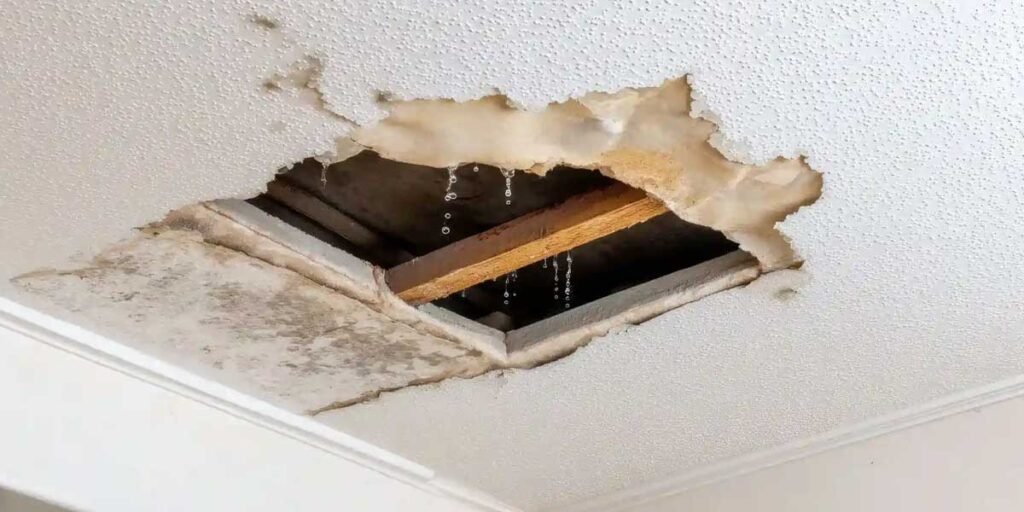
A roof leaks because water has found a path through the waterproofing layer — the shingles, the metal panels, the membrane, or the flashings — and into the roof deck below. The water almost never enters through the broad, uninterrupted surface of the roof. It enters at the interruptions: the seams between materials, the penetrations for pipes and vents, the junctions where the roof meets a wall or a chimney, and the valleys where two roof planes converge and channel water into a concentrated stream, notes Property management in Buckeye. In houses under 20 years old, roughly 80% of roof leaks are flashing failures — not shingle failures.
When water appears on the ceiling, the hole in the roof is almost never directly above the stain. Water runs along rafters, across the top of the roof deck, and down the inside of walls before finally dripping through a light fixture or a drywall seam. The ceiling stain is the end of the water’s journey, not the beginning. The actual entry point is uphill — sometimes by only a few feet, sometimes by 15 feet or more — and finding it requires tracing the water backward from the stain to the source.
The Most Common Roof Leak Causes, Ranked by Frequency
| Rank | Leak Cause | % of Leaks | Typical Roof Age When It Appears | Roof Types Affected |
|---|---|---|---|---|
| 1 | Failed flashing (step, counter, chimney, valley) | 40% | 10-20 years | All types |
| 2 | Failed pipe boot or vent flashing | 20% | 10-15 years | Asphalt shingle most common |
| 3 | Missing or damaged shingles (wind, age, impact) | 15% | 15-25 years | Asphalt, wood |
| 4 | Ice dam at the eave | 10% | Any age, winter only | All sloped roofs |
| 5 | Clogged gutter causing water backup under eave | 5% | Any age | All types |
| 6 | Skylight or chimney leak | 5% | 10-25 years | All types |
| 7 | Condensation (not a true leak) | 5% | Any age, cold weather | Metal, flat roofs |
Flashing failures dominate the list for a reason: the metal seams that seal the transitions between the roof and every vertical surface are exposed to more thermal stress and more UV radiation than the shingles, and the sealant that bonds them has a shorter service life than any roofing material. A roof that is otherwise in perfect condition will leak at a flashing joint if the sealant has cracked — and the sealant cracks 5 to 10 years before the shingles wear out.
1. Failed Flashing: The Leading Cause of Roof Leaks
Flashing is the metal — usually Galvalume steel, aluminum, or copper — that bridges the gap between the roof surface and a vertical penetration. It is the single most common leak point on every type of roof, accounting for roughly 40% of all residential roof leaks.
The failure is almost never the metal itself corroding through. It is the sealant at the flashing joints, the fasteners that hold the flashing in place, or the physical separation of two pieces of flashing that were once joined by a bead of caulk. Specific flashing failure modes:
- Step flashing at a wall-to-roof junction: The sealant between each L-shaped piece dries out, cracks, and admits wind-driven rain. The ceiling stain appears on the floor below the wall — often one or two stories down.
- Counter flashing on a chimney: The mortar or silicone in the reglet groove cracks from thermal cycling. Water enters the groove, runs behind the counter flashing, and drips down inside the chimney chase. The step flashing below is intact and would shed the water if the water had stayed on top of it.
- Valley flashing: The metal in the valley corrodes at the bottom of the V-channel from decades of concentrated water flow and debris abrasion. The shingles on either side of the valley are still in good condition, but the valley metal underneath has rusted through.
2. Failed Pipe Boots and Vent Flashings
The rubber collar around every plumbing vent pipe, furnace flue, and exhaust vent on your roof degrades from UV exposure. Neoprene collars crack at the point where they grip the pipe after 10 to 15 years. EPDM collars last 15 to 20 years. Silicone collars last 25 to 40 years. When the collar cracks, water follows the outside of the pipe straight down into the attic — a direct, concentrated leak that usually stains the ceiling in the room directly below the pipe.
A pipe boot leak is one of the easiest roof leaks to diagnose because the water stain is always directly below a plumbing vent pipe — in a bathroom ceiling, above a kitchen cabinet, or in a utility closet. The repair costs $250 to $500, and the pipe boot itself costs $15 to $60. The rest is the roofer’s labor and the minimum service call charge.
3. Missing or Damaged Shingles
Shingles can be blown off by wind, torn by falling branches, or simply wear out from age — losing their mineral granules, curling at the edges, and cracking through the mat. A single missing shingle is an open hole in the roof. Wind-driven rain blows directly onto the underlayment or the roof deck, and the underlayment — which is a secondary water barrier, not a primary waterproofing layer — eventually allows water through at a fastener hole, a seam, or an edge.
Missing shingles are visible from the ground with binoculars. Curled, cracked, or bald shingles are visible from a ladder at the eave. If the damage is isolated — one or two shingles missing after a windstorm — the repair costs $150 to $400. If shingles are missing or damaged across multiple roof faces and the roof is over 20 years old, the roof is reaching the end of its service life and a full replacement should be budgeted.
4. Ice Dams: Winter Leaks That Happen at the Eave
An ice dam forms when snow on the upper part of the roof melts — warmed by heat escaping from the attic — and the meltwater runs down to the cold eave, where it refreezes. The ice builds up layer by layer until it forms a dam across the eave. Subsequent meltwater pools behind the dam, and because water sitting on shingles will eventually find a way under them — through the gaps between shingle tabs, under the edges of the shingles, or up under the starter course — the pooled water leaks into the soffit, the fascia, and the exterior wall below the eave.
Ice dam leaks are the only roof leaks that appear at the exterior wall rather than in the middle of the ceiling. The water enters at the eave and runs down inside the wall cavity, staining the wall below the window or soaking the baseboard. The fix for an ice dam is not a roofing repair — it is attic air sealing and insulation to prevent heat from escaping into the attic and melting the snow on the roof in the first place.
5. Clogged Gutters: Water Backing Up Under the Eave
Gutters that are full of leaves, pine needles, and shingle granules cannot drain. Water overflows the back of the gutter and runs down the fascia board, where it can enter the soffit and the wall cavity. Clogged gutters also cause water to back up under the shingles at the eave — the drip edge is designed to shed water into a functioning gutter, not to resist water that is standing at the eave line for hours after a rain.
The fix is cleaning the gutters — a maintenance task, not a roofing repair. If the gutters are clean and water is still overflowing or backing up, the gutters may be undersized for the roof area, the downspouts may be clogged, or the gutter pitch may be wrong. A gutter contractor can diagnose and fix these issues for $150 to $400.
What to Do the Moment You Discover a Roof Leak
- Contain the water. Place a bucket under the drip. If the ceiling is bulging — water pooled between the drywall and the paint — poke a small hole in the center of the bulge with a screwdriver. The water will drain through the hole into the bucket instead of spreading across the ceiling and collapsing the drywall. A small drain hole costs $150 to patch and paint. A collapsed ceiling costs $800 to $1,500 to replace.
- Move furniture and electronics away from the wet area. Water that runs down inside a wall can reach an outlet on the floor below. If any outlet or switch near the leak is wet, turn off the circuit breaker for that room.
- Document the damage with photographs. If the leak was caused by a storm — wind, hail, a fallen tree — you will need photographs of the interior damage and the roof damage for the insurance claim.
- Call a roofer. Do not go onto the roof yourself during a storm or on a wet roof. A temporary repair — a tarp secured over the damaged area — costs $300 to $600 and buys time for a permanent repair in dry weather.
FAQ: Common Questions About Roof Leaks
Can I ignore a small roof leak if it only drips during heavy rain?
No. A small leak is a small hole in the roof deck that is actively admitting water into the attic. Every time it rains, water soaks the insulation, the drywall, and any electrical wiring in the ceiling cavity. The leak does not stay small — water rots the decking around the hole, the hole enlarges, and the next heavy rain admits more water than the last one. A $400 repair today is a $1,500 ceiling replacement and a $500 decking repair if ignored for a year.
Why is my brand-new roof leaking?
A new roof that leaks is almost certainly an installation error, not a material defect. The most common new-roof leaks: step flashing installed backward (water flows into the seam instead of over it), valley metal seams lapped in the wrong direction, pipe boots not sealed to the shingles, and ridge cap shingles nailed in the wrong location. The roofer who installed the roof should repair these at no cost under the workmanship warranty — typically 2 to 10 years, depending on the contractor.
A Roof Leak Is a Flashing Problem Until Proven Otherwise
The shingles on your roof are almost certainly not the source of the leak. The metal seams where the roof meets a wall, a chimney, a pipe, or a valley are the source. Those seams are sealed with caulk and rubber, not metal and asphalt, and the caulk and rubber degrade years before the shingles do.
When water appears on the ceiling, the first place to look is uphill from the stain at the nearest flashing. The second place is the nearest pipe boot. The third place is the nearest valley. If all three are intact, then — and only then — start looking at the shingles. The flashing fails first, every time.
