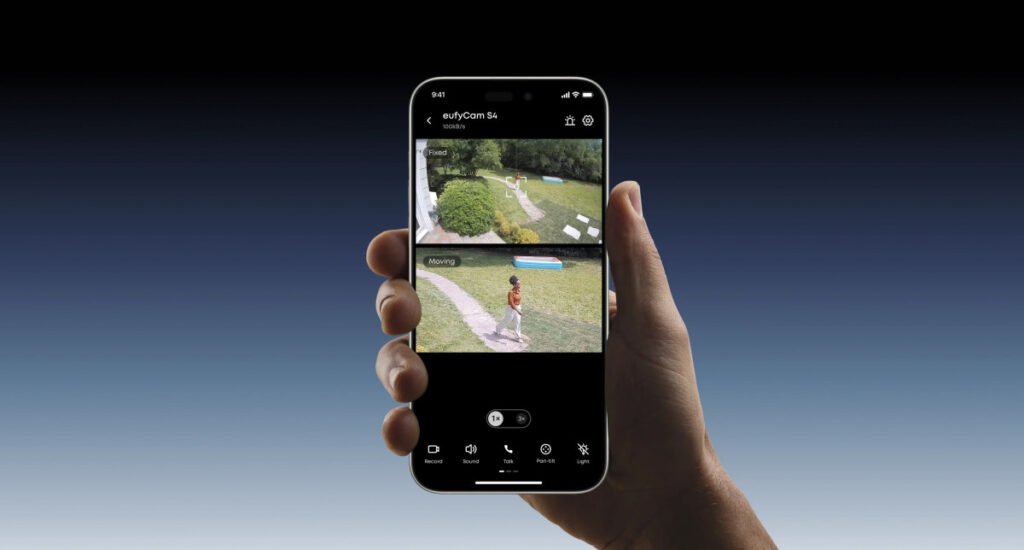
The detection range on most security cameras is accurate. What spec sheets rarely include is the distance at which a face becomes readable or a plate legible. For a camera advertised at 100-foot coverage, that number typically sits between 25 and 40 feet. A 90-foot driveway monitored by that camera might still leave a 50-foot stretch where no face is identifiable. Four specs drive that identification distance, and most buyers do not check any of them.
The Three Distances Every Camera Has
Answering your front door moves through three stages without you thinking about it: hearing the ring, seeing a shape at the peephole, and recognizing the face. A security camera processes a scene the same way, and most spec sheets only describe the first stage.
Distance Type
What It Means
Typical Range
Detection range
Camera triggers a motion alert
80–150 ft
Observation range
You can see a human outline or silhouette
40–90 ft (roughly 40–60% of detection range)
Identification range
You can recognize a face, read a license plate, or confirm clothing details
25–50 ft (roughly 25–40% of detection range)
When a manufacturer says a camera “covers 100 feet,” they almost always mean detection range. That same camera’s identification range is typically somewhere between 25 and 40 feet. That fact rarely appears in the headline spec. Security professionals specify camera systems using these exact tiers, measured in pixels per meter, under the IEC 62676-4 international standard for video surveillance systems. [Source: IEC 62676-4, jvsg.com, Pixel Density in Video Surveillance]
This gap explains why users frequently feel misled after installing a new camera: motion alerts fire at 80 or 100 feet, but the captured footage shows a blurry figure with no identifiable features. The camera worked exactly as advertised. It just detected motion, not identified the person.
“I did realize something with the $650 system that I can’t really see clear face or plate number on any moving object (person or vehicle). Now I know the image sensor size is the key factor, not the megapixel.”
[Source: ipcamtalk.com community forum, 2024]
What Actually Determines Identification Range
Identification range is not one number you can pull from a spec sheet. It is the result of four factors working together, and buying based on only one of them is what produces footage that looks usable on paper but falls short in the field.
Lens Angle and Focal Length
At 60 feet, a person walking across a 130° wide-angle frame can appear fewer than 50 pixels tall in the image. Pixel count on the sensor does not change that. The lens determines how much of the frame the subject occupies, and at wide angles, that fraction is small. Swap to a narrower 40°–70° angle and the same person at the same distance takes up a much larger portion of the frame. Past roughly 50 feet, lens angle affects identification range more than whether the camera is 2K or 4K. Swap a 4mm lens for a 12mm lens on the same camera body, and you can push identification range from roughly 20–25 feet out to 60–70 feet. You will cover a much narrower angle in the process, which is why lens selection and camera placement need to be planned together, not chosen off a spec sheet. [Source: Seneca Security, licensed security installer, New York]
Resolution
Raise the resolution on a wide-angle camera and you will not necessarily get a more identifiable face at distance. The lens angle determines how many pixels land on a given subject, and at 60 feet on a 130° wide-angle lens, that count is low regardless of sensor size. At 30 feet the difference between 4K and 1080p is visible in facial detail. At 100 feet on the same wide-angle lens, neither camera will produce footage usable for identification.
Cropping into a recorded clip to enlarge a face or pull a partial plate number gives you more pixel data to work with at 4K than at 1080p. It does not change what the lens resolved at the moment of capture, though.
One thing worth knowing: the industry recently raised the bar on what “identification” actually means in measurable terms. Under IEC 62676-4:2014, a camera capturing 250 pixels per meter was considered identification-grade. When the standard was updated in October 2025, that same 250 px/m threshold was reclassified as “Characterize.” At that level, you can describe clothing type, gait, and behavior, but the standard no longer considers it enough to identify an individual. The new Validate tier sits at 500 px/m, the threshold now required for verifying a known person or reading a license plate. [Source: IEC 62676-4:2025, cctvbuyersguide.com, October 2025] In practice, cameras marketed as “identification capable” based on pre-2025 specs are meeting a threshold the current standard places two levels below what courts and security professionals consider true identification.
Zoom Type
The word “zoom” in a spec can mean two very different things, and only one of them extends your identification range.
Optical zoom physically moves the lens elements to magnify the image before it reaches the sensor. When you go from 1× to 4× optical zoom, the sensor is receiving four times the detail from that portion of the scene. Image quality is preserved, and identification range is genuinely extended.
Digital zoom crops and enlarges the image after the sensor has already captured it. You gain no new detail. The pixels get stretched, which makes the image appear larger but actually less sharp. It does not extend your identification range in practice.
Hybrid zoom combines both, using optical zoom as the primary mechanism and adding a moderate amount of digital zoom on top. For security applications, hybrid zoom delivers meaningfully better results than digital-only.
Zoom Type
How It Works
Image Quality
Extends Identification Range?
Optical
Physical lens movement
No quality loss
Yes
Digital
Software crop and enlarge
Pixels stretched, detail lost
No
Hybrid
Optical primary, digital supplemental
Minimal quality loss
Yes, with limits
When reading a spec sheet: “optical zoom Xx” represents a real multiplier on your identification range. “8× zoom” without the word “optical” should be treated as digital zoom until confirmed otherwise.
Low-Light Performance
A camera that identifies faces reliably at 30 feet during the day may struggle to produce usable footage at half that range after dark. The drop in effective identification range depends on which night vision technology the camera uses.
Standard infrared (IR) night vision works in complete darkness, but effective identification range typically falls somewhere between 15 and 50 feet depending on the camera, with most mid-range models landing in the 25–40 ft window. The figure varies across sources and hardware, as different installers and testers report different numbers based on their specific setups. [Source: range synthesized from Seneca Security, How Far Can a Security Camera See; and total-sec.co.uk, Real-World CCTV Range Explained] The footage is also black-and-white, which means clothing colors, vehicle paint, and other visual identifiers are simply gone.
Color night vision cameras use larger apertures and more sensitive sensors to capture usable color in low-light conditions. Color matters for identification: a person in a dark hoodie versus a bright jacket can look identical in IR footage but are clearly different in color night vision. Cameras with advanced large-aperture lenses, like the F1.0 MaxColor Vision™ in the eufyCam S3 Pro, gather significantly more ambient light than a standard camera and produce full-color footage in near-dark outdoor conditions.
Floodlight cameras actively illuminate the scene with visible white light, which can push effective identification range to 50–80 feet at night. The camera’s presence is also visible to anyone approaching, since the white light is hard to miss.
Why Getting This Wrong Is Costly
Most buyers discover the detection-vs-identification gap after installation, not before. The camera triggers an alert, they check the app, and the footage shows a figure at the edge of the frame, technically captured, but too blurry to be useful.
At that point, the options are limited. You can move the camera closer to the target area, which usually means remounting hardware and potentially sacrificing the wide detection coverage you installed it for in the first place. You can add a second camera with a narrower lens pointed at the specific zone where you need identification. Or you replace the camera entirely.
None of these outcomes are cheap or convenient, and all of them stem from the same misread: treating detection range as identification range when shopping.
The practical cost shows up in three common scenarios:
Package theft at the door. A camera with a wide-angle lens catches the theft happening, but the footage shows a hooded figure with no identifiable facial features. The clip is useful for confirming that a theft occurred, but not for identifying who did it.
Vehicle incidents in the driveway. Motion detection fires, but the license plate at the end of the driveway is unreadable at 80 feet on a fixed wide-angle lens. A narrow lens or optical zoom would have resolved it.
Nighttime events. IR-only footage shows a silhouette. Clothing color, hair, and vehicle color are gone, which limits how useful the clip actually is.
Checking identification range before you buy, not after, is the one step that avoids all three.
What to Look For in a Long Range Security Camera
Those four factors translate directly into a checklist for any long range security camera:
Identification range: ask for this number explicitly, or check review footage at 50+ ft
Lens angle: narrower angles identify better at distance; wide angles detect better across area
Optical zoom: “optical zoom Xx” is the spec that extends identification range
Night vision type: color night vision preserves identification detail that IR-only cannot
AI tracking: auto-tracking PTZ cameras maintain identification range on moving subjects without manual adjustment
As a rough benchmark, focal length is the fastest way to estimate identification range before you buy. These are typical ranges for a 4K camera on a standard mount:
Focal Length
Field of View
Face ID Range
Typical Use
2.8mm
~110°
Up to 15 ft
Porch, small yard
4mm
~85°
Up to 22 ft
Front door, short driveway
6mm
~55°
Up to 35 ft
Mid-length driveway
8mm
~40°
Up to 50 ft
Large lot, parking area
12mm
~25°
60–70 ft
Street-facing, long alley
[Source: Seneca Security, How Far Can a Security Camera See; pvrblog.com, Security Camera Lens Guide]
The eufyCam S4 is worth looking at because the hardware physically separates detection and identification into two distinct modules. Each has a different job:
The upper 4K bullet lens covers a fixed 130° wide-angle view across a full driveway, entrance, or yard. It operates at the detection and observation level.
The lower 2K dual-lens PTZ operates with 8× hybrid zoom and 360° pan, 70° tilt. Once the bullet lens detects a subject, the PTZ locks on, zooms in, and tracks the target. Identification detail holds up to 164 ft (50 m). Actual distance may vary based on subject size and environmental factors. When multiple subjects enter the frame, it zooms out to keep all of them in view. One practical note: the bullet-to-PTZ handoff works fastest when both lenses are pointed toward the same target area. If the PTZ is angled away from the zone the bullet is monitoring, the initial tracking response can be slower, so orientation matters during setup.
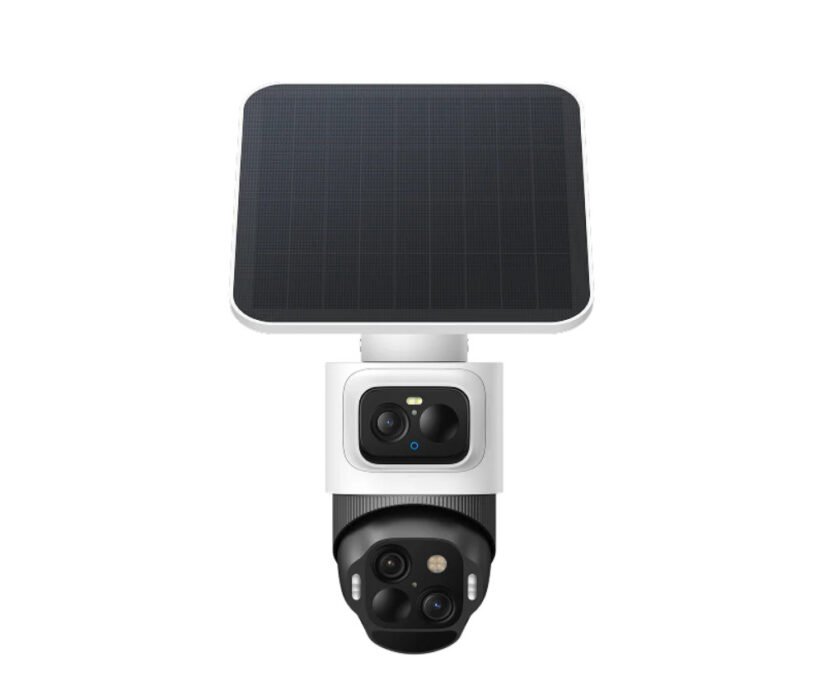
Running them as separate devices on a single property would require two mounting points, separate power sources, and manual switching between feeds. The eufyCam S4 handles the handoff automatically.
Two other things worth noting: the S4 runs without a HomeBase, with on-device AI handling human, vehicle, and pet detection and 32 GB of built-in storage. The SolarPlus™ panel keeps it charged year-round with as little as one hour of direct sunlight per day.
For comparison, the eufyCam S3 Pro, also 4K and also listed with “8× zoom,” uses digital zoom only, with no PTZ and no tracking. Its identification range at distance is shorter because no optical element extends the lens’s reach. Its advantage is low-light color performance: the F1.0 MaxColor Vision™ aperture produces full-color footage in near-darkness where many cameras fall back to grayscale IR. That is a genuine edge for nighttime identification at closer ranges where color detail, not distance, is the limiting factor.
Neither camera is universally better. The S4 extends identification range at distance through optical tracking. The S3 Pro prioritizes color fidelity in low light without active tracking. The right choice depends on whether your identification problem is about distance or darkness.
Conclusion
The gap between detection range and identification range is the most important distance most camera buyers never check. A camera that alerts you at 100 feet may only deliver identifiable footage at 30 to 40 feet. The ceiling is set by lens geometry and focal length, not by any defect in the hardware.
When evaluating any camera, look past the detection range headline and ask: at what distance can this camera produce footage I can actually use to identify a person? That number is smaller, and it is the one that matters.
To find cameras designed for clear identification at distance, explore the full range of eufy security cameras and filter by resolution, zoom type, and night vision range.
