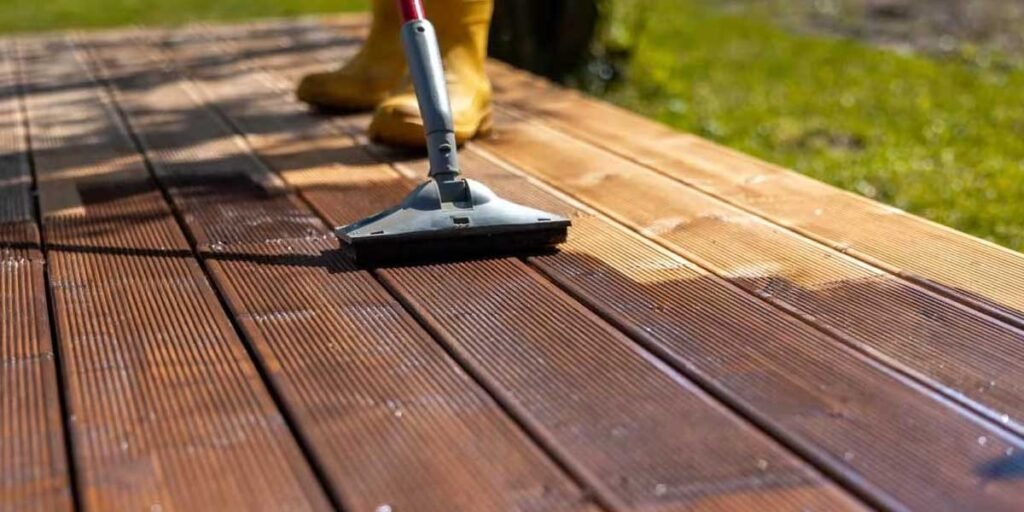
The deck staining cost calculator for a typical deck lands around $3 to $6 per square foot, with a national mid-range of $2.96 to $6.16 quoted by Homewyse, and the labor and the prep are the biggest line, about eight of every ten dollars, while the stain itself is small. A 20-by-20 deck runs about $1,200 to $2,500, and a 1,000-square-foot deck roughly $3,000 to $6,200, before the stain type, the cleaning, and your region move it. The honest surprise is the same as inside the house: the stain is the cheapest line, and the money lives in the cleaning, the prep, and the labor.
The following works as a calculator, measure the deck with the rails, apply the per-foot rate, and add a line for the deep-wash and any finish removal. Below is how the cost is built, the calculation by deck size, the stain types worth choosing, and the hidden costs that break a budget.
How deck staining cost is really built
According to Portsmouth Property Management Services, deck staining is labor-dominated, with the prep and the painter running about eight of every ten dollars and the stain a small share, and it carries a deep-wash and a two-coat schedule that an interior wall does not. The savings come from the labor, not from a cheaper can of stain.
| Cost line | What it covers | Share of a stained deck | Why it varies |
|---|---|---|---|
| Painter’s labor | Clean, prep, two coats, rails | Largest, about 80% | Size, rails, existing finish |
| Deep-wash (optional) | Power-wash and prep the surface | Optional line | Visible grime, algae, wear |
| Deck stain | The stain itself | Small | Type, quality, coats |
| Supplies | Tape, cleaners, repair, cleanup | Very small | Prep and finish |
Homewyse, which itemizes the deck job line by line, prices it into a small oil-based stain line, a labor line over five hours that carries the job, a tiny supplies line, and an optional deep-wash, and its May 2026 example comes to $370 to $771 for a 125-square-foot deck. That the labor and the prep run eight of ten dollars is the honest fact, because a deck needs a clean, dry surface to hold the stain, so the cleaning and the prep decide how well the coat lasts, and a deep-wash on a grimy deck adds its own line. Skimping on the wash to save a few dollars is how a coat fails early.
Use the deck staining cost calculator
Measure the deck’s square footage, add a share for the rails and the stairs, apply the per-foot rate, and add a line for the deep-wash and any finish removal, and the budget shows itself. The table works the common deck sizes so the number is readable straight off it.
| Deck | Square feet | Planning range | Stain needed (approx.) |
|---|---|---|---|
| A 12×12 | 144 | $430-$890 | About 1 gallon |
| A 20×20 | 400 | $1,200-$2,500 | About 3 gallons |
| A mid-size deck | 500 | $1,500-$3,100 | About 3-4 gallons |
| A large deck | 1,000 | $3,000-$6,200 | About 6-8 gallons |
These are planning ranges, not quotes, and they widen with the rails, the stairs, the stain type, the cleaning, and your region. The formula, the deck’s square feet times the per-foot rate plus the deep-wash and the finish line, gives a number you can carry to a quote, and the deck staining cost: average prices per square foot guide sorts the unit-price detail. For a fair comparison, ask each contractor to itemize the cleaning, the existing finish removal if any, the stain type, and the coats, so two quotes for the same deck line up line to line.
Stain type: semi-transparent, solid, oil, or water
Choose the stain by how much you want to see the wood, how durable you need it, and how often you want to recoat: a semi-transparent stain shows the grain and needs more recoating, a solid stain hides the wood and lasts longer, and oil soaks in while water dries fast with low odor. The type decides both the look and the upkeep.
| Stain type | Look | Durability | Best for |
|---|---|---|---|
| Semi-transparent | Shows the grain | Shorter, recoat often | New, nice grain |
| Solid | Hides the wood | Longer | Cover wear and age |
| Oil-based | Enhances the wood | Soaks in, protects | Rough or weathered wood |
| Water-based | Crisp, low odor | Good, dries fast | A quick, clean recoat |
The type is the decision behind the color. A semi-transparent stain keeps the natural grain and looks fresh but weathers and needs a recoat sooner, so it suits a newer deck with good wood. A solid stain reads almost like paint, hides stains, scars, and age, and lasts longer, at the cost of hiding the grain. An oil-based stain soaks into the wood and is a classic for protecting weathered boards, while a water-based stain dries fast and has low odor for a quicker project. Match the type to the deck’s age and how often you want to restain, and the price and the upkeep follow.
Deep-wash, finish removal, hidden costs, and regional variability
Add the hidden and regional lines on top of the staining: the deep-wash, removing an old finish or sanding, the rails and the stairs, moving the furniture, and, where local rules add them, a permit and sales tax. A per-square-foot price hides these, so an itemized quote for your deck is the honest total.
The hidden items are worth naming. A grimy or weathered deck wants a deep-wash first, since the stain only holds on a clean, dry surface, and a deck with a worn or peeling old finish may need it removed or sanded before a recoat, adding real time. The rails and the stairs take slow, careful work and add a line, the potted plants and the furniture to move are part of the prep, and a rotted or soft board should be replaced before it is stained. Labor and material rates shift by region, so one state’s figure will not hold in another. The honest comparison gives each contractor the same written scope, the size, the rails, the finish, the stain type, and asks for an itemized total.
DIY or professional: the threshold
Stain a small, reachable deck yourself to save the labor that dominates a job, and hire a professional for a large deck, heavy rails, a worn finish, or the prep a durable coat needs, because the cleaning, the sanding, and the careful coverage are exactly what you pay for and the stain is cheap. The prep and the painter are the big lines, so DIY saves on labor, not on the stain.
The threshold is honest. A small, ground-level deck or a porch that you can clean and reach is a capable DIY, and since the stain is a small share and the supplies are cheap, you keep most of the cost by doing it yourself, as long as the surface is clean, dry, and scraped. A large deck with many rails, a worn or peeling finish that needs removal, or a two-story deck that needs a higher reach is the professional’s call, because the hours and the finish are what you pay for and a rushed job blisters. Where the deck is small and the wood is sound, DIY wins, and where the size or the prep matters, the professional protects the one surface a deck shows off. It fits the rest of the home’s finishing work, and future recoat timing matters with the same care as the cost.
Frequently asked questions
How much does it cost to stain a 1000 sq ft deck? Staining a 1,000-square-foot deck typically runs roughly $3,000 to $6,200, or about $3 to $6 per square foot, depending on the stain type, the cleaning, and your region. The labor is the biggest part of that total.
How much stain for a 20×20 deck? A 20-by-20 deck, about 400 square feet, needs roughly three gallons for its coats, and the professional staining runs about $1,200 to $2,500. The stain itself is a small part of the job cost.
How much does a 5 gallon bucket of deck stain cost? A five-gallon bucket of quality deck stain typically runs roughly $100 to $250, which covers a good share of a mid-size deck, though the labor and the prep are the bigger part of a professional job. Prices vary by brand and type.
How much stain to do a 12×12 deck? A 12-by-12 deck, about 144 square feet, needs roughly one gallon for its coats, and the professional staining runs about $430 to $890. The stain material is a small share of that.
Is it worth staining a deck myself? It can be worth it on a small, reachable, clean deck, since the labor you save is the biggest line, but a large deck, heavy rails, or a worn finish is usually the professional’s job. Match the DIY to a deck you can clean and reach well.
Let the square footage, the stain type, and the deck’s condition decide
Estimate the deck staining cost by measuring the deck and the rails, applying the per-foot rate, and adding the deep-wash and the finish lines, and you have a number you can defend. The labor and the prep, not the stain, are where the budget lives, so the honest question is the deck’s size and its condition, and a small, sound, reachable deck is the DIY case while the large or the worn deck is the professional’s. Match the stain to the wood and how often you want to recoat, and the deck’s upkeep becomes part of the same yearly care as the rest of the home.
