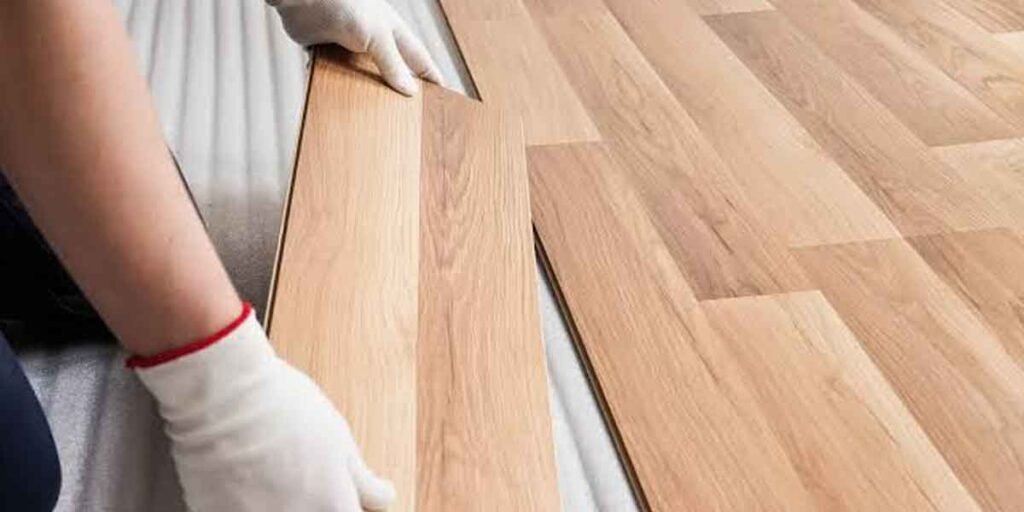
An 8 mm plank rated AC3 covers most family homes. Thickness and wear rating settle almost everything else, and plenty of laminate flooring buyers overspend on the pattern instead.
Sales language on the carton is generous with two words: waterproof, and commercial grade. Both mean something narrower than they sound, and the specifications that decide how the floor behaves in year five are printed in small type on the end of the box.
Start there.
Thickness and Wear Rating Decide Most of the Outcome
Thickness controls how solid the floor feels and how well the click joint holds. The wear rating controls how long the surface survives. For most homes, 8 mm with an AC3 or AC4 wear layer is where quality stops climbing faster than price.
The core is high-density fiberboard, and density is the hardest thing to check in a showroom. A dense core holds the click profile after the tenth time someone drags a dining chair across it. A soft core crushes the tongue, and the seam opens.
Laminate flooring planks in this category run from about 6 mm to 12 mm. The 6 mm and 7 mm boards show up in budget cartons and rentals, and they show their limits on any floor with bounce in it. An 8 mm board is the workhorse. Plan 10 mm and 12 mm for rooms where the floor should read as wood underfoot, and expect to pay for the extra depth.
Wear layers are graded AC1 through AC5 under the European standard EN 13329, the same document that sets the abrasion and impact tests. AC3 is the common residential floor for a household of adults. AC4 is sold for hallways, kitchens, and homes with pets. Nothing about the decor print makes up for a thin wear layer.
A plank with an attached pad removes a separate underlayment purchase and takes the hollow click out of the sound. It also adds height, roughly 2 mm on many products, which matters when the new floor has to clear a door you would rather not cut.
Density is invisible in a store.
The cheapest carton in the aisle and the most expensive one can be the same fiberboard under different paper. Money shows up in four places:
- A denser core that holds its thickness through humidity swings in an unconditioned room.
- A thicker wear layer that keeps the print under it from going cloudy in the traffic lane.
- A locking profile that stays under tension, so planks stop working apart and needing a tap back into line.
- An attached pad, which removes one purchase and an hour of work.
Two questions at the counter separate the tiers faster than the price tag does. What is the core made of, and what does the warranty exclude? Warranties on laminate flooring routinely exclude moisture damage and installation over an uneven subfloor, which tells you what the manufacturer expects to go wrong. Ask one more thing before you commit to a large order: whether the sample you carried home came from the same production run as the stock the store will sell you, and how a dye-lot mismatch gets handled after the planks are cut.
Third-party certification shortcuts the whole question. The NALFA Certification Seal, issued by the North American Laminate Flooring Association, an ANSI-accredited standards developer, means an independent lab put the board through ten performance tests: static load, thickness swell, light resistance, cleanability and stain resistance, large ball and small ball impact, surface wear, dimensional tolerance, caster chair resistance, and surface bond. A carton with that seal has answered the durability question before you open it.
Where a Waterproof Label Stops Being Useful
Waterproof laminate flooring keeps standing water out of the core for a stated window, usually hours rather than days. It does not seal the seams, and it does not license wet mopping, a leaking dishwasher, or a basement that takes on water twice a year.
That window is shorter than most shoppers assume.
Every plank has a water-resistant top layer, so the argument is never about the surface. It is about the core. A fiberboard core swells once water reaches it through a seam, and a swollen core does not go back down. Waterproof versions swap that core for a mineral or polymer composite that will not take on water, and that difference is real.
Two installation details decide whether the promise holds. The expansion gap at every wall, usually about 8 to 10 mm, lets the floor move without buckling, and pinching that gap is the most common reason a floating floor peaks in the middle of a room. A bead of perimeter sealant in a kitchen or laundry room keeps mop water and a dog bowl from reaching the same seam twice a week.
Pets are the case where a waterproof core earns its price. Dog nails scratch a wear layer, but the failure that ends a floor is urine reaching the core at a seam before anyone notices the smell. A mineral-core plank rated AC4 is the version to buy for a puppy, and it is not the cheapest one on the pallet.
Laminate is the wrong floor for a room with a floor drain, a known groundwater problem, or a washing machine that has already overflowed once. Waterproof covers spills you wipe up. It does not cover water that sits against a joint overnight. If a basement has taken on water before, that moisture belongs to a drainage contractor before it belongs to any flooring budget.
Some limits are not about the floor at all, and they mark where a homeowner should stop:
- In a home built before the 1980s, do not pull up old sheet flooring or the adhesive under it yourself. Layers from that era can contain asbestos, and a licensed abatement contractor tests and removes it. Installing over an intact substrate is the usual answer.
- If a slab or crawlspace smells damp, tests wet, or shows mold, fix the water source first. A moisture reading above the limit the underlayment maker publishes means the carton stays closed.
- If the subfloor is out of flat by more than the manufacturer allows over a few feet, it needs a leveling compound or a new substrate. Thick underlayment does not bury a hump.
- Once the work reaches stair framing, railings, in-floor heat wiring, or a gas appliance, it belongs to a licensed tradesperson. Those carry permits and safety exposure.
One more reason the cheapest board can smell different in a closed room. Cores are bound with either melamine-formaldehyde or urea-formaldehyde resin, and the melamine bond holds the formaldehyde more tightly, which is why LEED v2.2 credit EQ 4.4 rules out urea-formaldehyde cores while allowing melamine. That is a material specification to check on a spec sheet, not a health verdict about any one product.
Grey, Oak, and White Oak Laminate Flooring: Matching the Look to the Room
Color and texture do not change how long a floor lasts, and they decide whether you still like it in year three. Grey laminate flooring pulls blue in a north-facing room with little daylight and reads beige under warm bulbs, so a sample belongs in your room rather than in the store.
Width beats print.
Oak laminate flooring splits by species story. White oak runs pale and slightly grey, which is why white oak laminate flooring makes a small room read larger and cooler. Red oak carries a warm orange cast that fights espresso or walnut cabinets, and a pale plank separates those two surfaces where a warm one muddies both.
Plank width does more for a room than the pattern does. A 7-inch to 8-inch plank in a small bedroom reads as fewer, wider boards and quiets the pattern. That same plank in a narrow hallway turns the joints into a grid. Planks running the length of a hallway stretch it; running them across the width chops it into segments.
Edges and finish are the last two decisions, and both show up at cleaning time. A beveled edge imitates real hardwood and collects dust in the groove. A square edge looks flatter and wipes clean in one pass. A medium-gloss finish bounces more light and shows scratches sooner than a matte or embossed surface does.
What Drives the Price, and Which Costs You Should Not Cut
Plank price is the smallest variable in the job. Discount-channel listings for 12 mm waterproof laminate with an attached pad ran between about $2.12 and $2.40 a square foot across several Mohawk and Pergo collections. Trim, underlayment, and labor around that carton usually cost more than the carton.
Working out the laminate flooring cost for one room means pricing five things besides the planks: an underlayment or an attached-pad upgrade, trim and transitions, a moisture barrier if the floor goes over concrete, the baseboard or shoe molding you refit, and waste. Buy 5 to 10 percent extra for cuts and keep one unopened carton for repairs.
The place never to save is the wear layer. A thin board in a hallway looks fine for a year, then goes dull in the traffic lane, and laminate cannot be sanded back to life the way hardwood can. The print sits under the wear layer, not through it.
Installation is a weekend for a rectangular room, and two weekends once door jambs, offsets, and a leveling pass enter the picture. A professional carries the undercut saw that tucks planks beneath door casings, and the leveling tools that keep a hump out of the finished floor. That is what the labor line buys.
A plank that stays flat for a decade owes more to a dry, level subfloor and the expansion gap you left at the wall than to the name on the carton.
Frequently Asked Questions
What is the disadvantage of laminate flooring?
The main disadvantage of laminate flooring is that a swollen core cannot be repaired. Water that reaches a fiberboard core through a seam leaves the plank permanently raised, and the run usually has to come out. Laminate also sounds hollow over a concrete slab, and it cannot be refinished.
Is laminate better than vinyl?
Neither floor wins on every count. Vinyl tolerates standing water, feels softer underfoot, and quiets a room better. Laminate holds a sharper wood print for the money and holds its shape through the heat that makes vinyl planks in a sunroom gap at the ends.
How much does 1,000 square feet of laminate flooring cost?
One thousand square feet of mid-range plank material runs roughly $2,100 to $2,400 at the discount-channel prices above, before underlayment, trim, transitions, and labor. Add 5 to 10 percent for waste, and price installation separately, since most installers quote by the square foot with a minimum charge.
What is laminate flooring called now?
Laminate flooring still goes by that name. Some U.S. listings use the older phrase floating wood tile, and the hybrid or rigid-core floors on the same aisle are vinyl products rather than laminate. The core description on the carton is what separates them.
