An interior painting estimate is four inputs and one total. The inputs are the wall area to be coated, the coats the surface needs, the preparation those walls demand, and the work the price includes. The total is arithmetic, and it is the easiest part of the page to argue about.
Two quotes for the same bedroom can land $600 apart while both painters tell you the truth. They measured different surfaces, counted different coats, or folded different tasks into one line.
The four inputs an interior painting estimate is built from
Wall area, coats, preparation, and inclusions decide nearly all of a painting price. Paint itself is the smallest line on the page, and it is the one homeowners ask about first.
Homewyse’s May 2026 room example prices a 120-square-foot room at $507 to $983 depending on the options selected. Inside that total, the paint for walls and trim comes to $113 to $153, supplies $7 to $8, an optional prime adds $83 to $177, and the basic labor line covers 7.3 hours of prep, two coats, caulking, and cleanup. The hours carry the number. The paint is a rounding error next to them.
- Surface area: the square footage actually coated, counted per surface, not per floor plan.
- Coats: one over a matching color, two as the working standard, three when a dark wall has to go light.
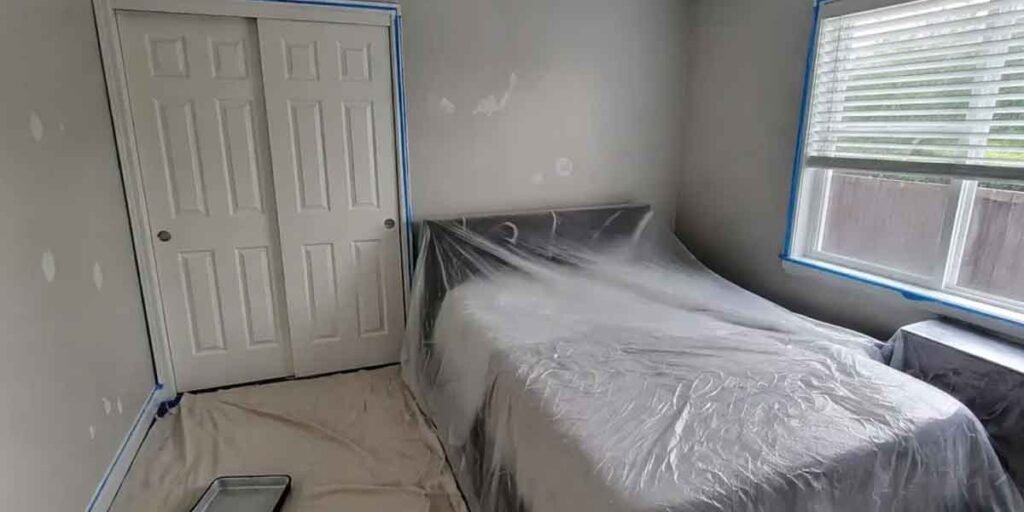
- Preparation: patching, sanding, caulking, masking, and protecting floors and furniture.
- Inclusions: ceilings, trim, doors, closets, and who supplies the paint.
A painter who hands you one number without naming those four is not hiding something. The trade calls the whole bundle interior painting, and the estimate has to call each part by name before it can be compared with anything.
Floor square feet and wall square feet are not the same number
A 12-by-12 room holds 144 square feet of floor and roughly 330 square feet of paintable wall once the perimeter, the ceiling height, and the openings are counted. The two figures differ by more than double, and quotes get written in both units.
Here is the arithmetic a painter does in their head. A 12-by-12 room has a 48-foot perimeter, and at an 8-foot ceiling that gives 384 square feet of wall before anything is subtracted. Take out a door and two windows, about 50 square feet, and the paintable surface lands near 330.
A rate of $3 per square foot is a bargain applied to the walls and a costly afternoon applied to the floor. Neither painter has to be wrong for the two quotes to disagree.
| How the quote is written | What the rate prices | Rough total for a 12-by-12 room |
|---|---|---|
| $3 per square foot | 144 square feet of floor area | About $430 |
| $1.60 per square foot (an example rate) | 330 square feet of wall surface | About $530 |
| Flat price, walls only | No unit stated | Not comparable until the inclusion list arrives |
One question settles it: which surface does the rate price? That answer does more for the comparison than any per-foot figure standing alone.
Preparation moves the number more than paint quality does
Preparation hours are the largest variable a painter cannot judge from the doorway, and the line most often shaved in a cheap quote. A walkthrough estimate assumes ordinary walls.
Homewyse publishes its assumptions on the same page as the price: basic labor covers cleaning, scraping, sanding, and patching up to four defects per 100 square feet, then two coats. Those are average conditions. Loose plaster, water staining, wallpaper residue, or a wall full of picture hooks turns into a change order, and the owner who never raised that possibility is the one who pays for it.
Coats follow the same logic. Two coats is the working standard because most color changes need both. One coat belongs on a same-color refresh over a clean wall. A third coat shows up over deep reds, saturated blues, and any strong pigment that refuses to disappear under lighter paint.
Paint volume is the simple part once the wall area is real. Coverage runs about 350 square feet per gallon per coat, so the 330-square-foot room above needs two gallons for two coats, rounded up. Procured’s contractor calculator works exactly that way, and so does every painter ordering at the counter.
The condition that stops a repaint: lead paint in a pre-1978 home
Disturbing painted surfaces in housing built before 1978 brings the EPA’s Renovation, Repair and Painting Rule onto the job. The firm has to be lead-safe certified, and a certified renovator has to run the lead-safe practices, including cleaning verification and three years of records.
Federal law banned consumer sales of lead paint in 1978, and a large share of older housing still carries it beneath later coats. The rule follows firms paid to disturb those surfaces, whether the crew is painting, hanging drywall, or replacing windows. Firms recertify every five years, and each renovator holds a certificate from an accredited training course.
Two boundaries matter when you own the place. Minor repair and maintenance that disturbs less than 6 square feet of interior paint per room falls outside the rule, so patching around a doorknob is not a certification event. An owner working on a home they live in is generally outside the rule as well, and that changes the moment the property is rented out, used for child care, or bought to resell.
Where a wall is peeling, crumbling, or shedding dust in a home of that age, the answer is a lead test and a certified firm. No estimate is worth comparing until that question is answered.
Labor carries the total, not the paint
The Bureau of Labor Statistics puts the median annual wage for painters in construction and maintenance at $48,660 as of May 2024, with the top tenth above $76,550 and the bottom tenth below $36,680. That wage sits under every honest labor rate quoted by the square foot.
Work it backward for the 330-square-foot room: two coats, masking, cutting in, cleanup, one person for most of a day. Even at the low end of that wage distribution the hours alone run into the hundreds before overhead, insurance, and drive time. A quote that undercuts the floor by half has to recover the difference somewhere, and the usual places are coats, preparation, and promises made at the walkthrough.
Paint quality is where the money is not. A premium gallon costs perhaps twice a budget gallon, which on a two-gallon room is tens of dollars set against hundreds in labor.
Comparing interior painting estimates line by line
Compare two interior painting estimates in a fixed order: area basis first, coats second, preparation clause third, inclusion list last. A total missing those four items is a conversation rather than a quote.
Five questions do the work while the painter is still in the room:
- Does your rate price floor area or wall surface?
- How many coats sit inside the quoted total?
- Are ceilings, trim, doors, and closets included?
- What happens if the walls need more patching than the walkthrough showed?
- Who moves and covers the furniture, and who supplies the paint?
Bring your own figures to that conversation. An interior painting cost calculator that asks for wall area, coats, and preparation produces a number you can hold beside every quote you collect, so the comparison begins with measurements you made instead of whichever total arrived first.
Frequently asked questions
How much should an interior painting estimate run for a 2,000-square-foot house?
A whole interior generally lands in the low thousands, and published national figures disagree because they price different scopes. Thumbtack’s cost page reports a range of roughly $605 to $2,464 for interior house painters with most projects near $1,200. Homewyse’s per-room model starts near $4.22 per square foot for basic work, and that rate is high because a minimum labor charge lands on a small room; the same rate applied across 2,000 square feet would overstate the work, since the minimum spreads across far more surface.
How much do interior painters usually charge?
Most painters price by the project or by the square foot of surface, and the labor behind that price tracks a national median wage of $48,660 a year for painters in construction and maintenance as of May 2024, according to the Bureau of Labor Statistics. A rate that implies far less per painter usually means fewer coats, lighter preparation, or a scope that grows after the first day.
How much do painters charge to paint a 12-by-12 room?
Homewyse’s May 2026 example puts a 120-square-foot room at $507 to $983 for basic work, and a 12-by-12 room holds 144 square feet of floor. Whether the ceiling, the trim, and the doors sit inside that number explains why two quotes for the same room can look several hundred dollars apart.
How much paint does a 1,500-square-foot house interior need?
Paint is bought against wall area, so the floor plan does not answer the question. Multiply the measured wall surface by the number of coats, divide by 350 square feet per gallon, and round up to the next full gallon. A 1,500-square-foot home needs a wall measurement before anyone can name a gallon count with confidence.
Treat every figure in a quote as a planning number. Local labor rates, permit fees, and paint prices move it, and conditions found behind the wall change the scope. A peeling surface in a home of that age is a licensed assessment and remediation question, not a repainting question.
None of this calls for a second opinion or a spreadsheet. It calls for the surface being priced, the coats, the preparation clause, and the inclusion list to appear in writing on the page you were handed, and for you to file that page next to the next quote that arrives. A total without those four lines is not yet an estimate.
