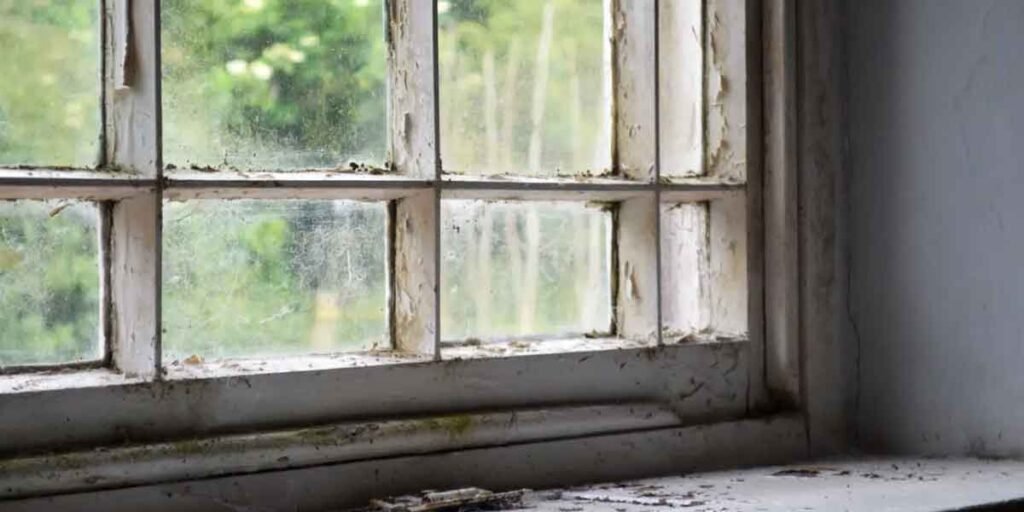
Keep the opening if the frame is sound and the wall is straight. Choosing energy-efficient windows in older homes starts with that frame decision, and it moves the budget more than any glass package on a quote.
Most older houses can take modern glazing without losing the trim that was milled to match the rest of the interior, which is why the frame question comes before the glass question. The houses that cannot usually announce it at the sill.
Repair and replacement get mixed up constantly, and they are not the same purchase.
Read the frame before reading anything else. Grey powder that reappears on the sill every week, a stripe of bare wood where the sash drags, a sill gone soft at the corner joint: each of those points to a different path. A sash that leaks around the meeting rail is wearing out even when the glass inside it is fine.
Measure the opening before you price glass
Three options fit an existing opening, and wall depth alone rules one of them out. Sash kits reuse the frame, pocket replacements slide inside it, full-frame units replace it. Measure the rough opening and the wall thickness before anyone quotes a number.
The measurement that matters is not the glass size. It is the depth from the interior face of the jamb out to the exterior trim, plus how far the opening has drifted from square. A quarter inch of out-of-square is workable in most homes.
Half an inch is not.
Sash kits
A sash kit replaces the moving parts and leaves the jamb, casing and sill in place. You keep the original trim profile, which matters in a house where the casing was milled to match the baseboard, and you give up less daylight than with any other route.
It works only while the jamb is solid and the sill has not rotted. A kit also keeps the original opening size, so a window that met the escape requirement still meets it afterward.
Pocket replacements
A pocket replacement slides a complete new window inside the existing jamb and covers the gap with stops and a frame. Installers call it an insert. It is the fastest path and the cheapest per opening, and published energy efficient windows cost ranges make sense only once you know which of the three paths you are pricing.
The cost of that speed is glass area. The new sash has to fit inside the old jamb, so a wide original sash shrinks inward by an inch or more on each side, and in a house with deep plaster returns the new unit can sit oddly far back in the opening.
Full-frame units
A full-frame unit removes the jamb as well and installs a window with its own frame and nailing fin. You get the whole opening back, a frame that is straight by construction, and the freedom to change size or position. You also open the wall, which brings flashing, interior patching, exterior trim work and the permits that go with them.
In an older house this is the path when the sill has rotted, when the rough opening has moved, or when the window is too small for the escape requirement the space has to meet.
What an old wall changes about the numbers
Old walls fight new windows in three places: depth, square and weight. Depth costs you glass, square forces a full-frame job, and weight decides whether the hardware you install will still work in five years.
Wall depth is where the arithmetic turns. A 2×4 exterior wall with lath and plaster runs about five to six inches deep, and an insert with its own frame and interior stop eats into that depth at the perimeter. The glass ends up smaller than the sash you pulled out, and the room gets a little darker in a way nobody predicts from a brochure.
Why does that matter beyond light? Because a bedroom with a single window can lose enough clear opening to fall short of the escape minimum, and the local building department measures the finished window, not the original one.
Weight is the second constraint. A tall pre-war double hung sash can weigh far more than the vinyl unit that replaces it, and thin balances or tired chains will not hold a heavy sash in place. If the plan keeps the existing sash, rebuild the balance system at the same time instead of waiting for the sash to drop.
Exterior storm windows complicate the arithmetic further. A storm left in place over a new low-e unit traps air and moisture between two panes, and the condensation then shows up on the interior face of the storm rather than on the new glass. Keep storms that vent through their own weep openings, and consider removing or replacing sealed ones.
What energy-efficient windows actually change
A single pane of glass insulates about as well as a closed screen. Moving an opening to two panes, a low-e coating and an inert gas fill is a real gain in comfort, and it shows up in the heating bill more slowly than most buyers expect.
Two figures are worth keeping straight. The U.S. Department of Energy has long put the share of residential heating and cooling energy that moves through windows at roughly 25 to 30 percent, and ENERGY STAR estimates that replacing single-pane windows with certified units lowers the average household bill by up to about 13 percent. Both are national, whole-house averages, not a forecast for one living room in one climate.
Where the house leaks often matters as much as what the glass does. Air moving through an unsealed attic hatch or a rim joist in the basement can outweigh the difference between a U-factor of 0.30 and one of 0.25, and no window sticker changes that.
The NFRC label carries four numbers worth reading: U-factor, solar heat gain coefficient, visible transmittance and air leakage. Cold regions reward the lowest U-factor you can buy. In a hot, sunny climate the solar heat gain coefficient does more of the work, and a very low number will noticeably darken the room.
Lead paint changes the plan
In a home built before 1978, disturbing painted surfaces can create lead dust, and the federal Renovation, Repair and Painting Rule applies to anyone paid to do that work. It generally does not cover owners working on their own home, with exceptions that catch landlords and flippers.
The EPA banned lead-based paint for residential use in 1978 and states that about three-quarters of pre-1978 homes still contain some of it. Window sills and doors sit in the highest-risk group because they are friction surfaces, where paint wears into dust with every open and close.
Anyone you pay to disturb paint in a pre-1978 home must be certified and trained in lead-safe work practices, and the certification belongs to the firm. The rule generally does not apply to a homeowner renovating a house they live in, but it does apply if you rent out part of the house, run a childcare there, or buy, renovate and sell homes for profit.
Dry scraping or power sanding a window jamb is where a homeowner should stop and hand the work over. Lead-safe practice relies on wet methods, plastic containment and HEPA cleanup, and doing it by hand without those controls spreads dust through the house instead of onto a drop cloth.
Bring in a certified renovator when you find failing paint on friction surfaces, when a window has been painted shut and needs prying, or when children under six live in or visit the home regularly. Those are conditions where the cheap route and the safe route stop being the same route.
Where a retrofit fails in year three
Most replacement windows that disappoint their owners fail at drainage and seal details rather than at the glass. Clogged weep holes, exterior sealant that has pulled away from the sill, and hardware nobody lubricated account for a large share of the complaints.
Weep holes sit at the bottom of the exterior frame and drain whatever gets behind the sash. Paint, pollen and careless caulk close them. Once they close, water stands in the sill channel, and the first sign is usually a stain on the interior stool rather than a leak you can watch. Sealant is a wear item, not a permanent joint. Exterior caulk lines need a look every year or two, and the joint that opens first tends to be where the sill meets brick or siding, because that is the joint that moves most with temperature.
By the third winter the new sash still slides, the glass is still clear, and the paint on the bottom rail has gone dull. After a hard rain the exterior sill channel holds a thin film of water that takes an afternoon to dry. Nothing looks broken.
Glazing putty ages on the same schedule. Where putty has cracked away from the glass, water reaches the joint and softens the wood behind it, which is how a repairable sash becomes a full-frame job.
Signals that decide repair or replacement
Repair wins while the frame is solid and the fault sits in the moving parts. Replacement wins once the frame has failed, the opening has moved, or the space cannot meet its escape requirement. The signals below separate the two, and the pattern matters more than any single item.
| What you see | What it usually means | What it calls for |
|---|---|---|
| Sash drags and wears the paint at one corner | The jamb has moved or the sash has warped | Measure square; expect a full-frame unit |
| Grey powder on the sill every week | Friction on paint in a pre-1978 home, or wood drying out | Test for lead before any sanding |
| Sill soft at the corner joint | Water has been entering for years | Full-frame replacement |
| Condensation on the interior glass every cold morning | Indoor humidity, or a failed seal | Check ventilation and the seal before ordering |
| Cracked glass, sound frame | Impact or thermal stress | Replace the sash or the glass unit only |
| One window in the room, below the escape minimum | The finished opening cannot serve as an escape | Resize it, or add another opening |
Choosing energy-efficient windows in older homes, room by room
Glass choices follow the space, not the catalogue. Bedrooms need an opening a person can actually climb through and safety glazing where glass sits near the floor, bathrooms need privacy glass and working ventilation, and west-facing rooms need solar control more than the lowest U-factor available.
For an escape window, the usual code figures are roughly 5.7 square feet of clear opening, about 20 inches wide by 24 inches high, with the sill no more than 44 inches above the floor. Adopted editions differ, so confirm the numbers with the local building department before ordering anything, and remember that an insert reduces the clear opening it is measured against.
Safety glazing is the other rule that catches older houses, because the requirement follows the glass position rather than the house age. Any pane within roughly 18 inches of the floor usually has to be tempered or laminated, and a window beside a door or a tub falls in the same group. Address that on the quote, or the inspection finds it later.
Bathrooms want a different trade. A low solar heat gain coefficient matters less than privacy glass and a window that opens, because steam and humidity need somewhere to go, and a sealed unit with no ventilation puts the moisture into the walls instead.
Sun orientation sets the rest. South and west elevations carry the strongest afternoon load, so solar-control low-e earns its place there, while a north-facing window in a cold climate gets more value from the lowest U-factor and a warm-edge spacer. If the house is a rental or sits in a condo building, check the rules on exterior appearance first: matching the other units can decide the frame color and the visible glass before you ever reach performance.
Where a door is part of the same project, the logic carries over with less room to maneuver. An exterior door carries the same NFRC rating, a glass door loses heat faster than a solid one, and the weatherstripping and threshold do more for a drafty entry than a marginal difference in the door’s U-factor.
Questions that come up before ordering
Is there a federal tax credit for energy-efficient windows in 2026?
No. The federal credit for windows and skylights covered products purchased and installed between January 1, 2023 and December 31, 2025, and ENERGY STAR states that window has closed. Utility and state rebate programs still run, so check those before ordering, and do not build a budget from articles that still quote the old 30 percent figure.
What type of window is most energy-efficient?
A fixed picture window, because it never opens and holds a permanent seal. Among windows that operate, casement and awning units compress against the frame when they lock and leak less air than a double hung sash.
Do replacement windows fit an existing rough opening?
Pocket replacements are built to sit inside the old jamb, so they fit by design and shrink the glass instead. Full-frame units need the opening measured first, and often squared, because they carry their own frame and fin.
Can I keep the old frames and replace only the glass?
Yes, while the jamb and sill are sound. Sash kits and glass-only units cost the least and preserve the original trim profile. They do nothing for a frame that has already rotted or an opening that has moved.
Who sells the most energy-efficient windows?
No single seller holds that title, because efficiency belongs to a specific assembly rather than a brand. The NFRC label on the unit you are buying tells you more than any ranking of manufacturers.
Do I need a certified contractor for lead paint?
If someone is paid to disturb paint in a pre-1978 home, their firm must be certified and the work must follow lead-safe practices. Owner-occupied do-it-yourself work is generally exempt, with exceptions for rentals, home childcare and resale.
