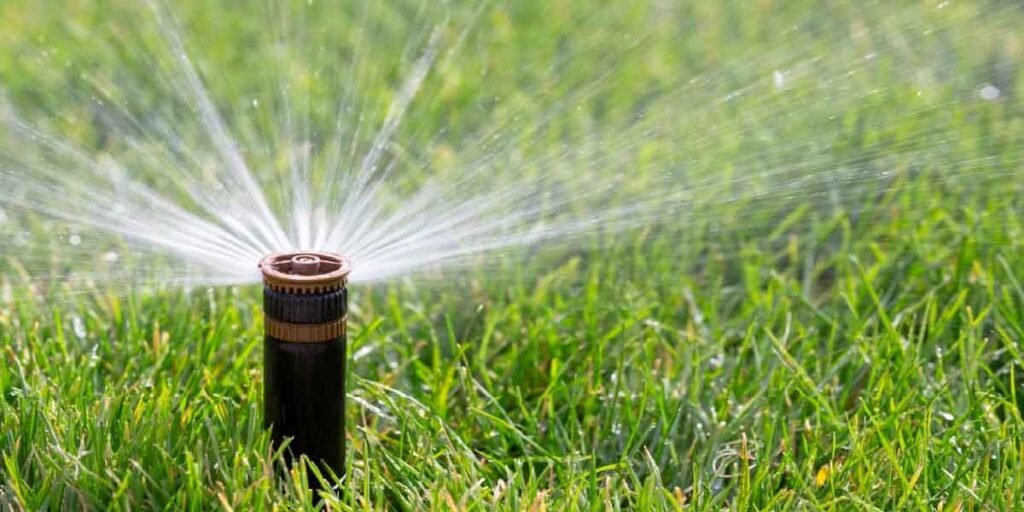
Four families cover nearly every yard: surface, sprinkler, microirrigation, and subsurface drip. Which of the types of irrigation systems belongs in yours is settled by soil, slope, wind, and how deep the ground freezes.
The catalog is not the decision.
Water pressure and how fast your soil takes water decide more than any product page does, and both are measurable this weekend with a screwdriver, a hose, and a tuna can.
What the Main Types of Irrigation Systems Actually Do
Surface irrigation moves water across the ground, sprinklers throw it through the air, microirrigation drips it at the root zone, and subsurface drip delivers it below the surface. USGS sorts field methods into three of those families.
Those three categories map onto the four types of irrigation systems a homeowner buys, because microirrigation splits into tubing laid on top of the soil and tubing buried under it.
Surface irrigation is the oldest family and the rarest in a residential yard. It survives in vegetable rows and in a bed a gardener floods by hand, and it asks for ground that is already level.
Where the Earliest Irrigation Systems Started
Farmers in Mesopotamia and Egypt started diverting water from the Tigris, the Euphrates, and the Nile around 6000 BC, carrying it through small channels onto fields that rainfall alone could not support. Molle, Avellà Reus and Sanchis Ibor trace that history in their 2019 book Irrigation in the Mediterranean, and it is the reason surface methods are still called gravity systems.
Cambridge geoarchaeology puts the oldest canal evidence at a Euphrates floodplain site dated roughly 7500 years before present, and lower Euphrates research places early irrigation experiments in the Halaf period, 6000 to 5100 BC. A 2025 sediment study at the Sumerian city of Lagash argues that residents used twice-daily tides to water crops before cities existed, a claim other archaeologists have publicly disputed.
Gravity systems still cover most of the world’s irrigated land. The ICID compilation behind FAO data puts surface irrigation at 91.9 percent of 239 million hectares, sprinkler at 5 percent, and drip at 1.6 percent. The United States runs the other way: USDA survey data shows sprinkler systems on about 49 percent of irrigated farmland, with micro-irrigation rising from 7 to 12 percent between 2008 and 2023.
Modern hardware did not change the underlying question. Water still has to enter the soil at a rate the soil will accept, and a canal gate in 3000 BC and a pressure-compensating emitter today answer the same constraint.
Sprinklers Still Own the Lawn
Turf is the one surface where throwing water into the air makes sense, because grass roots run shallow and even coverage matters more than precision. Fixed spray heads, rotors, and multi-stream rotator nozzles are the three common head types, and they differ mainly in how fast they apply water.
Fixed sprays pour water on faster than rotors do. On a lawn with deep loam that is harmless. On clay it is the beginning of a runoff problem, and the honest fix is programming rather than new hardware. EPA WaterSense rates labeled spray sprinkler bodies for up to 5,600 gallons saved a year where supply pressure runs high.
Microirrigation Puts Water at the Root Zone
Microirrigation covers drip tubing, drip tape, and soaker hose, all of which wet a narrow band of soil instead of an entire bed. EPA WaterSense puts microirrigation at 20 to 50 percent less water than conventional spray systems.
Soaker hose is the cheap end of that family and it behaves like it. The perforations are not precise, the downhill half of a sloped run drinks more than the uphill half, and minerals close the pores within a season or two, which is how UC ANR describes the product in its own irrigation guide.
Subsurface Drip Hides the Whole System
Subsurface drip buries the tubing under mulch or turf, so nothing sits in the sun or in the path of a string trimmer. It also hides leaks, clogged emitters, and rodent damage until a dry patch shows up, and a repair means digging.
UC ANR assigns potential efficiency to each of the types of irrigation systems a yard might use: 80 to 95 percent for drip and subsurface drip, 70 to 85 percent for solid-set sprinklers, and 45 to 65 percent for conventional furrow. Potential ranges assume good design and steady maintenance. Field checks regularly find real systems below the range, mostly because of clogging and slow leaks.
| Family | Best fit | Efficiency |
|---|---|---|
| Surface | Vegetable rows, level beds | 45-65% |
| Sprinkler | Lawns and open turf | 70-85% |
| Drip (micro) | Beds, containers, slopes | 80-95% |
| Subsurface drip | Lawns, permanent rows | 80-95% |
Failure looks different in each family. Uneven ground and a sealed surface defeat surface irrigation, wind and tilted heads cut sprinkler coverage, emitters clog or tubing gets cut in a drip zone, and buried tubing hides root and rodent damage until a dry patch appears.
Match the System to Soil, Slope, and Wind
Soil infiltration decides which family can keep up. Texas A&M AgriLife puts clay at 0.04 to 0.2 inches of water absorbed per hour, loam at 0.2 to 0.4, and sand above 0.8.
Dig a hole a foot deep, fill it with water, and time how long the water takes to vanish. A hole that still holds water after an hour is clay, and that is the whole test.
Why does a zone that muds the bottom of a slope leave the top dry? Water applied faster than the soil can absorb it runs downhill instead of soaking in. Drip answers that with a slow application rate, which is why slopes and windy sites end up on microirrigation while flat, sheltered ground usually gets a spray zone.
Wind is the second filter. Spray thrown into moving air lands off target, and the mist that never reaches the ground is water the meter already counted. Drip does not care. Sites that are both windy and sloped get microirrigation for two independent reasons.
Clay also punishes long runtimes, and cycle-and-soak is the standard answer. Texas A&M AgriLife recommends splitting a zone’s runtime into two to four shorter cycles with 30 to 60 minutes of soak time between them, and heavy clay needs the longer end of that range.
Texas A&M AgriLife also estimates that runoff wastes 30 to 40 percent of the water a system applies when zones run too long.
The first cycle darkens the top inch and stops. Water sits there for half an hour. Then the second cycle goes in, and a zone that puddled on Monday is dry six inches down by Wednesday.
Pressure, Flow, and Zone Limits Decide the Layout
A residential service delivers more pressure than any drip zone wants, so drip runs through a pressure regulator at the valve. Zone capacity is the constraint most homeowners miss, and UC ANR publishes the working numbers.
- Half-inch or five-eighths-inch drip tubing should not run longer than 400 feet on one valve.
- A single zone should not carry more than 200 one-gallon-per-hour emitters.
- Spaghetti tubing, the eighth- or quarter-inch kind, should stay under 8 feet.
Sizing starts with water volume rather than hardware. Iowa State University Extension puts one inch of water over one square foot at 0.623 gallons, and most lawns want about an inch a week, so 1,000 square feet of turf takes roughly 620 gallons a week and about 12,000 gallons across a 20-week season.
Compare that figure with the flow your meter can supply and you get the number of zones the yard needs.
Skip the arithmetic and the symptom is pressure collapse: zones that ran fine one at a time stop reaching the far heads when two run together.
Backflow Protection and the Work That Should Not Be DIY
The International Residential Code requires approved backflow protection wherever a lawn irrigation system connects to drinking water. Section P2902.5.3 allows three devices: an atmospheric vacuum breaker, a pressure vacuum breaker, or a reduced pressure assembly.
Device choice follows the hazard. An atmospheric vacuum breaker is the cheapest of the three and it cannot have a valve downstream of it, which is one of the most common inspection failures on residential systems. Any system that injects fertilizer or pesticide has to use a reduced pressure assembly instead, and that rule exists because a hose left in a bucket of fertilizer is enough to pull chemicals into household plumbing.
Local water utilities add their own layer on top.
Yakima, Washington accepts only double-check and reduced pressure assemblies for domestic irrigation, North Carolina requires a separate irrigation meter on new in-ground systems, and many utilities require annual testing by a state-certified tester.
EPA water-security material cites the American Backflow Prevention Association’s 1999 survey, in which irrigation was the most frequently reported source of cross-connections. That finding is about yards like the one outside your window, not about industrial sites.
Draw the line in these places:
- Backflow assembly installation and annual testing: certified tester or licensed plumber.
- Any chemical injection, fertigation, or fertilizer tank tied into the line.
- Controller power wiring, pump relays, and 240-volt pump circuits: licensed electrician.
- Cutting into the main service line or adding a tap: licensed plumber, plus utility approval.
- Anything buried: call 811 before the shovel goes in.
Freeze Damage, Maintenance, and What Breaks First
Water expands by about one-eleventh when it freezes, which is enough to split pipe, crack valves, and open pump cases, according to Colorado State University Extension. Winterization protects more of the system than any component choice does.
The blowout has hard limits. Colorado State puts air pressure ceilings at 50 psi for polyethylene and 80 psi for rigid PVC, while Toro and K-Rain both cap the job at 50 psi with the compressor regulated. Compressed air should never pass through the backflow assembly, because the rubber seals inside a pressure vacuum breaker or a reduced pressure device can be damaged by the heat of the air.
I skipped the far zone one fall because the compressor was running hot and I wanted to be finished. That valve cracked over the winter, and I found it in April by the geyser coming up beside the sidewalk.
Repairs follow a predictable order.
Nozzles and emitters clog first, valve diaphragms fail next, and buried pipe outlasts both. Soaker hose is the exception, and UC ANR notes that some of it survives only a season or two before mineral deposits close the pores.
Flow sensors and smart controllers shorten the worst failure, which is a break you cannot see. A sensor that trips on an abnormal zone reading finds a leak in minutes rather than at the next water bill.
Controllers: Where the Water Savings Come From
EPA WaterSense reports that swapping a standard clock timer for a labeled irrigation controller saves an average household nearly 8,800 gallons a year, and weather-based control trims about 20 percent against a fixed schedule.
Irrigation is where much of that loss hides. EPA estimates that as much as half of the water used for irrigation is lost to evaporation, wind, or runoff, and a single broken or missing head can waste up to 25,000 gallons in one season.
A controller is to a yard what a thermostat is to a furnace.
The same shift shows up in smart ac technology new innovations changing home cooling, where sensors and weather data replaced a schedule somebody set once and forgot.
Automation alone does not save water. EPA notes that homes with automatic irrigation systems use about 50 percent more water outdoors than homes without them, which points at scheduling rather than hardware, and that is the argument for a controller that reacts to rain and soil moisture instead of a timer that cannot.
Frequently Asked Questions
What are the four types of irrigation systems?
Surface, sprinkler, microirrigation, and subsurface drip. USGS sorts field methods into surface, sprinkler, and micro, and subsurface drip belongs to the micro family because it uses the same emitters underground.
What are the five main types of irrigation?
Surface, sprinkler, drip, subsurface drip, and manual watering. Lists that reach five are usually splitting drip into tubing laid on the surface and tubing buried below it, or counting hand watering and hose-end sprinklers as a category of their own.
What is the most efficient type of irrigation system?
Microirrigation and subsurface drip, which UC ANR puts at 80 to 95 percent potential efficiency, against 70 to 85 percent for solid-set sprinklers and 45 to 65 percent for conventional furrow.
What are the different types of home irrigation systems?
Hose-end sprinklers, soaker hoses, drip tubing or drip tape, in-ground spray or rotor zones, and subsurface drip under turf. Controllers, backflow assemblies, and zone valves are shared parts rather than separate system types.
Which irrigation system works on clay soil?
Drip and other low-rate systems, because clay absorbs water at 0.04 to 0.2 inches an hour and most spray heads apply it faster than that. Cycle-and-soak programming lets an overhead zone work on clay anyway.
Fill a hole with water and time how long it takes to disappear. That number decides whether you are buying drip tubing, rotator nozzles, or nothing at all, and it costs one afternoon.
