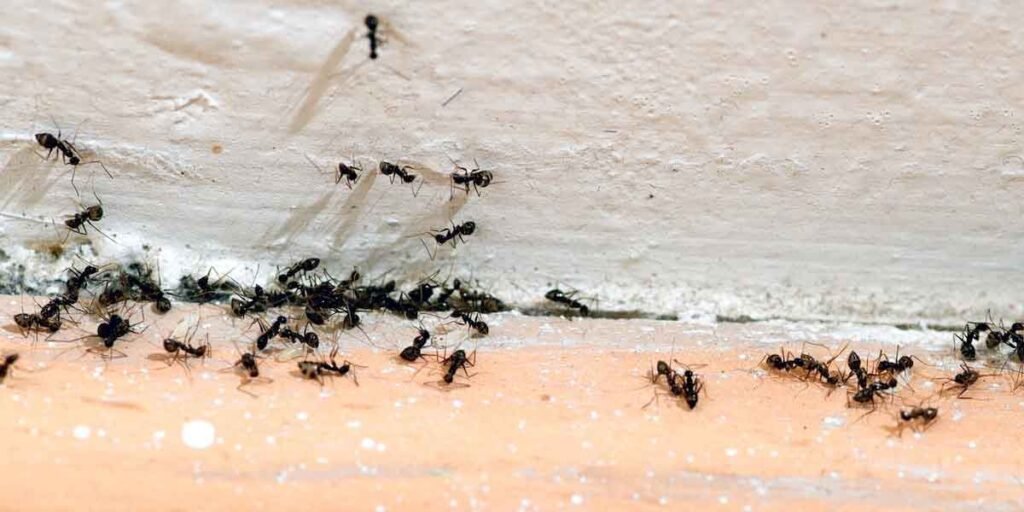
The first reliable sign of ants in the house is a line, not a lone insect: workers following the same route along a baseboard, pipe, or counter edge. One ant means nothing. A trail that reappears in the same spot for two days means a colony has found something it wants.
Spraying comes first in most households, and that order is wrong. A contact spray splits a pharaoh ant colony into several new ones. Spraying around carpenter ants kills the workers in view while the damp wood that invited them in stays damp.
What Counts as a Sign of Ants in the House
Three kinds of evidence matter: live workers on a trail, physical traces such as sawdust piles, shed wings, or grease smears near a void, and the conditions that let them in, usually damp wood or a steady water source. A single ant proves nothing. A pattern that repeats at the same spot is the signal worth acting on.
A worker walking a straight line is navigating by scent. University of Minnesota Extension describes those routes as chemical trails that the colony lays down and reuses, and notes that following carpenter ant workers back to a nest works better after dark.
Ants also follow the building itself. The USDA Agricultural Research Service describes pipes, conduits, and wiring as natural highways that carry them into a structure and along its interior, which is why a trail tends to hug an edge instead of crossing open floor.
Look where the line stops, not where it is busiest. That end point is either food, water, or the gap they came through.
Start with the route.
Why Ants in the House Show Up All at Once
Weather moves these insects indoors far more often than a dirty kitchen does. A Stanford study by biologist Deborah Gordon and her colleagues tracked 69 households for 18 months and found that indoor ant numbers peaked in cold, rainy weather, with a second, smaller peak during hot, dry spells.
Both extremes push in the same direction. Heavy rain floods the shallow nests that many outdoor species build just below the surface, and UC Cooperative Extension describes the result as ants relocating to higher, drier ground, which is often a wall. Hot dry stretches work from the other end, because ants need water and a home is where water is.
Mississippi State University Extension sums up the calendar: activity builds in spring as temperatures rise, holds through summer while colonies hunt water, and climbs again in early fall. A long heat wave or a heavy storm can move that schedule forward by days.
Once a scout finds something worth taking, recruitment is fast. Kansas State University Extension’s household pest guide describes the pheromone trail as a standing invitation that other workers reinforce with every trip, which is why a counter that was clear at bedtime can be busy before breakfast.
In practice, this often means the kitchen was never the problem. The insects arrived because of what happened outside, and the countertop was simply the nearest reliable source of moisture and crumbs. That pile is not clutter.
By the third morning the line has a favorite corner. It turns where the backsplash meets the counter, crosses two feet of tile, and disappears behind the dishwasher. Nothing in the scene has changed except that you now know the route by heart.
What the Ants Look Like Changes the Answer
Size and location narrow the species down quickly. Small, uniform workers on a kitchen counter point to sugar-feeding species that respond well to bait. Large workers of varying size near wood or in a bathroom point to carpenter ants and a moisture problem worth tracing.
Across the household species, workers range from about 1/20 inch to 1/2 inch, according to University of Minnesota Extension, so size narrows the list without settling it. What size cannot tell you is whether the colony sits inside the building or on the other side of the foundation.
Small workers, all the same size
Odorous house ants are the usual suspects. Nebraska Extension’s guide to pavement and odorous ants puts them at roughly an eighth of an inch, dark brown to black, with sparse yellowish hairs. The field test most people know is smell, and it is the one I trust least. In 2015 a study in the journal American Entomologist found that about 80 percent of websites describe the crushed odor as rotten coconut, then asked 143 visitors at North Carolina’s BugFest to smell fresh specimens. Most chose blue cheese. The compound responsible, 6-methyl-5-hepten-2-one, is the same class of chemical that gives blue cheese its bite.
Pavement ants are the other small, dark species that marches into kitchens. Nebraska Extension separates them by build rather than odor: two visible nodes between thorax and abdomen, grooves across the head and thorax, and a stinger that rarely gets used. Crush a pavement ant and nothing distinctive happens.
Their outdoor nest gives them away in summer. Nebraska Extension describes pavement ants nesting under sidewalks, driveways, and slabs, where they push fine soil up through cracks, so a line of fresh dirt piles along a walkway often belongs to the same colony sending workers indoors.
Pharaoh ants are smaller still. Alberta Health Services puts them at about 1.5 millimeters and yellowish, and they are the species where spraying does the most damage. Penn State Extension’s pest-management guidance is blunt: repellent sprays trigger budding, in which part of a colony moves out and starts new nests elsewhere in the building. Bait, placed where workers are already feeding, is what reaches the queens.
Large workers that vary in size
Carpenter ant workers run from about 3/16 to 1/2 inch, and winged queens reach 3/4 inch, according to University of Minnesota Extension. Inside one colony the workers are not the same size, which is the detail worth remembering at the counter.
A common mistake is assuming a mixed trail means two species moved in together. A range of sizes in one line is the signature of a single carpenter ant colony, and it matters because these ants do not eat wood. They excavate it, and they prefer wood that is already wet.
Cornell University’s carpenter ant bulletin calls them an indicator of structural problems for that reason. Texas A&M AgriLife’s school IPM plan puts it more plainly: water-damaged or softened wood is especially conducive to nesting.
Sawdust, Shed Wings, and the Water Behind Them
Coarse sawdust under a baseboard, sill plate, or window trim is carpenter ant frass, which is wood shavings pushed out of a hidden gallery and usually mixed with soil and dead ant parts. The pile is a moisture clue as much as an ant clue, because the wood had to be damp before anything carved into it.
Termites do not leave a dump pile like that, which makes frass one of the few signs that separates the two groups without a microscope. The gallery is the second clue: carpenter ants sand it smooth along the grain and push debris out through small slit-like openings at the surface.
Oddly enough, the tool that settles most of these cases is a moisture meter, not an insecticide. Pest Control Technology’s inspection guidance tells technicians to flag wood where a meter reads above 20 percent. That reading is what turns “there are ants in a wall” into “find the leak.”
Fix the leak and the ants lose their site. Sweep up the frass without finding the water and the pile returns, usually in the same corner within a few weeks.
Flying ants or termites
Winged insects indoors are the one case where a five-second check changes everything. Ant swarmers have a pinched waist, elbowed antennae, and front wings longer than the rear pair. Termite swarmers have a thick straight waist, bead-like antennae, and four wings of equal length that extend well past the body, per Mississippi State University Extension and Kansas State University Extension.
Swarmer season gives that sign a time stamp. Winged reproductives emerge in spring and early summer, and workers never have wings at all. Texas A&M AgriLife treats winged ants seen indoors, particularly in spring, as a strong indication that a colony is nesting somewhere in the structure.
If the insect you caught matches the second list, check the structure before thinking about bait. The 39 subtle signs of termite damage in your walls, floors, and joists are mostly quiet ones, and an inspection covers ground that ant products never touch.
When Ants in the House Need a Professional
Three situations justify calling a licensed pest management professional: carpenter ants with frass or visible water damage, pharaoh ants that scattered after a spray, and any sting reaction that goes past local swelling. A kitchen trail of small sugar-feeding ants rarely needs one.
Ants in the house that stay in one room are usually following a route from outside and never moved in. The pattern that points inward is different: workers on a wall, a floor, and a cabinet in the same day, at all hours, with no obvious outdoor source.
Carpenter ant colonies often nest in wall voids and structural wood that nobody can reach without opening something up. Texas A&M AgriLife notes that finding them can require drilling into wood and wall cavities. Baiting pharaoh ants works, but it takes weeks, repeated checks, and the discipline to leave the trails alone while the colony folds.
Fire ants are the medical case. The CDC’s National Institute for Occupational Safety and Health lists the warning signs that mean emergency care rather than a home remedy after a sting: chest pain, nausea, severe sweating, trouble breathing, serious swelling, or slurred speech. Anyone with a known venom allergy should not wait to see whether those appear.
One boundary covers everything else. Pesticide labels set the legal limit on what a homeowner may apply and where, and a doctor’s advice outranks any article on stings. The information here is about identification and the limits of do-it-yourself work, not a product recommendation or medical guidance.
If the trail only exists near wood, water, or a wall cavity, stop treating it as a household chore.
Questions About Ants in the House
Why are there suddenly ants in my house?
Weather usually explains the timing. Heavy rain floods shallow outdoor nests and pushes workers toward higher, drier ground, and hot, dry stretches send them hunting water indoors, so invasions tend to follow a storm or a dry week.
Are ants in a house good or bad?
They range from nuisance to warning sign depending on the species. Small sugar-feeding ants contaminate surfaces, carpenter ants point to water damage that keeps spreading until someone finds the source, and stinging species can seriously harm a person who is allergic to the venom.
How do you get rid of ants when you don’t know where they’re coming from?
Follow the workers back instead of killing them where they stand. USDA research describes pipes, wiring, and utility runs as the routes ants prefer, so a night watch along those edges usually ends at an entry point, and that entry point is what makes sealing and baiting work.
How long does it take to get rid of ants in the house?
Expect days to weeks, not hours. University of California IPM notes that a baiting program can run 5 to 10 days before forager numbers visibly fall, and a pharaoh ant colony usually takes longer because the queens have to be reached nest by colony.
