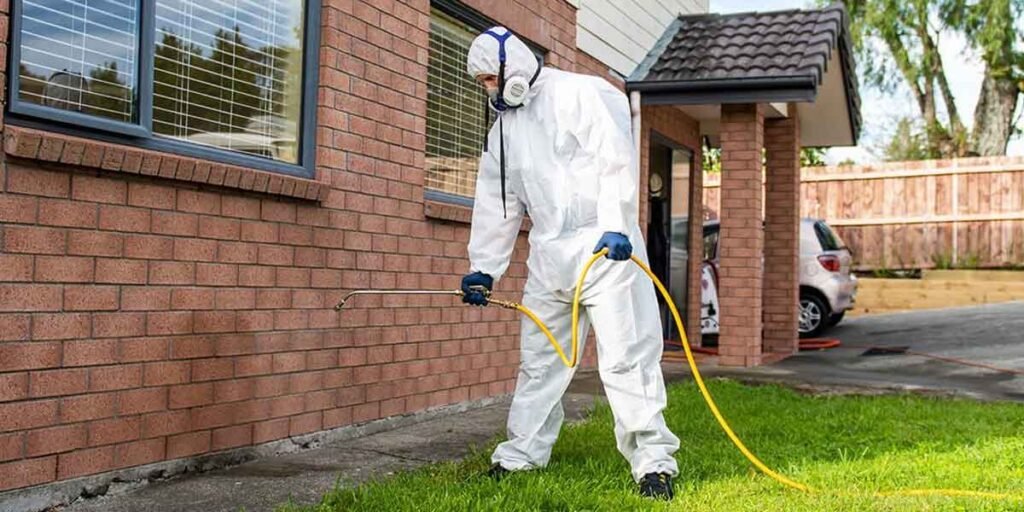
Ants treatment reaches the colony or it does nothing. Every product on a hardware shelf kills the workers you can see, and only something carried inside and shared kills the queens that replace them.
That one fact splits the job in two. A trail that starts outdoors and runs along a foundation or a windowsill is usually a homeowner’s job. A colony arriving in three rooms at once, or staying busy through the winter, usually is not.
The test for telling them apart comes down to where the colony sits, and four observations answer it.
Why Ants Treatment Fails Before the Product Choice
Ants treatment fails at this stage because the product never reaches a queen. Workers are the visible fraction of a colony, and contact sprays kill only those. The nest keeps producing replacements, so the trail returns within days and the spray looks like it stopped working.
University of California IPM states the mechanism plainly: insecticide sprays kill only the foraging ants, and more ants emerge from the nest. A spray is not a weak product. It is a product aimed at the wrong end of the colony.
The second failure mode is worse, because it leaves you with more ants than you started with. Budding is one colony splitting into several. Kansas State University’s pest control manual records it as a trait of multi-queen species, triggered by contact insecticide near a nest or a foraging site, and a single colony can become three groups in three rooms over a couple of weeks.
I sprayed a kitchen trail once with an aerosol can and felt finished for two days. On the third morning the same ants were feeding in a bathroom on the far side of the house, a room the colony had never used. Nothing in the pattern had changed except the address.
The aerosol was not defective. I had removed the visible part of a colony whose center I never located, and the colony answered by reorganizing.
What DIY Ants Treatment Can Finish
Slow-acting bait placed on an active trail finishes most single-nest indoor problems, provided the colony is reachable from outside the building. Bait works because returning workers share the toxicant inside the nest, so it has to be slow enough to travel and mild enough that ants keep feeding on it.
University of California IPM gives a cheap, specific sugar bait for sugar-feeding species such as the Argentine ant. Dissolve half a teaspoon of powdered boric acid and nine teaspoons of granulated sugar in one cup of hot water. That lands near 1 percent boric acid and 19 percent sucrose, inside the 0.5 to 1 percent band the same source identifies as effective.
Strength is where homemade bait goes wrong in a counterintuitive direction. Boric acid above 1 percent becomes repellent to ants, so a batch made with a heaping spoonful performs worse than a weaker one. University of California IPM notes the same effect in commercial products, where formulas above 1 percent control less than those in the 0.5 to 1 percent range.
Food preference is the other variable you control. Colonies of the same species shift between protein and sugar through the season, and the recommended move is to set out more than one bait type and watch which one the ants actually take. A bait that sits untouched is not weak. It is the wrong menu.
Placement decides the rest, and the practical rule is to put the station where the trail already runs and nobody wipes it away. A trail that is busy at breakfast and gone by noon is still the same trail, and a bait station behind the toaster keeps working for a week while one parked on a busy counter leaves with the crumbs.
Bait also has to out-compete whatever else the colony is eating. University of California IPM lists the availability of alternative food as one of the variables that decides whether a bait works, so sealing the cereal box and rinsing the recycling bin can matter as much as the product you pick.
Two habits decide whether the attempt finishes. Do not spray anything while bait is out, because residues contaminate the bait and stop the feeding that delivers it. Leave the trail in place until the workers stop coming, since wiping it clean in the first days removes the route the bait depends on.
Expect more than a week. University of California IPM puts bait-based control at more than one week rather than an afternoon, and workers that crowd a fresh bait station in the first days are recruits, not a sign of failure.
When the Nest Is Out of Reach
Four observations move an ants treatment out of range of surface work: activity in more than one room, a trail that continues through winter, small ants that ignore bait, and a line that disappears into a wall or an outlet. Each one points to a nest inside the structure, where bait and spray cannot follow.
Ants Coming From More Than One Room
One trail at one entry point is a perimeter problem. Two rooms on opposite walls is a different situation, because the ants are arriving by separate routes. Tracing a trail back to its colony works outdoors, along a foundation or up a tree trunk. Indoors, the same trace usually ends at a wall cavity, and the cavity does not open for inspection.
Activity That Continues Through Winter
Outdoor colonies slow down when the ground cools. Activity in January and February, especially in a cold climate, means the colony is living inside the heated envelope. It has found food, water, and warmth without leaving the building, and bait can reduce a colony like that without ending it.
Small Ants That Ignore Every Bait
Workers that never take bait, split into new clusters when disturbed, and appear in kitchens and bathrooms year-round describe Pharaoh ants and odorous house ants. Both are multi-queen species, which is why budding matters more in a house like that than nearly anywhere else.
Carpenter ants advertise themselves by size instead. Workers on the same trail differ noticeably, with some twice the length of others, while most household ants run uniform. That mixed line shifts the job from bait to water, which is a repair rather than a treatment.
A Trail That Runs Into a Wall or an Outlet
Ants that enter through a wall void are following a gap that often shares space with wiring and plumbing. Drilling, dusting, or pouring liquid into that cavity is where the job stops being a product choice, because the risk moves from the ants to the building.
Sealing the visible gap with caulk does not end it either, unless the nest was located first. It relocates the entry and leaves the colony intact on the other side of the seal.
Finding the nest before any of that is a low-tech job. Penn State Extension suggests listening for rustling inside a wall with a stethoscope or an inverted glass, which is often the only way to hear a colony that never shows itself on the floor.
Entry work is worth doing, but it is prevention rather than treatment. University of California IPM’s perimeter list covers most of it: prune back plants that bridge to the structure, keep mulch and irrigation away from the foundation, and seal the crevices insects actually use. None of that touches a colony that is already inside.
What a Professional Ants Treatment Should Include
A hired ants treatment should start with an inspection that identifies the species and finds the nest, then treat the colony rather than the visible trail, and finish with a written service record and a stated re-treatment term. A price quoted without an inspection is a spray schedule, not a diagnosis.
The inspection is the part that cannot be skipped. Penn State Extension states why in its carpenter ant fact sheet: the parent and satellite nests must both be found and eliminated, and locating them is the work that separates a real treatment from a repeat visit.
A re-treatment term is the window in which the company returns to the same area for the same species at no additional charge. It is the clause that says what happens if the ants come back, and a service without one moves that risk onto you.
Species identification comes out of that inspection, and it drives everything downstream. A bait that works on a sugar-feeding colony does nothing for a species that wants protein, so a technician who names the species on the first visit is showing that the bait choice is reasoned rather than habitual.
Four things are worth refusing:
- A price given over the phone before anyone has seen the property.
- A treatment that consists only of a broadcast spray or a total-release fogger.
- A service with no stated re-treatment term for the same species in the same area.
- An applicator who cannot show credentials.
That last item is checkable. Structural pest control is licensed at the state level under plans the EPA approves, and every state runs a licensing program for the businesses and the applicators who treat homes. Federal law sets the other half of the line: general-use products may be bought and applied by anyone, while restricted-use products may be applied only by a certified applicator or by someone working under one’s direct supervision. Technicians are commonly registered rather than certified, so asking for the name and license of the supervising applicator is a reasonable request.
The same federal framework binds a homeowner, which is the part most product guidance leaves out. A pesticide label is legally enforceable. The federal definition of using a product in a manner inconsistent with its labeling covers going above the labeled rate, adding a site the label does not list, or applying by a method the label prohibits, while applying less than the labeled rate is generally allowed. Doubling a mix is not.
The Two Ant Problems Where the Fix Is Not a Product
Fire ants and carpenter ants both resist a product-first answer. Fire ants need a two-step method across the whole yard plus a sting plan for the people who live there. Carpenter ants follow water into the framing, so the repair has to come before the treatment.
Fire Ants: The Two-Step Method and the Sting Boundary
Texas A&M AgriLife Extension’s two-step method is the reference approach. Broadcast a bait product over the whole area first, then treat individual nuisance mounds five to seven days later, so the mound work does not disturb the baiting. Soil surface temperature between 70 and 90 degrees Fahrenheit is the foraging window, and bait put down on wet ground ahead of rain is wasted.
Bait products differ in speed. Formulations built on hydramethylnon or spinosad act in roughly two to four weeks, while insect growth regulator baits take two to six months and need fewer repeat applications over large areas. Boiling water poured on a single mound is the older household option, and AgriLife puts its success rate at about 60 percent, with survivors relocating to a new spot.
Gasoline is the one method to rule out in plain terms. AgriLife lists petroleum products as both a fire hazard and an environmental harm, and no mound is worth that trade.
Stings are where this stops being a pest question. CDC worker-safety guidance on fire ants names the symptoms that require emergency care: severe chest pain, nausea, severe sweating, loss of breath, serious swelling, or slurred speech. For someone allergic to the venom, a single sting can produce anaphylaxis, and Mayo Clinic’s first-aid guidance puts epinephrine ahead of antihistamines for that reaction. A household with a known venom allergy should treat every fire ant mound as a medical boundary.
Carpenter Ants Follow Moisture, Not Cleanliness
Carpenter ants behave differently from most household ants because they nest in wood rather than walk across it. Penn State Extension’s fact sheet reports that the ants seldom tunnel into dry, sound wood, and that they usually will not infest wood with a moisture content below 15 percent. A spotless house with a leaking shower pan still has a carpenter ant problem.
That is why the water source is the first job. Penn State lists the usual candidates: poor ventilation, a leaking roof, defective flashing, overflowing gutters and downspouts, condensation from water pipes, and leaks from bathtubs, showers, or appliances. Repair comes first and treatment second, because a colony that keeps finding a wet cavity will keep coming back.
Leaks that feed a colony are the hard ones to find, since the wet cavity is rarely where the water enters. A supply line or a drain that has wept inside a wall for months leaves its evidence behind the drywall instead of on the floor, and locating that hidden water is a different trade. The benefits of professional plumbing inspections are worth weighing before a treatment is booked, for the simple reason that a colony living in a wet wall cavity re-establishes itself after every visit until the cavity dries.
Two visits to the same trail with no change in the pattern is the answer to the do-it-yourself question. At that point the missing piece is not a stronger product.
Ants Treatment Questions Homeowners Ask
What is the best way to get rid of ants?
Slow-acting bait placed on an active trail, with the nest located first, removes more of a colony than any spray. Sprays kill only the workers you can see, and a nest that stays hidden keeps replacing them.
Does vinegar kill ants permanently?
No. Vinegar wipes out the pheromone trail and kills the workers it touches, and neither loss reaches a queen. The colony rebuilds the trail within days from a nest that was never treated.
Can ants treatment remove all of a colony?
Indoors, yes, when the nest is found and reached. Outdoors, no. University of California IPM states that totally eliminating ants from an outdoor area is generally not feasible, so the realistic outdoor target is keeping them away from specific places: foundations, entry points, and plants they are guarding for honeydew.
Is it better to kill ants or leave them alone?
Leave the ones that stay outdoors and never touch the building. The same source notes that most ant species are not pests, that they improve soil, and that some prey on pest insects. Treat when a colony is inside a structure or farming honeydew on plants you care about.
Which ants treatment works best indoors?
An enclosed bait station is the usual first choice inside a home, because it keeps the bait fresh, keeps it away from children and pets, and still lets workers carry the toxicant back to the nest. Sprays and foggers work against that by killing the foragers the whole method depends on.
