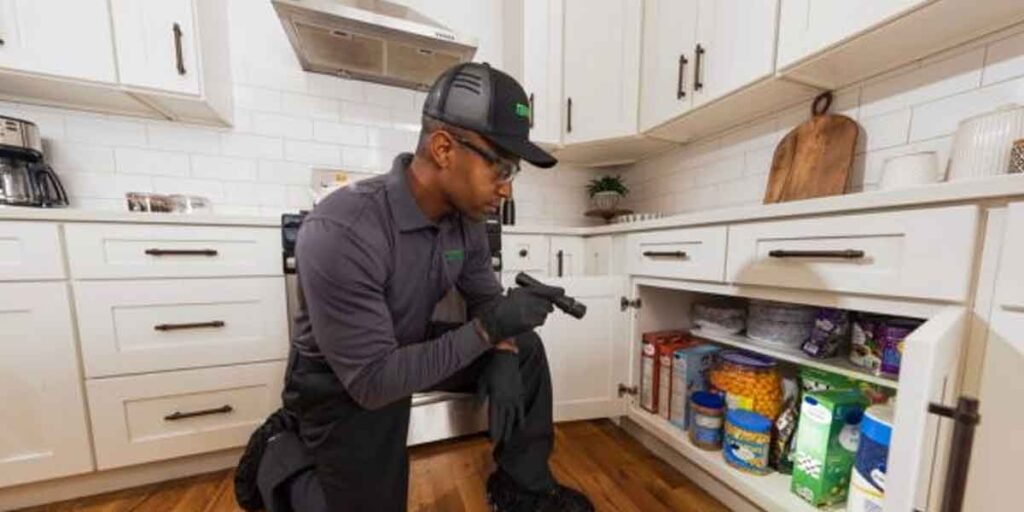
Treating cockroaches usually costs between $100 and $600 per visit, and HomeAdvisor’s 2025 cost data puts the national average near $200. Return visits decide your total, not the per-visit rate.
A German cockroach population living in a kitchen wall takes weeks of baiting and follow-up monitoring. An American cockroach that wandered in from a water meter box usually stops at the entry points once they are sealed. Same invoice format, and totals that differ by a factor of three.
Species, harborage count, and the warranty clause move a cockroaches treatment cost estimate. Square footage mostly does not.
What Cockroaches Treatment Cost Covers on a Real Invoice
An estimate for cockroaches has three parts: an inspection that names the species, the treatment itself, and the return visits written into the contract. The treatment is the visible line, and the return-visit clause is where two bids for the same kitchen separate.
Inspections get discounted because they double as a sales visit. They still carry the one piece of information that sets the method, and guessing the species wrong is the most expensive error in the process.
Misidentification is the reason a written inspection earns its price. Beetles and cockroaches get confused in dim light because both are flattened and dark, and UC IPM draws the line at the wings: adult cockroaches carry membranous wings under a shield, and beetles do not. A household that pays to treat a beetle problem bought a spray with no target.
Ranges below come from the 2025 cost data published by HomeAdvisor, Angi, and Fixr. These are retail numbers for residential work, and a quote landing well outside them deserves a question.
| Invoice line | Quoted range | What it pays for |
|---|---|---|
| Inspection and species identification | Often bundled, or $0 to $100 | The species, the harborage map, and whether the source is indoors or outdoors |
| Gel bait, bait stations, and monitoring traps | $100 to $600 per cycle | Weeks of bait consumption plus the trap counts that show whether it worked |
| Broadcast spray | $40 to $100 per application | Contact kill where the nozzle reached, with nothing left for the population behind the cabinets |
| Total-release fogger, bought retail | A few dollars a can | Very little cockroach control and residue on horizontal surfaces |
| Fumigation or tenting | $1,000 to $3,000, and $2,500 to $7,500 for tenting | A whole-structure treatment rarely justified for cockroaches |
Three pricing models sit behind those numbers. A per-visit quote charges for each trip, so the total climbs with the trip count and has no ceiling. A program quote bundles a season of scheduled visits at a flat rate, which lowers the price per visit and often adds exterior perimeter work a single kitchen problem never needed. A result-based quote ties a flat fee to a defined outcome, usually a set number of return visits plus a monitoring threshold that closes the contract.
Compare the three by the trip count each one includes. A per-visit quote that covers one trip becomes a two-trip quote once the second visit is billed, and that second visit is the one that shows whether the first attempt worked.
Why Species Changes What Cockroaches Treatment Cost Buys
Species shapes the bill more than house size does. German cockroaches breed indoors and demand repeated baiting plus exclusion, while American, Oriental, and Turkestan cockroaches invade from outside structures and are cheaper to handle at the point of entry.
The German cockroach is the species that turns a small problem into a recurring bill. University of California IPM notes that one female and her offspring can produce more than 30,000 cockroaches in a year, and that adults pass through a crack 1/16 inch wide. The Illinois Department of Public Health adds that German cockroaches spend about 75 percent of their lives in hiding, which is why a spray that reaches the floor tiles never touches the population inside the wall void behind them. Their egg case, called an ootheca, holds roughly 30 young, and the female carries it until a day or two before it hatches.
A treatment that kills adults and leaves the egg cases in place looks effective for about two weeks and then stops looking effective.
Indoor breeders: why the second and third visits are not padding
Bait works on the roaches that eat it, and the egg cases already in the walls hatch on their own schedule. UC IPM notes that baits can take 7 days or longer before fewer cockroaches appear. Judging the program on day three and calling for a spray costs the household twice for one result.
Outdoor species: what an exclusion quote should cover
American cockroaches reach about 2 inches long, carry egg cases holding roughly 12 young, and cement them where they incubate for about two months. Oriental cockroaches live in cool, damp places such as basements, garages, and drains, and Turkestan cockroaches have been displacing them in warmer, drier areas, harboring in water meter boxes, cracks between concrete blocks, potted plants, and sewers.
For these species the money goes into sealing pipe penetrations, repairing screens and drain traps, and treating harborage outdoors. A kitchen-by-kitchen baiting program sold to a household with an outdoor species is the wrong product at a defensible price, and mixed infestations exist often enough that an inspection which never leaves the kitchen is an incomplete one.
Wings change what an exclusion quote has to cover. American and smokybrown cockroaches fly on warm evenings, and male brownbanded cockroaches fly above about 85°F, so upper floors and attic spaces may need sealing that a ground-level perimeter treatment skips. Oriental and Turkestan cockroaches do not fly, which is why they turn up in basements, drains, and water meter boxes instead.
The Bait Data That Decides Cockroaches Treatment Cost per Result
Bait placed where monitoring traps say the roaches are performs measurably better than a routine spray. A Johns Hopkins-led review in the American Journal of Preventive Medicine measured how wide that gap runs.
In that work, monitoring-guided bait placement cut bedroom-floor cockroach allergen by 82 to 84 percent and reduced trapped roaches by more than 90 percent. Conventional professional pest control produced reductions no better than the comparison homes. Method, not budget, separated the two: baits placed at harborage, retreatment only when traps caught roaches again.
A second finding explains why one bait fails in one apartment and works in the next. In a 2013 study in Science, Wada-Katsumata and colleagues found that some German cockroach populations carry a heritable aversion to glucose, a sweetener used to make baits palatable. Of 19 field populations sampled worldwide, 7 contained glucose-averse individuals, and for those roaches the sweetener registers as bitter.
A technician who rotates active ingredients is answering that finding, and bait rotation belongs in the quote as a real line, not as an upsell.
It costs a formulation change, not a second program.
Preparation Work That Cockroaches Treatment Cost Does Not Include
Prep work sits outside the quoted number and runs on your time. Cabinets get emptied, surfaces get wiped, and the gaps you can reach get sealed before anyone arrives.
The list is shorter than it looks, and it repeats before every return visit.
That repetition is where households get caught.
- Empty kitchen and bathroom cabinets, including the bottom drawer and the space under the sink.
- Wipe counters, the sides of the stove, and the floor of the sink cabinet, since crumbs and drips are what sustain the population between visits.
- Put pet food and water bowls away for the night before each service.
- Break down cardboard boxes and paper stacks, which are harborage as much as storage.
- Seal baseboard gaps, pipe penetrations, and cabinet backs where a caulk line will hold.
Two costs hide here. One is time, which is predictable. The other is a return visit that arrives before the prep is finished, because a technician who finds full cabinets works around them and the harborage stays where it was.
Where DIY work stops being a saving
Retail gel bait, boric acid dust inside dry wall voids, and sticky monitoring traps are all available to a homeowner, and the product label is federal law under FIFRA, not a suggestion. Restricted-use products require a certified applicator, and a bait tube does not repair a leaking trap under the sink.
Hand the job to a licensed applicator when the infestation crosses a shared wall, when two full bait cycles leave the trap counts flat, when the harborage sits inside a wall void or a plumbing chase, or when nobody has identified the species. Multi-unit buildings add a legal layer that a hardware store cannot price.
The Fogger Shortcut: Cheap Cockroaches Treatment Cost, Expensive Outcome
Total-release foggers are the one purchase that reliably makes a cockroach problem more expensive. They do not control the population, and their repellent ingredients push insects deeper into wall voids or into the next room.
Researchers at North Carolina State University tested over-the-counter bug bombs in infested homes and found no measurable effect on cockroach populations two weeks or one month afterward, while residues on horizontal surfaces rose roughly 600 times above baseline. UC IPM reaches the same conclusion from the extension side: foggers and aerosol sprays can disperse cockroaches to other areas without killing them, and sprays do not deliver long-term control.
The EPA’s safety page for total-release foggers concentrates on risk management, not on results. One can per room at most, six feet of clearance from ignition sources, the house vacated for two to four hours, then ventilation before re-entry.
A product that asks for that much evacuation and leaves the population in place is a sunk cost, and the bait program that follows gets billed as a new job.
When Cockroaches in an Apartment Move the Cost to the Landlord
In rental housing, the structural repair belongs to the property owner and the prep work belongs to the tenant. Almost two-thirds of American homes have detectable cockroach allergen, and about 10 percent sit above the level linked to asthma symptoms, according to the NIEHS and HUD survey work behind those figures.
The National Cooperative Inner-City Asthma Study found detectable cockroach allergen in 85 percent of bedrooms tested, with the worst asthma outcomes among children who were both sensitized and exposed above 8 units per gram in the bedroom. A National Center for Healthy Housing review of nine studies covering 950 homes tied high allergen levels to cracks or holes in walls, water leaks, and visible roach signs. Those are building conditions, and a tenant cannot caulk the far side of a shared wall.
A Seattle-King County trial with 274 low-income households shows the limit of tenant-side effort. The program engaged families on cleaning and reporting, then ran into structural housing defects it had no authority to repair. Where the building stays broken, the same unit gets treated again next season.
The Inner City Asthma Study puts an order of magnitude on doing the work properly: under $1,500 per family for a bundled intervention that produced 38 additional symptom-free days.
That figure covers more than pest control, and it still frames the comparison between fixing a building once and treating one unit four times a year.
Sealing a baseboard gap, replacing a dripping trap under a sink, and closing a pipe penetration are ordinary repairs, and Home Improvement guides cover those categories. An inspection report that lists them in writing, with photographs, is the document that moves the cost to whoever owns the structure.
CDC guidance for households managing asthma advises against sprays and foggers, since the application itself can set off an attack.
That leaves baits, traps, sealing, and cleaning as the tools that work for everyone in the building, including the neighbor whose unit shares the wall.
Rental rules vary by state and by lease. State tenant advocacy offices and legal aid handle enforcement when a landlord refuses repairs, and the pest clause in a lease is worth reading before signing it.
Five Questions That Reveal a Cockroaches Treatment Cost Likely to Grow
A bid becomes a real number once five answers sit on paper. Each question below is one a technician can answer on site.
- Which species, and where was it confirmed? An answer naming German, American, Oriental, or Turkestan cockroaches and a location tells you the method is chosen, not guessed.
- How many return visits are included, and how far apart? Bait needs a week or more to shift trap counts, so a schedule with no second visit is a single attempt sold as a program.
- Which method, exactly? Bait and traps, dust in voids, spray, or fogger. A fogger in the plan ends the conversation.
- What voids the warranty? Unfinished prep, self-treating between visits, and new harborage are the usual exclusions, and they should be in writing.
- Are monitoring traps placed before and after? Trap counts are how a program proves it worked, and how you compare two quotes on the same footing.
Ask for those counts in writing at the start and at the end. A provider who cannot produce a before-and-after number is charging by the trip, and the trip count is set by whoever writes the invoice.
Frequently Asked Questions
Can I treat cockroaches myself instead of paying for a service program?
Yes, when the problem is small, indoors, and the species is confirmed. Retail gel bait placed at harborage, sticky traps for monitoring, and boric acid dust in dry voids handle light German cockroach infestations, and the label sets the legal limits on where and how much you apply. Bring in a licensed applicator when the counts do not move after two bait cycles or the harborage is inside a wall.
Do exterminators get rid of cockroaches permanently?
No treatment removes cockroaches permanently; the working goal is eliminating the population in a unit and removing the conditions that let another one establish.
A result-based contract sets a monitoring threshold that ends the service, and trap counts near zero over consecutive checks are the closest thing to done.
How much does treatment for cockroaches cost in an apartment?
Apartment treatments land in the same $100 to $600 per-visit range as single-family homes, but the responsibility splits. Structural repairs and building-wide treatment fall to the owner, while prep and access fall to the tenant, and single-unit work rarely holds when the source is in a shared wall.
Why do cockroaches come back after treatment?
They come back for three reasons: egg cases that hatched after the application, harborages the treatment never reached, and populations that reject the bait’s sweetener. Rotating the active ingredient and rechecking trap counts catches all three before a second full program gets sold.
Do cockroaches bite people?
Rarely, and not in a way that usually sends anyone to a doctor. Mouthparts can graze skin in heavy infestations, mostly at night, and Texas A&M AgriLife Extension notes that many skin reactions blamed on bites are allergic responses to cockroach debris instead. The allergen load is the reason to spend money, not the bite risk.
Health and lease questions sit outside what an estimate can answer. A diagnosed allergy or asthma condition belongs with a clinician, and a lease dispute belongs with a tenant lawyer in your state.
