Exterior Painting ideas stand or fall on the surfaces they land on. Taste comes second.
A deep charcoal that looks right on a color card can warp vinyl siding on a July afternoon.
The same mid-tone reads warm on the south wall and flat gray on the north one.
Roof color, brick, window frames, and any homeowners association palette are fixed before a brush is opened. Siding, trim, shutters, and the front door are the parts you actually choose, and working from the fixed end first narrows the rest quickly.
Four numbers carry an exterior painting decision: light reflectance value, the vinyl siding floor, ultraviolet exposure by elevation, and the age of the building.
Roof and brick decide first, because they cannot move
A palette starts at the top and works down. Roofing, brick, stone, and window frames outlive any paint job, so the siding has to answer them.
Warm roofs and cool roofs behave differently as backdrops. Browns, tans, and warm grays drag cool blue siding toward green in direct light, while charcoal and slate shingles leave the field color free to run warm or cool. The darkest element also belongs in one place only: a black roof, black shutters, and a black door leave the eye with nowhere to land.
Brick and stone are the least negotiable inputs, because their color comes from the material and the mortar, not from a coating.
A red brick facade with orange mortar wants trim in the same family, while limestone and cast stone sit close enough to neutral to accept most schemes.
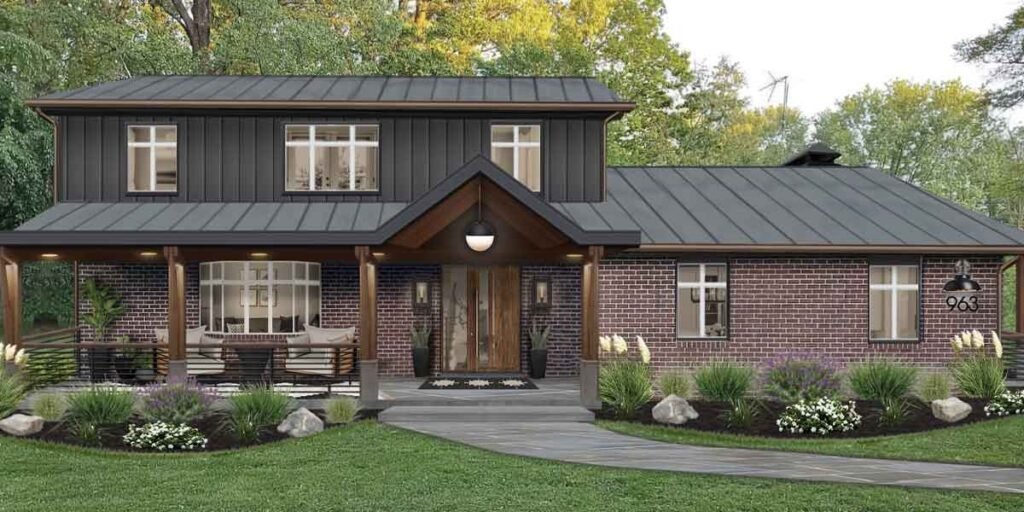
Where brick runs along the bottom of a facade and painted siding sits above it, the siding works best as a lighter version of the brick’s undertone. A cool gray field over warm red brick is what makes a home look assembled from two different buildings.
The order that holds up on most properties:
- Roof, and any masonry that stays unpainted
- Window frames, metal trim, and gutters
- Siding or field color
- Trim, then shutters and the front door as the accent
Homeowners association rules and historic district review can overrule that order at any point. HOA guidelines typically name an approved palette and a submission step, and a historic district can require a certificate of appropriateness before a color change reaches the wall. Both are public documents, and both are cheaper to read before the paint is bought.
The number vinyl siding will not forgive
Light reflectance value, or LRV, measures how much light a cured film sends back on a scale from 0 to 100, and every major brand publishes the figure for each color. On vinyl siding the number stops being a preference: exterior technical data sheets from Benjamin Moore set a floor of LRV 55.
Siding manufacturers write the same threshold into their own guidance. AZEK’s exterior paint guide requires an LRV of 55 or higher, or a color drawn from a line built for vinyl with solar-reflective pigments, and Royal Building Products draws the line at 57. Under that threshold a dark film absorbs more solar heat, the panel runs hotter than the vinyl was tested for, and the siding can deform.
That floor rules out much of what the current color conversation celebrates. Benjamin Moore named Silhouette AF-655, a deep espresso, as its 2026 color of the year on October 16, 2025, and third-party color libraries place it near LRV 8 to 10. Sherwin-Williams announced Universal Khaki SW 6150 on September 24, 2025, a warm mid-tone at LRV 40, still under the vinyl limit.
A dark color keeps its place in an exterior painting scheme on fiber cement, wood, stucco, and doors. A black front door or a deep charcoal garage door carries the 2026 palette without putting a low-LRV film on a vinyl panel.
Sun-facing walls fade first, and one color reads two ways
South and west elevations take the most ultraviolet light in the northern hemisphere, and the coatings industry documents the outcome. Dunn-Edwards attributes the greatest color loss to southern exposures and the least to northern ones, and Behr’s technical guidance reports the same south-and-west pattern for gloss retention.
Two rules follow. Darker colors absorb more heat and energy than lighter ones, which speeds the breakdown of the binder and the film itself, and organic pigments in saturated reds, blues, greens, and yellows lose color faster than inorganic earth tones and whites.
A saturated green on the west wall of a two-story home is the pairing that shows its age first, and a deep red front door on a south wall is the piece that fades toward pink before anything else in the scheme.
Elevation changes how a single color reads as well.
The shaded north wall loses the warmth the west wall shows at four in the afternoon, so a mid-tone that looks balanced on a chip can read flat once it is up.
On a Tuesday in July the west siding is amber and the north siding is gray, and both came out of the same can that morning. The west trim looks cream. The north trim looks light gray.
Sample on the siding, not on the chip
Exterior color has to be judged on the material it will cover. Resene’s color guidance asks for a brushout applied to the actual substrate or a spare piece of the cladding, with an A4 drawdown as the minimum and an A2 mock-up for a final decision.
Chips and fan decks are printed, and their pigment load differs from the paint that ends up on the wall.
Vista Paint’s color-matching bulletin states the point plainly: a color should never be accepted from a fan deck chip, a digital image, or a verbal description.
Sample pots carry a limit of their own. Benjamin Moore’s data sheet for its 8 oz. samples describes them as made for interior use, usable for judging an exterior color, and not built to withstand sun and weather. A sample left on the siding for a week has already moved.
The north and south sides of one building are the two test spots worth the bother, checked at more than one hour of the day.
Once a color is settled, the job turns into quantities: siding area, coats, trim length, and the repair work hiding under the old film. Those are the line items behind an exterior painting estimate, and they carry more of the final cost than the color choice does.
Brick and stucco need a coating that breathes
Paint on masonry follows one structural rule: the coating has to let water vapor out faster than the wall takes water in. The spread is wide. KEIM’s technical data for mineral masonry paint puts lime and silicate coatings at 70 to 85 perms by ASTM E96, against less than 1 perm for film-forming acrylic and elastomeric films.
Masonry takes in water through wind-driven rain, capillary rise, and any leak above it, and it dries through the face of the wall. A low-permeance film caps the drying side, so vapor condenses behind the coating, lifts it off the surface, pushes salts out through the paint, and in freezing weather splits the brick face. The Utah State Historic Preservation Office names the result spalling.
Mineral coatings exist for that reason. Limewash carbonates into the masonry while potassium silicate paints bond to it, and both stay vapor-open, which is why those materials are the ones named for previously unpainted historic brick. Standard latex in a deep tone is the pairing that fails in a freeze-thaw climate.
Sound, unpainted masonry does not need a coating to perform. Repointing, drainage, and flashing come before any film goes on, and exterior painting over a wall with an active leak traps the water instead of stopping it.
Where exterior painting stops being a weekend job
The line is drawn by the age of the building and the size of the disturbed area. Paid work that disturbs painted surfaces in housing built before 1978 falls under the EPA’s Renovation, Repair and Painting rule, and exterior work loses its small-job exemption at 20 square feet.
The exemption is more specific than the rule’s headline. Interior work is exempt below six square feet of disturbed paint per room, while exterior work is exempt below 20 square feet aggregated across every side of the building, and work performed within 30 days counts as one job for that arithmetic.
Removing a painted component counts its entire surface area.
Window replacement and demolition disqualify a job at any size.
Homeowners painting their own residence sit outside the rule. Landlords, home-based child-care providers, and flippers do not, and each of those roles puts a homeowner on the certified side, where the firm has to be certified and a certified renovator has to be on the job.
Other stop signs have nothing to do with lead. Work above the first story, on a roof, or from a ladder set against gutters is fall-protection work before it is paint work. Sanding a failing film on a pre-1978 window frame is the activity the RRP rule was written for, and it is the one part of an exterior painting project to hand off.
Rot and moisture are the last boundary for an exterior painting job. Paint over soft board or a wall with an active leak blisters within a season, and no color survives that.
FAQ
What is the best color for a house exterior?
No single color is best. Roof tone, brick, window frames, and any HOA palette narrow the range first, and vinyl siding adds a light reflectance value floor of 55.
What color is replacing gray in 2026?
Warmer browns and earth tones. Benjamin Moore named Silhouette AF-655, a deep espresso, its 2026 color of the year on October 16, 2025, and Sherwin-Williams picked Universal Khaki SW 6150, a warm mid-tone at LRV 40, on September 24.
What are the latest exterior paint trends?
Warm mid-tones with dark accents held to small areas. Both 2026 colors of the year sit at the warm end of the spectrum, and in exterior painting they most often land on shutters, doors, and trim instead of a full wall, where heat absorption and ultraviolet exposure decide how they age.
What is the most popular exterior painting color for a house?
White and light neutrals stay the most common whole-house choices, and durability is part of the reason. Lighter colors run cooler and fade more slowly than dark ones, which matters most on south and west walls.
