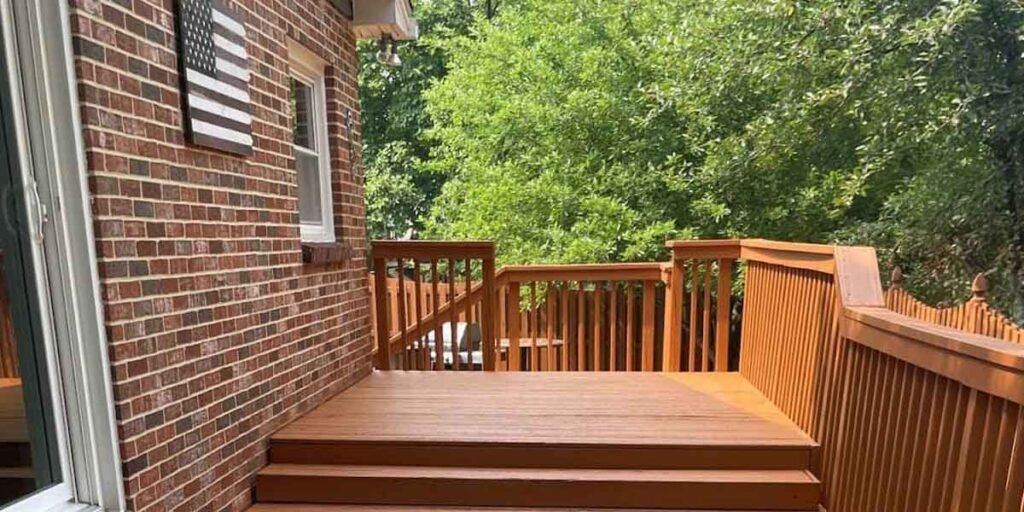
Pigment load narrows deck staining colors more than the name printed on the swatch does. A finish with almost no pigment shows whatever tone the boards already carry. A heavily pigmented one covers that tone instead. Two stains sold as “honey oak” can land nowhere near each other on the same deck.
Deck staining decisions that start at the color card tend to end in a second coat. The order that holds up is pigment level first, the wood under it second, the yard around it third, and the shade name last.
Why Pigment Load Decides the Color You Get
Pigment load sets how much of the wood’s own tone survives and how long a deck staining coat holds up. Clear finishes show nearly all of that tone and wear out fastest. Opaque finishes hide the boards and last longest, with one exception on flat decking that changes the ranking.
Four finish classes sit between those two ends, and the color card rarely says which one you are holding. Color lines do: Sherwin-Williams sells its deck finishes under the SuperDeck label, split into transparent, semi-transparent, semi-solid, and solid families with a separate color card for each.
Clear and lightly tinted water repellents carry almost no pigment, so red cedar stays red-brown and treated pine keeps its green tint. Semi-transparent stains add enough pigment to shift the tone while the grain still reads through. Semi-solid stains leave only a ghost of the grain. Solid-color stains and paint cover the boards completely.
The Forest Products Laboratory’s Wood Handbook, in its chapter on finishing wood, gives deck surfaces roughly one to two years for a clear or lightly tinted finish and two to three years for a semi-transparent stain on new smooth boards. It rates solid-color stain and paint low for horizontal decking, because a film-forming coat wears through underfoot and then peels. The same chapter states the trade plainly: the higher the pigment concentration, the longer the finish lasts.
| Finish class | What stays visible | Color control | Life on a horizontal deck face |
|---|---|---|---|
| Clear or lightly tinted water repellent | Grain and all of the wood’s own tone | Almost none | About 1-2 years on new smooth boards |
| Semi-transparent stain | Grain, with slight blotching on pine | Moderate | 2-3 years on new smooth boards; 3-6 on textured or weathered ones |
| Semi-solid stain | A faint ghost of the grain | Strong | Falls between the two, and varies by brand |
| Solid-color stain | No grain at all | Complete | Rated low for horizontal decking by the Forest Products Laboratory |
That ranking explains a complaint that surfaces every spring: the railing still looks fine while the walking boards have gone patchy.
Manufacturers build the same split into their warranties, and the fine print separates the deck face from the vertical surfaces. Wolman’s product sheet for its semi-transparent deck stain lists three years on horizontal surfaces and five on vertical ones. Sherwin-Williams puts a three-year limited warranty on its SuperDeck semi-transparent deck stain.
Recoating is where pigment load turns into money. A clear finish facing full sun may need a fresh coat every second year, while a semi-transparent coat in a similar tone can stretch several more seasons, so the honest comparison is the ten-year number rather than the price on the can. The deck staining cost calculator runs material and labor for a deck your size, which is the only way to weigh a cheap coat that returns often against a dearer one that does not.
What the Boards Do to the Color
The wood under the stain is part of the color, and three properties of it outweigh any swatch: what the mill treated it with, how the grain takes up pigment, and how long it has sat outdoors.
Treated lumber sold for decks is usually copper-azole treated, and the copper leaves a green cast. Mississippi State’s Forest and Wildlife Research Center describes that tint fading toward gray as the wood weathers in place. Warm browns and red-browns land close to the color on the card over that green base. Cool grays and near-whites do not, which is why an ash-toned swatch can look sickly on a fresh treated deck and fine on an old one.
Copper leaves the boards, too. The residue behind that green cast can wash out of the lumber and stain masonry, pavers, and siding below a deck edge, and copper-wood technical notes recommend flashing or joist tape wherever treated boards sit against a wall or above stone.
Cedar and redwood behave differently again. Both carry water-soluble extractives that can weep at joints and under railings, and both hold a red-brown tone that a clear finish mostly preserves. Deck staining over western red cedar reads warmer than the identical product over treated pine.
Grain structure causes the striping that gets blamed on the stain. Pine’s dense summerwood bands take up less finish than the soft springwood beside them, so one color can read as stripes on treated lumber and as a flat tone on cedar.
Board face texture shifts the same color again. A textured or ripped face holds more finish than a smooth-sawn one, and the Wood Handbook table gives textured decking roughly double the service life of smooth boards.
Time outdoors resets the starting point. Ultraviolet light breaks down lignin at the wood’s face and leaves a silver-gray cellulose layer, and deck staining over that gray cannot bring red or brown back. Brighteners, mostly oxalic acid, lift the gray and the iron staining without bleaching the fiber the way chlorine does.
The Forest Products Laboratory has documented what waiting costs. Boards left bare for weeks lose some of their ability to hold a coating, and a deck that has sat uncovered through two winters may be too checked and fuzzy to take a semi-transparent coat at all.
Moisture is the last gate before any color goes on. Manufacturers’ data sheets gate the first coat on moisture content, and treated boards often stay wet at the core for weeks after delivery, even when the face feels dry.
Reading a Swatch Against the Yard, Then Testing It
Deck staining color is judged at the size and in the light where it will live. A paint chip is a vertical square under diffuse light; a deck is a large horizontal plane under direct sun, and those two conditions make the same pigment read differently.
Paint companies print a light reflectance value, from 0 to 100, on the back of their color cards. That number compares one color to another more reliably than a name does, since “weathered gray” from two brands can sit twenty points apart.
Use it to settle the siding question instead of guessing. A deck within a few points of the walls reads as an extension of them. A wide gap turns the deck into the loudest shape in the yard. Neither is wrong, but the second is a deliberate choice about where the eye lands when someone steps out the back door.
Sun exposure belongs in the same decision. A dark deck absorbs more solar heat than a pale one, and boards facing south without shade will say so on bare feet in July. Sherwin-Williams markets an IR Reflective tier of its deck stain on that argument, claiming solar-reflective pigments lower a surface’s temperature. Heavy pigment survives that exposure longer, which is why the same sunny deck holds a darker, more pigmented coat longer than a pale clear one.
Swatches settle less than people expect, so run patches on the deck itself. Brush three candidate colors across three or four boards each, spanning a joint so any seam effect shows up, and leave them alone for two days.
Read the patches at midday and again near dusk. A brown that looks flat at noon can warm up in low light, and a gray that reads calm on a card can go bright in full afternoon sun. Check the treads and the boards by the door as well, because those take the abrasion and their color ages first.
Judge the patches dry.
Water darkens wood and deepens whatever sits on top of it, so the rich tone a patch shows right after a rainstorm is a preview of a look that lasts about as long as the damp does.
When to Stop Before the Color Choice
Some decks should not be stained this season. Soft boards underfoot, a railing that shifts when you lean on it, or fasteners that turn without biting point to rot, and color over wet rot buys one season at best.
Old paint raises a different problem. If a home was built before 1978, painted surfaces may hold lead, and the EPA’s Renovation, Repair and Painting rule applies to paid work that disturbs more than 20 square feet of exterior painted surface, so any crew hired for that stripping has to be a certified firm. Doing the work yourself in your own home falls outside the rule, but lead-safe handling still applies to the dust a scraper raises.
Cleaning products carry their own boundary. Chlorine bleach and oxygen bleach both handle mildew and gray fiber, and neither belongs in the same bucket as ammonia or an acid cleaner; the CDC’s household chemical guidance is explicit about the gas that combination releases.
High, unguarded decks, stair runs with open risers, and abrasive stripping across a large area are the cases where the color decision waits for help. Stripping and structural repair are the two items on a deck that reliably take longer and cost more than the owner expects.
Deck Staining Color Questions
What is the best color to stain a deck?
The best color is the one the boards can actually show. On treated pine, warm browns and mid-tones work with the copper green underneath instead of against it. On cedar or redwood, a semi-transparent coat in the wood’s own family keeps the tone the boards arrived with.
What is the most popular color for decking right now?
Mid-tone grays and gray-browns sell best in most markets, with the traditional warm browns close behind. Popularity says nothing about durability, because the finish class matters far more than the shade: a heavy gray semi-solid coat and a clear finish in the same gray behave nothing alike.
Should the deck be lighter or darker than the siding?
Slightly darker than the siding is the safer default, because a horizontal plane already reads lighter than a vertical one under the same light. Comparing light reflectance values keeps that call out of guesswork: a few points of separation looks intentional, while a wide gap makes the deck the first thing anyone notices.
Does deck stain color fade?
Yes, and the pigment load decides how fast. Ultraviolet light breaks down the coating as well as the wood, so a clear finish loses its look within a year or two on a sunny deck while a semi-transparent stain holds its tone longer. Solid-color stain fades slowest, one reason it stays on railings and vertical trim.
