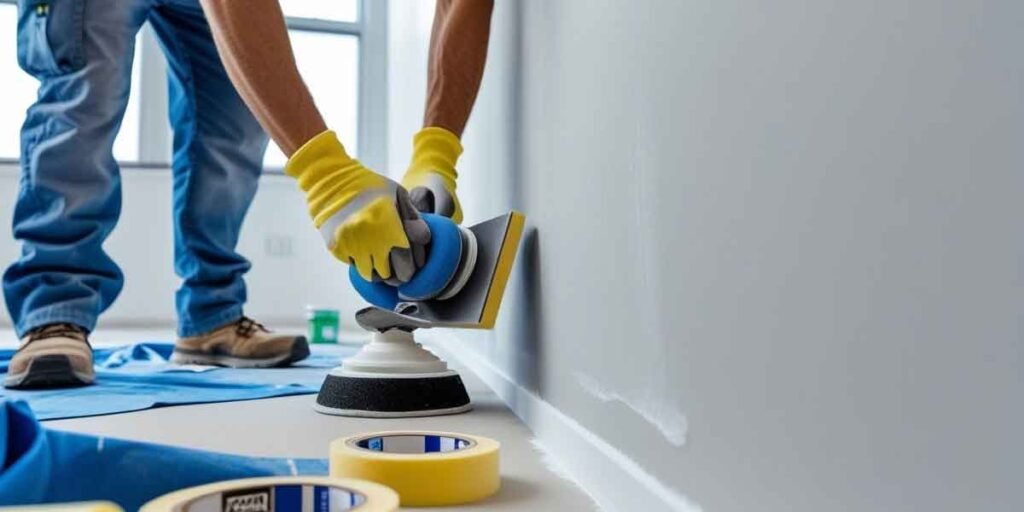
Most wall dirt comes off with warm water and a few drops of dish soap. What decides whether the new coat holds in paint preparation is the residue you are lifting, not how hard you scrub.
Paint preparation rests on one physical rule: paint bonds to the wall, not to whatever sits on the wall. Dust, cooking grease, smoke film, dried soap, and mold each fail differently under a fresh coat, and each one lifts with a different product.
The useful order runs backward from the bucket. Identify the residue, test it somewhere hidden, pick the cleaner, then wash and rinse. Some walls also carry conditions that end the do-it-yourself version of the job.
What Is Actually on the Wall?
Five residues cover nearly every painted wall: household dust, kitchen grease, smoke film, dried soap and mineral film, and mold. Dust and soap film lift with warm soapy water, grease and smoke film need a degreaser, and mold needs a detergent wash plus a fix to the moisture that feeds it.
Cooperative Extension bulletins gave the order long before spray bottles arrived: brush down the cobwebs and dust, wash, then rinse. Work the ceiling first, then the walls from the top down, with a dust mop, a cloth tied over a broom, or the brush attachment on a vacuum.
Dust first is not fussiness. Dry dust that meets a wet sponge becomes a thin paste, and that paste works into seams, wallpaper edges, and the gap above the baseboard where a sponge cannot reach back in to get it out.
A hallway wall that has never seen a stove gives up a grey film in one pass. The wall beside a range hood still feels faintly tacky two days after it was wiped, and that tack is the residue that ruins the next coat.
The Rag Test
Wipe a one-foot square of wall with a clean white cloth dampened with warm water, then look at the cloth. Grey or black means dust and smoke film, amber and slick means cooking grease, and blotches that spread under the cloth instead of lifting are mold.
Run the test somewhere it will not show, low on a wall or behind furniture, and read the result before you mix a bucket.
The same patch answers a second question. Extension guidance treats washing as something a wall has to qualify for: wash a hidden spot with sudsy water, and if the coating does not fade, run, or peel, the wall can be washed. A wall that fails that check leaves the cleaning stage behind and moves into paint preparation, where the coating itself gets handled.
Grease is the residue that costs the most to miss. I washed a kitchen wall once with soap and warm water, waited a day, and rolled two coats. The yellow came back through inside a month, in the shape of the cooking zone.
Paint Preparation: Matching the Cleaner to the Residue
Paint preparation products are not interchangeable. Warm water with a few drops of dish soap handles dust, smoke film, and ordinary grime; trisodium phosphate or a phosphate-free substitute cuts heavy grease; diluted chlorine bleach is for mold on hard surfaces; household ammonia, about a quarter cup to a gallon of sudsy water, cuts grease on painted woodwork.
Two buckets do more for the next coat than any product swap:
- Wash bucket with warm water and the cleaner, kept sudsy as you work.
- Rinse bucket with clean warm water and a second cloth, emptied as soon as it clouds.
Extension bulletins are specific about both the rinse and the gloves, because dirty water redeposits what you just lifted and household ammonia is strong enough to hurt skin.
Surface type changes how much water a wall will take. Extension washing instructions single out wallpaper as the fragile case that gets a hidden-patch test before a full wash, and they route painted woodwork through the same suds with the ammonia mix for greasy trim. Bare paper and joint compound are the two surfaces where a wrung-out cloth beats a wet sponge.
Do not combine cleaners.
EPA’s mold guidance is explicit that a chlorine bleach solution never goes into a solution or detergent that contains ammonia, since the mixture can release toxic fumes.
Work one reachable section at a time, starting low on the wall and moving up, so suds do not run down over dry wall and streak it.
Dark and matte coatings leave less room for error, because streaks and dry rings sit on the wall instead of disappearing into a sheen. Extension guidance handles that with small sections, rinsed and wiped dry before the next one starts.
Scrubbing harder is the wrong lever. The guidance for a very dirty wall is to wash it twice, and to throw out the water as soon as it turns grey, instead of pressing down on a sponge for another pass.
Where Cleaning Walls Stops Being a Homeowner Job
Five conditions move wall cleaning out of do-it-yourself scope: mold covering more than about ten square feet, a moisture problem that has not been fixed, coatings that may contain lead, water damage that has reached the materials behind the wall, and mold on materials that cannot be cleaned.
EPA draws the mold line at a patch smaller than roughly three feet by three feet, which a homeowner can usually handle with detergent, water, and protection. Growth beyond that, or growth that followed a lot of water damage, belongs with remediation guidance and contractors who do that work.
The moisture is the part homeowners skip. EPA’s cleanup standard is that the water or moisture problem has to be completely fixed before the cleanup can be called finished, which puts a leaking pipe or a failed flashing detail ahead of any paint on the schedule.
Lead paint adds a boundary that no amount of washing changes. The federal government banned lead paint sales for housing in 1978, and EPA estimates that about three quarters of homes built before that year still hold some of it. Paid work that disturbs those coatings falls under the Renovation, Repair and Painting rule.
Interior work that breaks more than six square feet of painted surface in a room, exterior work above twenty square feet, and separate jobs in the same room within thirty days all count as one job. Owners working on their own home sit outside the rule, while owners who rent it out, run a child-care program there, or renovate to resell do not.
Cleaning sits right at that line. A wet cloth does not disturb a coating, while scraping, sanding, or dry sweeping loose paint does, and that is the point to stop and hand the work to a lead-safe certified contractor, or to follow EPA’s lead-safe practices if the work is your own.
This is the half of paint preparation that gets skipped, because the wall looks the way it did before anyone touched it.
Porous materials get their own answer, since moldy ceiling tiles, carpet, and similar absorbent surfaces are often not cleanable and may have to be discarded instead.
Those five conditions are safety and regulatory lines instead of cleaning preferences, and each one ends the do-it-yourself version of the job.
Drying and the Final Check
Rinse the wall with clean water, wipe it with a dry cloth, and let the remaining moisture leave on its own. The gate before the first coat is a second clean cloth that still comes away white.
A wall that looks bright is not proof of anything, especially under a window or above a radiator where light hides a thin film. Wipe a different spot and look at the cloth rather than the wall.
If color shows up, that section gets washed and rinsed again. Cleaners that stay behind work against the next coat. The rinse bucket earns its place for exactly that reason.
Frequently Asked Questions
Do walls need to be cleaned before painting if the old paint looks fine?
Yes, because anything a cloth can lift off the wall sits between the old coating and the new one. Dust, grease, and smoke film are the three worth catching before the paint can opens. Old paint that looks fine says nothing about what is sitting on it.
Can dish soap be used for wall paint preparation?
Warm water with a few drops of mild dish soap is the traditional wash for paint preparation, and extension guidance pairs it with a second bucket of clean water for rinsing. That second pass carries the lifted soap away. Skip it and the film stays on the wall for the next coat to cover.
Can you paint over mold on a wall?
Painting over mold leaves the moisture problem in place. EPA guidance is to scrub the wall with detergent and water, dry it completely, and fix the water source first. A film of paint substitutes for none of those steps.
How long should walls dry before the first coat?
Long enough that the wall feels dry to the hand and shows no damp patches, which is what “dry completely” means in EPA’s cleanup guidance. Humid weather and thick textured walls take longest, and a dry-cloth pass after rinsing shortens the wait.
The cloth test is the gate, and the whole job hinges on it: color on white cotton means washing again, and a clean cloth means the wall is ready for paint.
