The Spark of Rebellion
In the late summer of 1921, the rugged mountains of West Virginia became the stage for a conflict unlike any other in American history. What began as a march for union rights quickly escalated into the largest armed labor uprising since the Civil War. The Battle of Blair Mountain was the violent climax of the long-simmering West Virginia Mine Wars, pitting thousands of coal miners against the powerful coal operators and their hired forces.
This was not merely a dispute over wages; it was a fight for basic human dignity and the right to organize. The miners, many of them World War I veterans, were prepared to use their military training to challenge a system that had systematically oppressed them for decades.
The Company Town System: Seeds of Conflict
For generations, coal miners in the southern counties of West Virginia lived under a system of near-total control known as the company town. The coal operators owned everything: the houses, the stores, and even the local law enforcement. Miners were paid low wages, often in company-issued currency called “scrip,” which could only be used at the inflated company stores.
Safety conditions in the mines were deplorable, and any attempt to unionize was met with brutal force. The operators employed private detective agencies, most notably the Baldwin-Felts, to intimidate workers, enforce evictions, and ensure that the United Mine Workers (UMW) union remained locked out of the region.
Yellow Dog Contracts and Scrip
The companies forced workers to sign “yellow dog contracts,” pledges that they would not join a union. Those who dared to organize were immediately fired and evicted from their company-owned homes, often at gunpoint. This repressive environment created a powder keg of resentment, waiting only for a spark to ignite.
The Road to War: Matewan and the Assassination
The tension first boiled over in May 1920 with the Matewan Massacre, a shootout between Baldwin-Felts agents and pro-union townspeople, including Police Chief Sid Hatfield. The incident left ten men dead and turned Hatfield into a folk hero for the miners.
The final tipping point came on August 1, 1921, when Hatfield was assassinated by Baldwin-Felts agents on the steps of the McDowell County Courthouse. Outraged and convinced that the system would never grant them justice, thousands of miners mobilized.
The March of the Red Neck Army
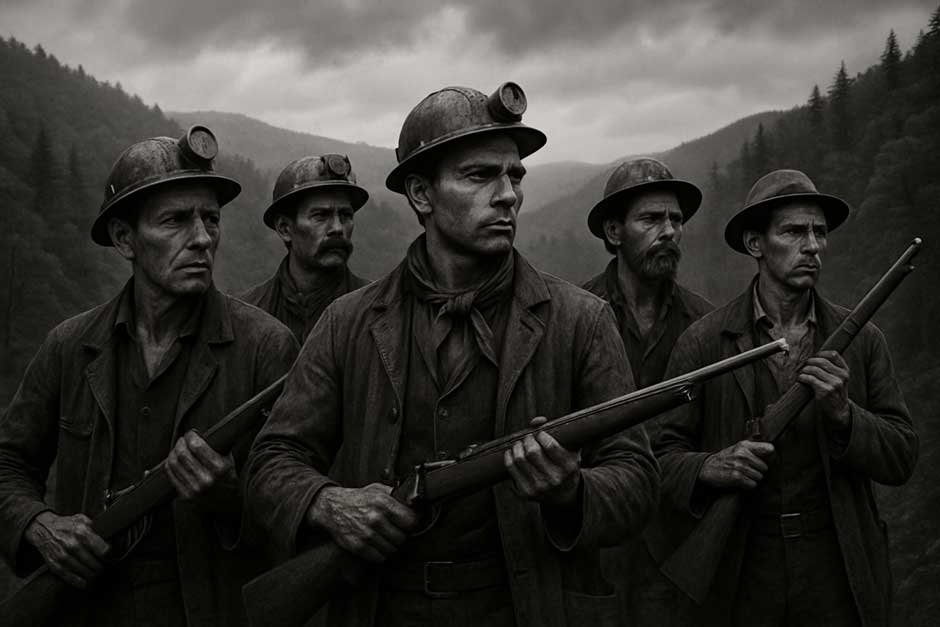
By late August, nearly 10,000 armed miners had gathered near the state capital of Charleston. Their goal was to march south to Mingo County to free their jailed comrades and finally break the grip of the coal operators’ control. To distinguish themselves in the dense forests, many of the marchers tied red bandanas around their necks, earning them the nickname “The Red Neck Army.”
The miners, led by figures like Frank Keeney and Fred Mooney, were a formidable force. They carried military-issue rifles and shotguns, determined to cross Logan County, a stronghold of anti-union power.
The Defenders of Logan County
Standing in their way was Sheriff Don Chafin of Logan County, a man fiercely loyal to the coal operators who had financed his political machine. Chafin scraped together a private army of around 3,000 men, a mix of deputies, state police, and citizen militiamen, known as the Logan Defenders.
Chafin’s forces fortified the ridge of Blair Mountain, setting up machine gun nests and trenches along the 2,000-foot peak. He vowed that “No armed mob will cross the Logan County line,” setting the stage for a direct and bloody confrontation.
Five Days of Fire: The Battle on the Ridge
The fighting began in earnest on August 31, 1921, and raged for five days. The miners repeatedly assaulted the Defenders’ lines, often surging forward only to be repulsed by heavy machine gun fire. The hills and hollows of Blair Mountain echoed with the sound of relentless gunfire.
It was a chaotic and brutal affair, with both sides suffering casualties. The exact number of dead remains unconfirmed, with estimates ranging from 20 to over 100.
The Shock of Aerial Bombardment
In a shocking escalation, Sheriff Chafin ordered private biplanes to fly over the miners’ positions. These planes dropped homemade explosives—pipe bombs filled with nuts and bolts—and even chemical weapons, including tear gas and nausea-inducing gas bombs. This marked one of the few times in American history that citizens were subjected to aerial bombardment on their own soil.
Federal Intervention and the Bitter End
The scale of the conflict eventually forced the federal government to act. President Warren G. Harding ordered federal troops, including a squadron of Army Air Service reconnaissance planes, to the area. The miners, who were not rebelling against the U.S. government but against local corruption, willingly surrendered to the federal soldiers.
The intervention effectively ended the battle on September 4, 1921. In the short term, the miners suffered a crushing defeat. Their leaders were indicted for treason and murder, and the UMW’s organizing efforts were severely hampered for years.
A Legacy Forged in Coal and Blood
Despite the immediate failure, the Battle of Blair Mountain is now recognized as a pivotal chapter in American labor history. The sheer scale of the uprising exposed the brutal realities of the company town system and the desperate plight of the miners.
The fight for workers’ rights in West Virginia would continue, eventually leading to the successful unionization of the coalfields under the New Deal legislation of the 1930s. Today, Blair Mountain stands as a powerful, enduring symbol of the American worker’s struggle for justice and the right to a fair life.
