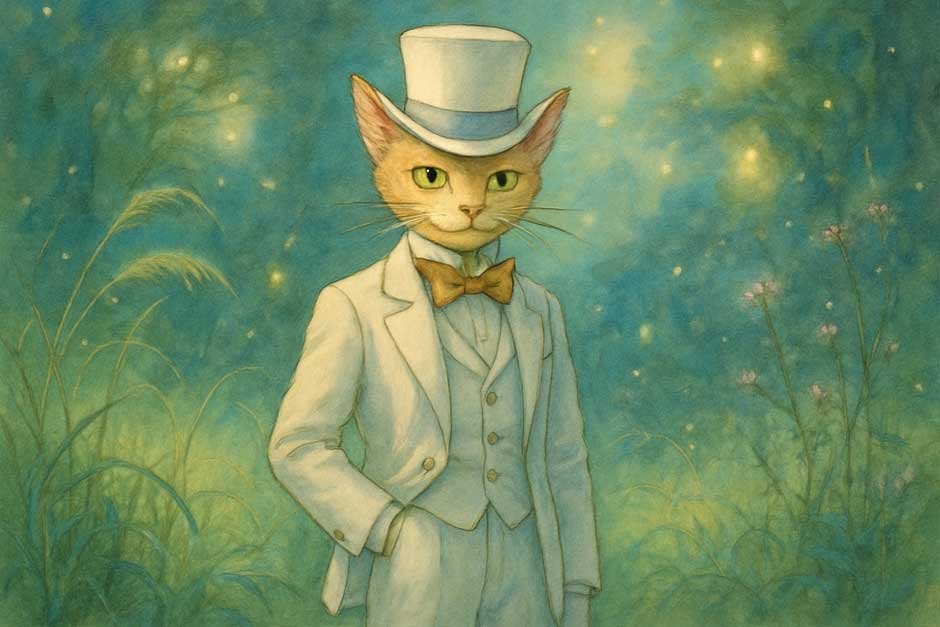
What if the mundane act of saving a stray cat could spiral into a fantastical, life-altering journey? For Haru Yoshioka, a shy and unremarkable high school student, this is precisely what happens in The Cat Returns. This 2002 Studio Ghibli film, directed by Hiroyuki Morita, is often seen as a lighter, more whimsical entry in the studio’s celebrated catalog.
Yet, beneath its charming surface, the film offers a profound meditation on self-discovery, agency, and the seductive nature of escapism. It is a story that resonates deeply with anyone who has ever felt overwhelmed by the pressures of their own reality.
A Spin-Off’s Charm: Connecting to Whisper of the Heart
The film’s origins are rooted in a previous Ghibli work, Whisper of the Heart (1995). It was originally conceived as a short project, but eventually expanded into a feature-length film.
The Cat Returns serves as a spiritual spin-off, bringing back two beloved characters: the elegant, dapper statue-turned-cat, Baron Humbert von Gikkingen, and the large, grumpy white cat, Muta. Their reappearance links the two narratives, suggesting that the events Haru experiences might be the very fantasy novel being written by Shizuku in the earlier film.
This connection adds a layer of meta-narrative charm, grounding Haru’s adventure in the creative imagination of another Ghibli protagonist.
The Allure of the Cat Kingdom: Escapism and Identity
Haru’s life is marked by a quiet sense of dissatisfaction and a lack of direction. When she saves the life of a mysterious cat, who turns out to be Prince Lune of the Cat Kingdom, she is showered with overwhelming, and often unwanted, gifts.
Her half-hearted acceptance of a marriage proposal to the Prince is all the Cat King needs to whisk her away to his bizarre, theatrical domain. The Cat Kingdom is a place of architectural excess and exaggerated scale, a perfect projection of Haru’s subconscious desire to flee her mundane life.
It initially offers a tempting form of relief from embarrassment and responsibility. However, the film quickly reveals that this escapism is a trap, replacing familiar pressures with a more insidious form of control and conformity.
The Slow Transformation: A Metaphor for Lost Selfhood
The most potent symbol in Haru’s journey is her slow, physical transformation into a cat. As she spends more time in the Cat Kingdom, she begins to grow whiskers, pointed ears, and a tail.
This metamorphosis is a powerful visual allegory for the erosion of identity. The more Haru aligns herself with the Kingdom’s demands and the more she accepts the role thrust upon her, the more her sense of self dissolves.
It serves as a cautionary tale: abandoning one’s individuality for the illusion of ease or belonging can lead to the complete loss of who one truly is. Her humanity is literally at stake until she finds the will to resist.
The Baron’s Counsel: Believing in the Self
Fortunately, Haru is not alone. She is guided by the suave and philosophical Baron, who is not merely a rescuer but a mirror for Haru’s latent potential. He is the embodiment of the composure and self-respect she lacks.
His iconic counsel, “Believe in yourself,” is the thematic core of the entire film. The Baron does not fight Haru’s battles for her; instead, he models dignity and guides her toward the internal fortitude she needs to reclaim her life.
Alongside the Baron is Muta, whose gruff exterior hides a deep loyalty, and the stone raven Toto, who aids in their escape. These companions represent the support system Haru needs to navigate her psychological crisis.
The Great Escape and the Return to Reality
The climax of the film is a thrilling, almost frantic escape from the collapsing, unstable towers of the Cat King’s castle. This physical flight mirrors Haru’s psychological breakthrough.
She finally asserts her own will, rejecting the King’s demands and embracing the difficult reality of her human life. Her decision to return is not a rejection of fantasy, but a profound reclamation of selfhood.
Haru re-enters her world with a transformed understanding of herself—more grounded, more autonomous, and less dependent on external validation. The film’s final scene, where she casually dismisses news of a former crush, completes her arc, showing that what once felt important now holds little gravity.
Conclusion: Finding Purpose in the Ordinary
The Cat Returns may be one of Studio Ghibli’s shortest and most lighthearted features, but its message is enduring. Haru’s journey illustrates that the greatest return is not to a place, but to oneself.
The film teaches that fulfillment arises not from altering one’s world or escaping into a fantasy, but from cultivating the inner resilience required to inhabit it fully. Haru’s adventure is a quiet triumph of self-realization, proving that identity is found when we stop fleeing our own lives.
Frequently Asked Questions About The Cat Returns
Is The Cat Returns a sequel to Whisper of the Heart?
No, The Cat Returns is considered a spin-off, not a direct sequel. It features characters (Baron and Muta) who first appeared in a fantasy sequence within Whisper of the Heart. Many fans interpret the events of The Cat Returns as the story that the protagonist of Whisper of the Heart, Shizuku, was writing.
Who are Baron and Muta?
Baron Humbert von Gikkingen is an elegant, anthropomorphic cat figurine who runs the Cat Bureau. He is a symbol of dignity and self-respect. Muta, whose full name is Renaldo Moon, is a large, cynical white cat and a notorious figure in the Cat Kingdom. They are Haru’s primary guides and protectors.
What is the main theme of the movie?
The main theme is self-acceptance and finding one’s own voice. The film explores the dangers of escapism and the importance of believing in oneself. Haru’s journey is about learning to value her ordinary life and finding the confidence to face her problems instead of running away from them.
