Early Life and the Warhol Influence
David LaChapelle, born in 1963, showed an early passion for art, initially enrolling as a painter at the North Carolina School of the Arts. His artistic journey began with an analogue technique, hand-painting his own negatives to achieve the intense, saturated color that would become his trademark.
A pivotal moment arrived when he moved to New York City as a teenager. After his first photography show, he was discovered by Andy Warhol, who hired him to work for Interview Magazine.
Warhol’s simple instruction—”Do whatever you want. Just make sure everybody looks good”—gave LaChapelle the creative freedom to develop his unique, narrative-driven style, setting the stage for his explosive career.
Defining the LaChapelle Aesthetic: Kitsch, Color, and Surrealism
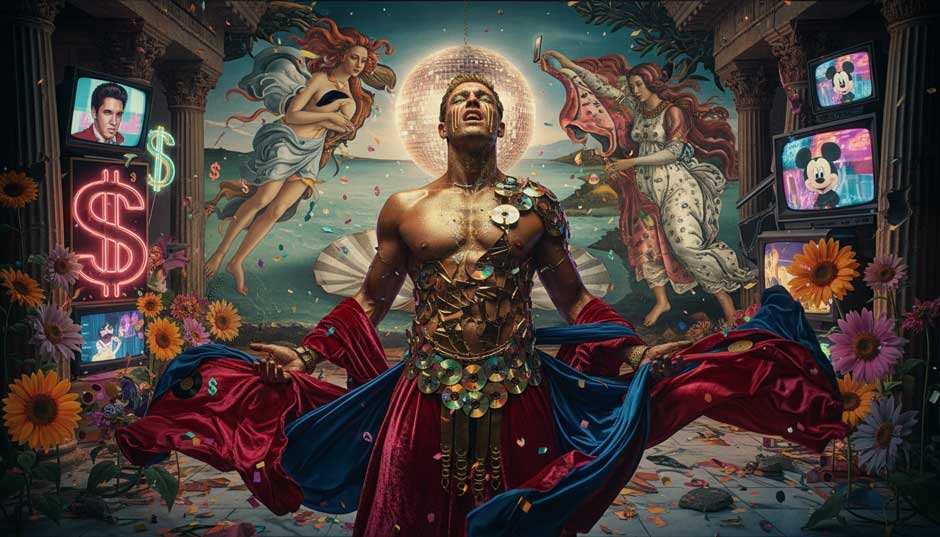
LaChapelle’s photographic style is instantly recognizable and has been described by critics as “hyper-real and slyly subversive.” It is a bold blend of high art and low culture, often categorized as “kitsch pop surrealism.”
His images are characterized by a masterful use of vibrant, almost electric color and meticulously constructed, elaborate sets. He transforms the traditional photographic tableau into a theatrical stage, where reality is heightened and exaggerated.
This distinctive aesthetic, which has earned him the moniker “the Fellini of photography,” challenges the viewer to look beyond the surface and engage with the underlying narrative.
The Intersection of Commercial and Fine Art
For decades, LaChapelle dominated the worlds of fashion and celebrity portraiture, shooting for major publications like Vogue, Vanity Fair, and Rolling Stone. He became the go-to photographer for iconic figures, capturing the likenesses of everyone from Madonna and Lady Gaga to Kanye West and Leonardo DiCaprio.
His commercial work was never purely transactional; it was always infused with his artistic vision, pushing the boundaries of what magazine photography could be. This success allowed him to fund and pursue his more personal, fine art projects.
In recent years, LaChapelle has shifted his focus almost entirely back to fine art photography, with his work being exhibited in prestigious museums and galleries worldwide, confirming his status as a serious contemporary artist.
Key Themes and Social Commentary
LaChapelle’s work is a powerful mirror reflecting the complexities of modern society. Beneath the dazzling spectacle of his images lies a sharp, often satirical, social commentary.
Consumerism and Celebrity Culture
Many of his most famous pieces critique the excesses of consumerism and the cult of celebrity. He uses exaggeration and parody to expose the superficiality and sometimes destructive nature of fame, often depicting celebrities as modern-day mythological figures or religious icons.
Religion and Iconography
A recurring theme is the blending of classical art history and religious iconography with contemporary pop culture. LaChapelle frequently references Renaissance paintings and biblical scenes, reinterpreting them with a modern, often provocative, sensibility to explore timeless questions of morality and faith.
Redemption and Paradise
In his later work, particularly after a period of self-imposed retreat, LaChapelle began exploring more spiritual themes. His recent series focus on ideas of redemption, the environment, and the search for paradise, moving away from the celebrity-driven narratives toward a more contemplative and profound artistic expression.
Beyond Photography: Film and Music Videos
LaChapelle’s visual genius was not confined to still photography. He successfully translated his unique style to moving images, directing numerous acclaimed music videos for artists like Christina Aguilera, Moby, and Jennifer Lopez.
His 2005 feature-length documentary, Rize, which explored the South Central Los Angeles street dancing phenomenon of “krumping,” showcased his ability to capture raw, authentic human experience while maintaining his signature visual flair.
The Enduring Legacy of David LaChapelle
David LaChapelle has left an indelible mark on the visual culture of the 21st century. His pioneering work blurred the lines between commercial photography, fine art, and popular media, influencing a generation of photographers and visual artists.
His ability to create images that are both visually stunning and intellectually challenging ensures his place in art history. LaChapelle’s hyper-real, vibrant world remains a compelling and essential commentary on the age of spectacle.
