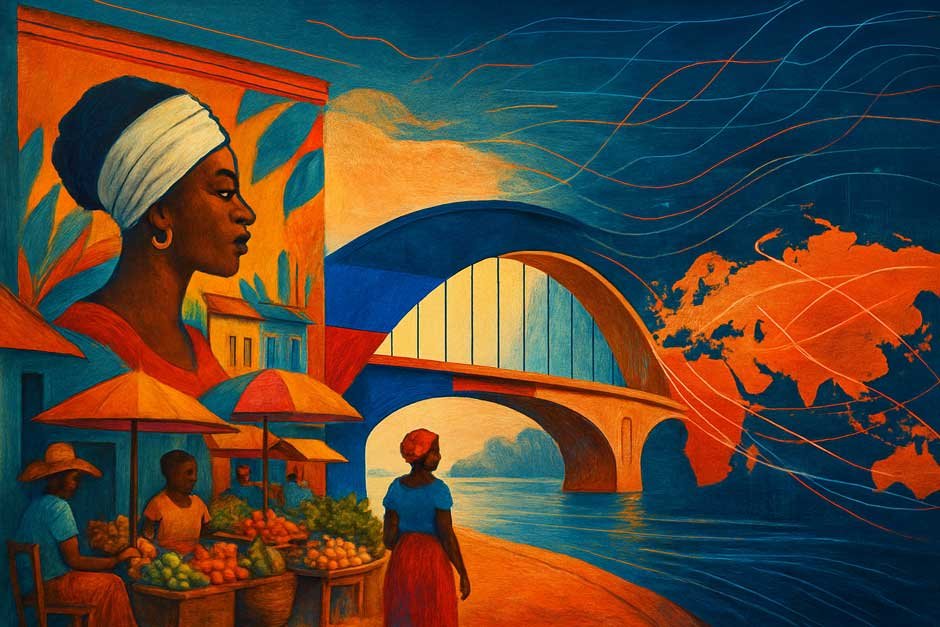
Is the journey from **Haitian Creole to English** merely a linguistic exercise, or is it a profound voyage into the heart of a nation’s culture and history? For many, the task of accurate translation is far more complex than simply swapping words between two languages. It is an act of cultural stewardship, requiring a deep appreciation for the nuances that make Kreyòl Ayisyen so unique.
The Linguistic Tapestry of Haitian Creole
Haitian Creole, or Kreyòl Ayisyen, is a French-based creole language spoken by nearly all of Haiti’s population. It is one of the country’s two official languages, alongside French, and serves as the vibrant, everyday voice of the people.
Its structure is a fascinating blend, drawing heavily from 18th-century French vocabulary but possessing a distinct West African-influenced grammar. This unique heritage means that a direct, word-for-word translation often fails to capture the intended meaning or cultural weight of a phrase.
Understanding the historical context of its formation—born from the necessity of communication among enslaved people from various African language groups—is crucial. This history imbues the language with a resilience and expressiveness that translators must honor.
Hurdle 1: The Challenge of Standardization and Variation
One of the primary difficulties in translating **Haitian Creole to English** stems from the language’s relative lack of universal standardization. While a standardized orthography exists, regional and social variations are common.
Vocabulary and even pronunciation can shift subtly across different regions of Haiti, and among the diaspora communities worldwide. A term used in Port-au-Prince might carry a different connotation in a rural area.
For a translator, this means relying less on rigid dictionary definitions and more on contextual and cultural immersion. It demands a flexible, investigative approach to ensure the translation is accurate for the specific audience and setting.
Hurdle 2: Decoding Idioms and Proverbs
Haitian Creole is exceptionally rich in proverbs (pwovèb) and idiomatic expressions, which serve as a repository of the nation’s wisdom and social commentary. These phrases are often metaphorical and cannot be translated literally.
Consider the proverb, “Dèyè mòn gen mòn,” which literally means “Behind mountains are mountains.” Its true meaning, however, is “Beyond every problem, there is another problem,” or “There is always more work to be done.”
A translator’s skill is truly tested in conveying the emotional and philosophical depth of these expressions into English. It requires translating the **meaning** and the **spirit**, not just the individual words.
Hurdle 3: Navigating Cultural and Social Context
Language is inextricably linked to culture, and Haitian Creole is no exception. Many expressions are deeply rooted in Haitian history, social structures, and traditional beliefs, including Vodou.
The formality of speech, for instance, is heavily influenced by social dynamics, age, and respect. Knowing when to use the formal “ou” versus the informal “w” (though less pronounced than in French) or choosing the appropriate greeting is a cultural act.
A successful translation must possess **cultural fidelity**. It must ensure that the content resonates with the English-speaking audience without stripping away the essential Haitian soul and context of the original message.
Strategies for Effective Haitian Creole to English Translation
Embrace Contextual Translation
The most effective strategy is to move beyond lexical equivalence and embrace contextual translation. This involves reading the entire text, understanding the author’s intent, and then finding the most natural and equivalent expression in English.
This approach is particularly vital when dealing with technical or specialized vocabulary that may not have a direct, one-to-one counterpart. The translator acts as a cultural mediator, bridging two distinct worldviews.
Utilize Modern Translation Tools Wisely
While machine translation tools have improved, they should be used as aids, not replacements for human expertise. Tools can provide a quick first pass, but a human translator is essential for correcting cultural missteps and idiomatic errors.
Specialized glossaries and dictionaries, often compiled by linguists and native speakers, are invaluable resources. They help to navigate the regional variations and the evolving lexicon of Kreyòl Ayisyen.
Prioritize Clarity and Natural Flow in English
The final English output must read naturally to a native speaker. A translation that is too literal often sounds awkward or stilted, a common pitfall when translating from a creole language.
The goal is to produce a text that is not only accurate but also engaging and fluent. This often requires restructuring sentences and choosing English vocabulary that matches the tone and register of the original Creole.
The Future of Haitian Creole to English Communication
As the Haitian diaspora grows and global communication increases, the demand for skilled translators who can navigate the complexities of **Haitian Creole to English** will only rise. This work is critical for diplomacy, humanitarian aid, business, and cultural exchange.
The effort to translate Kreyòl Ayisyen is more than a professional service; it is a vital contribution to preserving and sharing the rich heritage of Haiti with the rest of the world. It ensures that the voices, stories, and wisdom of the Haitian people are heard clearly and respectfully across linguistic borders.
