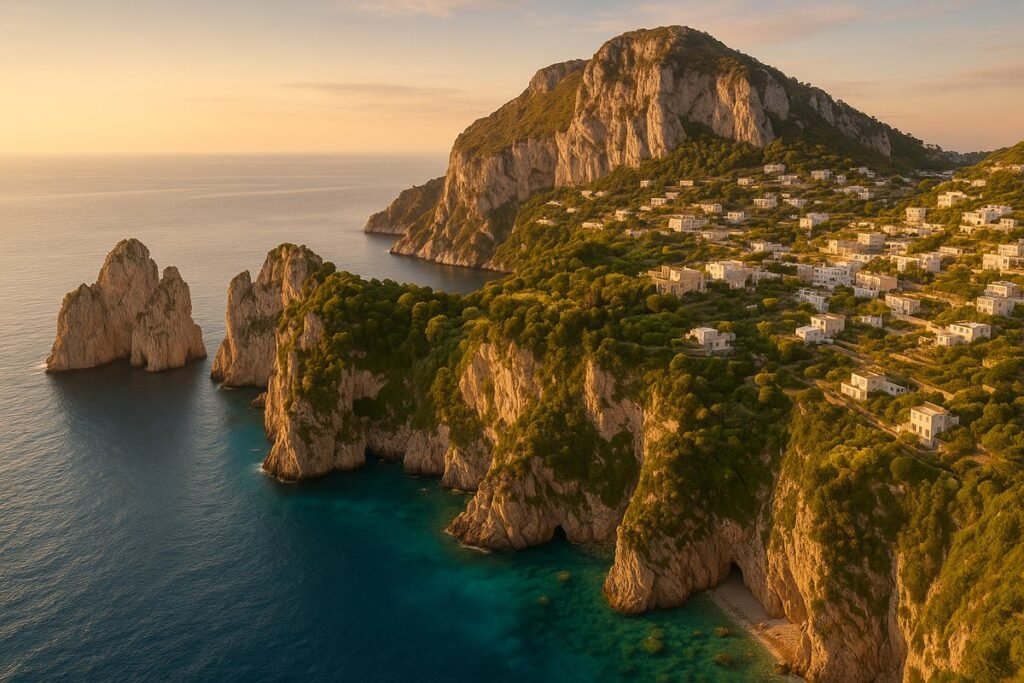
When people ask, “how old is Capri?”, the answer is more complex than a single number. This legendary island in Italy’s Bay of Naples has two distinct ages: a geological story that stretches back millions of years, and a human history that is ancient in its own right.
Capri is a place where dramatic cliffs meet sparkling blue waters, a destination that has captivated emperors, artists, and travelers for centuries. To truly understand its age, one must look deep into the rock it’s made from and trace the footsteps of those who have called it home.
The Geological Origins of Capri
The geological age of Capri is staggering. The limestone rock that forms the island’s foundation dates back between 65 and 190 million years ago, to the Jurassic and Cretaceous periods. Imagine dinosaurs roaming the Earth as these rocks were slowly forming under a shallow sea.
The island’s current dramatic shape, however, was established much more recently. Around 40 to 50 million years ago, during the Eocene epoch, tectonic forces pushed and sculpted the land into the two main massifs we see today: Capo to the east and Monte Solaro to the west.
For a time, Capri was not an island at all. During the Pleistocene era, a thin strip of land connected it to the Sorrentine Peninsula, allowing large mammals to migrate across. Eventually, rising sea levels submerged this connection, creating the island we know and love.
Prehistoric Inhabitants and Early Settlement
While the rock is ancient, the story of human life on Capri began in prehistoric times. Archaeological evidence shows that humans inhabited the island during the Stone Age. The first significant discoveries were made in 1882 at the Grotta delle Felci, or Cave of Ferns.
These early excavations, and others that followed, unearthed stone artifacts and even the remains of long-extinct animals. This confirmed that Capri has been a site of human activity for thousands of years, long before written history began.
Greek mythology even speaks of the island’s first inhabitants, a people known as the Teleboi. While their existence is legendary, it adds another layer to the deep and ancient history of Capri.
The Greek and Roman Eras
The recorded history of Capri island starts to take shape with the arrival of the Greeks. Beginning in the 8th century BC, Greek colonists settled the region, establishing two towns on the island by the 5th or 4th century BC.
Capri’s most famous historical chapter began with the Romans. In 29 BC, the Emperor Augustus was so enchanted by the island that he acquired it from the city of Naples. He established a residence there, marking the beginning of Capri’s time as an exclusive imperial resort.
His successor, the Emperor Tiberius, fell even more deeply in love with the island, spending the last ten years of his life ruling the Roman Empire from his magnificent villas. He built twelve villas across Capri, the most famous of which, Villa Jovis, still has impressive ruins that visitors can explore today.
Medieval Times Through the Renaissance
After the fall of the Roman Empire, Capri’s history became more turbulent. Fearing raids from pirates, the population moved from coastal areas to the more defensible high ground, establishing the towns of Capri and Anacapri in the 10th century.
Over the following centuries, the island fell under the control of various powers, including the Republic of Amalfi and the Kingdom of Naples. During the Napoleonic Wars, it was even occupied alternately by French and British forces before being returned to the Kingdom of the Two Sicilies in 1813.
This period was marked by struggle and change, a stark contrast to the peace and opulence of the Roman era. Yet, the island’s resilient community and strategic importance ensured its continued presence on the historical map.
Modern Rediscovery and Tourism Boom
The 19th century marked a cultural renaissance for Capri. Its rediscovery began in earnest in 1826 with the public unveiling of the Blue Grotto, a sea cave filled with an ethereal blue light. This natural wonder captivated artists, writers, and intellectuals from across Europe.
This newfound attention transformed Capri into one of southern Italy’s most popular resorts by the late 19th century. The 20th century brought further modernization, including the construction of the funicular railway, which made the island more accessible than ever.
Today, Capri is a world-famous destination, known for its stunning scenery, luxury shopping, and timeless charm. It continues to enchant visitors, just as it did Emperor Augustus over two millennia ago.
A Timeless Legacy
So, how old is Capri? It is as old as the dinosaurs in its geology, as ancient as the first human settlers in its prehistory, and as rich as the Roman Empire in its documented past.
From a block of limestone formed over millions of years to a modern paradise, Capri’s age is not a single date but a continuous story of natural formation and human civilization. Its enduring appeal is a testament to its multi-layered and fascinating history, a legacy that continues to unfold.
