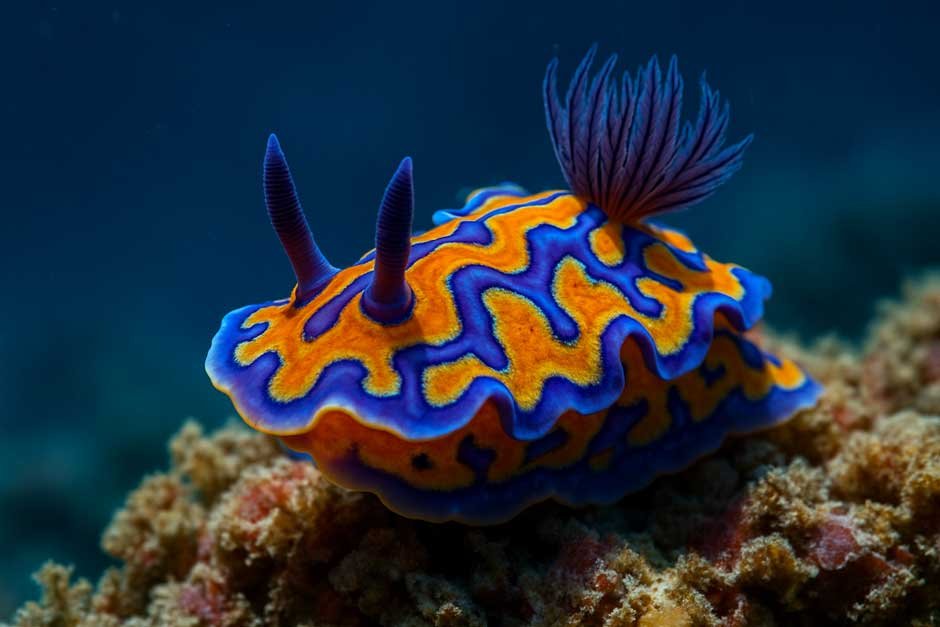
Introduction: What is a Nudibranch?
Have you ever seen a creature so vibrant, so utterly alien, that it looks like it was painted by a psychedelic artist? Deep on the ocean floor lives one such marvel: the nudibranch.
These soft-bodied marine gastropod mollusks, often affectionately called “sea slugs,” are far more than simple garden slugs of the sea. They represent an astonishing diversity, with over 3,000 known species dazzling divers and marine biologists alike.
The world of the nudibranch is one of brilliant color, sophisticated defense mechanisms, and highly specialized diets. They are a testament to the incredible evolutionary paths life can take beneath the waves.
A Rainbow Beneath the Waves: Appearance and Anatomy
The most striking feature of the nudibranch is its spectacular, often psychedelic, coloration. Unlike their snail relatives, nudibranchs shed their shells after their larval stage. This leaves them exposed, but certainly not defenseless.
Their bodies can be thick or flattened, long or short, yet they are always a canvas of nature’s most daring hues. This vibrant display is not merely for show; it is a critical part of their survival strategy.
The Meaning Behind the Name: “Naked Gills”
The name “Nudibranchia” literally translates from Latin as “naked gills.” This refers to the feathery, external gills, or branchial plume, that most species display prominently on their backs.
These gills are essential for respiration, allowing the creature to extract oxygen from the surrounding seawater. This exposed, delicate structure is a defining characteristic of the group.
Sensory Organs: The Role of Rhinophores
Perched on the nudibranch’s head are two horn-like structures called rhinophores. These are not eyes, but highly sensitive chemosensory organs.
The rhinophores allow the nudibranch to “smell” or taste chemicals in the water. This helps them locate their highly specific food sources and potential mates. They are often retracted quickly if the animal senses danger.
Masters of Defense: How Nudibranchs Protect Themselves
Without a shell to retreat into, nudibranchs have evolved ingenious and effective ways to deter predators. Their defense mechanisms are as varied and colorful as the creatures themselves.
Warning Colors: Aposematism in Action
The brilliant colors of many nudibranch species serve as a clear warning sign to potential predators. This phenomenon, known as aposematism, signals that the creature is unpalatable or toxic.
A hungry fish that attempts to eat a brightly colored nudibranch often learns a painful lesson. This ensures that the next time, it will steer clear of similar-looking prey.
Stealing Venom: The Kleptocnidae Strategy
Perhaps the most astonishing defense mechanism is the ability of some nudibranchs to “steal” the stinging cells, or nematocysts, from their prey, such as hydroids and sea anemones.
They ingest these cells without triggering them. They then transport them through their digestive system and store them intact in specialized sacs at the tips of their cerata (finger-like projections on their backs). These stolen weapons are then used for their own defense, a strategy known as kleptocnidae.
A Specialized Diet: What Do Nudibranchs Eat?
Nudibranchs are carnivorous, but their diet is incredibly specialized. Most species are monophagous, meaning they feed on only one type of prey.
Their preferred meals include sponges, hydroids, bryozoans, and even other sea slugs or their eggs. This highly selective diet is often the source of their vibrant coloration.
For example, a nudibranch that feeds on a specific colored sponge will often absorb the pigment. It incorporates this color into its own tissues for camouflage or aposematic display.
Life Cycle and Reproduction
Nudibranchs are simultaneous hermaphrodites, meaning each individual possesses both male and female reproductive organs. This greatly simplifies the search for a mate, as any two individuals can reproduce.
When mating, they exchange sperm, and both individuals will later lay eggs. The eggs are typically laid in a beautiful, coiled ribbon or spiral pattern, often attached to rocks or algae. They will then hatch into free-swimming larvae.
Global Travelers: Habitat and Distribution
These fascinating creatures can be found in every ocean across the globe, from the frigid waters of the poles to the warm, tropical reefs. They inhabit a vast range of depths, from the intertidal zone down to the deep sea.
Their distribution is closely tied to the availability of their specific food source. Where the food is, the nudibranch will follow, making them excellent indicators of a healthy and diverse marine ecosystem.
Frequently Asked Questions (FAQ)
Are nudibranchs dangerous to humans?
No, nudibranchs are generally not dangerous to humans. While some species can store toxins or stinging cells for defense, these are only released when the animal is attacked or handled roughly. They pose no significant threat to divers or swimmers.
How long do nudibranchs live?
The lifespan of a nudibranch is typically quite short, ranging from a few weeks to a year, depending on the species. Their short life cycle is balanced by their rapid reproduction.
What is the difference between a sea slug and a nudibranch?
All nudibranchs are sea slugs, but not all sea slugs are nudibranchs. “Sea slug” is a broad term for marine gastropods that lack a shell. Nudibranchs are a specific order (Nudibranchia) within that group, defined by their “naked gills.”
Do nudibranchs have eyes?
Yes, nudibranchs do have simple eyes, but they are primarily used to sense light and dark, not to form detailed images. Their main senses for navigation and feeding are their rhinophores.
