Are you tired of fluctuating indoor temperatures and rising energy bills? The solution to a more comfortable home and significant savings might be right above your head: your attic insulation. This guide explores the most effective attic insulation for energy efficiency, helping you enhance your home’s comfort and reduce energy consumption.
Understanding the Core Principles of Attic Insulation
Effective attic insulation creates a thermal barrier that resists heat flow, significantly improving a home’s energy efficiency and comfort, according to property management Murrieta CA. This involves understanding heat transfer through conduction, convection, and radiation, and recognizing the role of R-value, air sealing, and moisture control in maximizing insulation effectiveness.
The Science of Heat Transfer: Conduction, Convection, and Radiation
Heat transfer is the process insulation aims to reduce. The three main mechanisms are: conduction, heat moving through solids like your ceiling; convection, heat moving via fluids like warm air rising into a colder attic; and radiation, heat transferred through electromagnetic waves such as the sun’s rays heating your roof. Effective insulation addresses all three to create a comprehensive thermal envelope.
Demystifying R-Value: What It Means for Your Home
The R-value measures an insulation material’s resistance to heat flow. A higher R-value means better thermal resistance and less heat transfer. The ideal R-value depends on your climate zone, as recommended by ENERGY STAR and the Department of Energy. Factors like compression and moisture can reduce the R-value, so proper installation and maintenance are key.
Beyond R-Value: The Crucial Role of Air Sealing and Moisture Control
R-value alone doesn’t guarantee insulation effectiveness. Air sealing and moisture control are equally vital for maximizing energy efficiency and preventing attic issues. Air leaks can cause significant heat loss as conditioned air escapes through gaps. Sealing these leaks before insulating creates a tight thermal envelope. Moisture control prevents mold, wood rot, and insulation degradation. Proper attic ventilation works with air sealing to manage humidity and condensation, ensuring insulation longevity.
Exploring the Top Attic Insulation Materials for Energy Efficiency
Choosing the right attic insulation material is crucial for optimal energy efficiency. Each type offers unique advantages regarding R-value, installation, cost, and environmental impact. Understanding these differences helps you select the best fit for your home.
Fiberglass Insulation: Batts vs. Blown-In
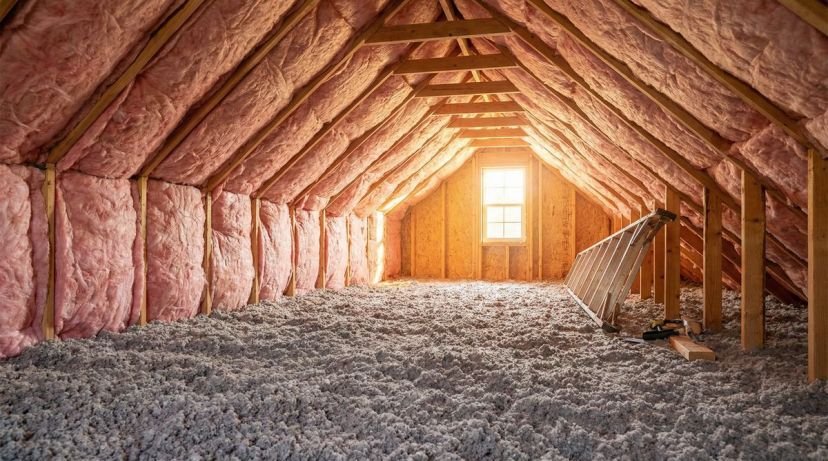
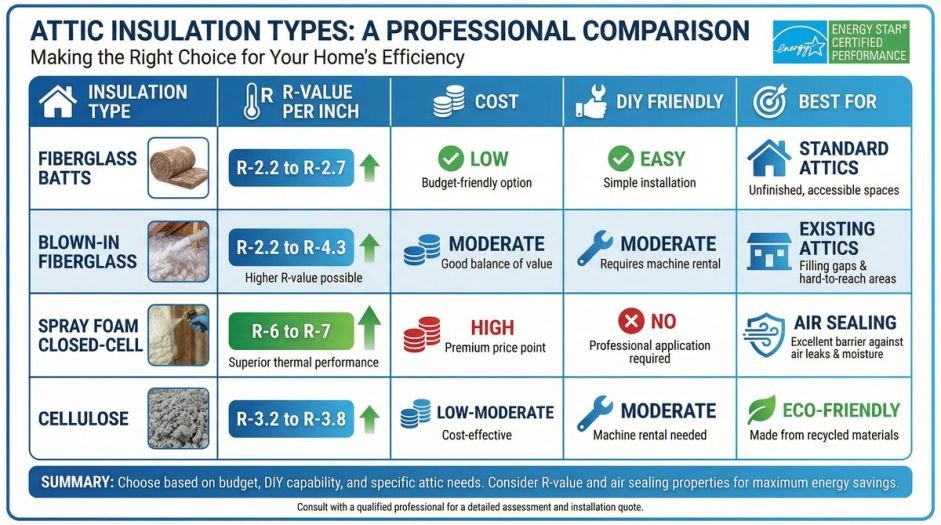
Fiberglass is common and available as batts or blown-in loose-fill. Fiberglass batts are pre-cut rolls fitting between joists, affordable and DIY-friendly but require careful installation to avoid gaps or compression that reduce effectiveness. Blown-in fiberglass fills irregular spaces better, improving air sealing. Fiberglass typically offers R-2.2 to R-4.3 per inch but is vulnerable to moisture damage and requires protective gear during installation.
Cellulose Insulation: The Eco-Friendly Performer
Made from recycled paper treated for fire and pests, cellulose is a blown-in loose-fill that fills irregular spaces densely, providing excellent sound dampening. Its R-value (R-3.2 to R-3.8 per inch) is comparable or slightly higher than fiberglass, and it reduces air movement effectively. It performs well in cold climates but can absorb moisture, risking mold if not managed. Professional installation ensures proper density and coverage.
Spray Foam Insulation: Open-Cell vs. Closed-Cell
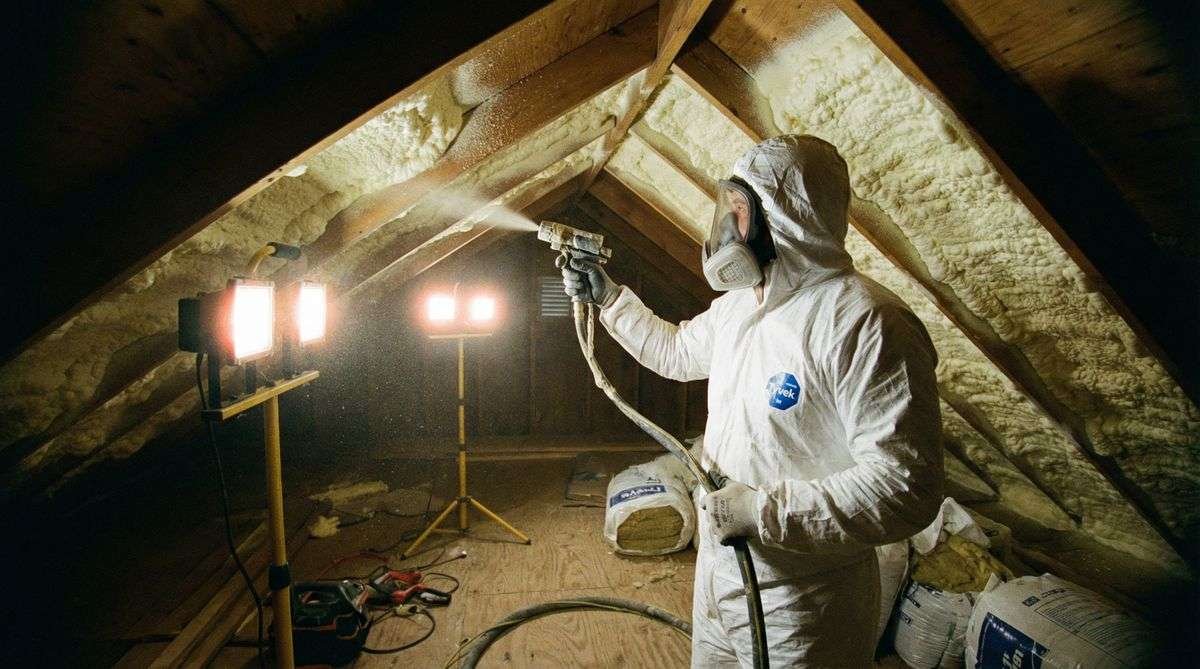
Spray foam is highly efficient due to superior air sealing and high R-values, making it a top choice for energy-efficient insulation. Open-cell spray foam is less dense, flexible, with R-3.5 to R-4.0 per inch, good for air sealing and soundproofing. Closed-cell spray foam is denser, rigid, with R-6.0 to R-7.0 per inch, providing a vapor barrier, structural support, and moisture resistance, ideal for unvented attics. Both require professional installation and have higher upfront costs offset by long-term savings.
Mineral Wool Insulation: Fire Resistance and Soundproofing
Mineral wool (rock or slag wool) is made from natural minerals or recycled byproducts. It offers exceptional fire resistance, water repellency, and sound absorption. Non-combustible and stable, it maintains R-3.0 to R-4.2 per inch without settling, resists mold, pests, and moisture. Though costlier and heavier than fiberglass, its durability and performance justify the investment. Available in batts and loose-fill.
Rigid Foam Boards: Space-Saving Efficiency
Rigid foam boards (polyiso, XPS, EPS) provide high R-values in thin profiles. They are ideal where space is limited, offering thermal resistance and often air/vapor barriers when sealed properly. Polyiso has the highest R-value (R-5.6 to R-6.5 per inch) and is fire-resistant. XPS (R-5.0 per inch) is moisture-resistant, used below grade. EPS (R-3.6 to R-4.2 per inch) is economical. Boards are durable and don’t settle but require careful sealing to prevent leaks and are often used to reduce thermal bridging.
Key Factors for Choosing the Right Attic Insulation
Selecting the best attic insulation requires evaluating your climate zone, budget, installation preferences, and attic conditions to ensure maximum energy savings and durability.
Climate Zone and R-Value Recommendations
Your location and climate determine the ideal R-value. The U.S. Department of Energy provides R-value recommendations by climate zone to protect against heat loss and gain. Colder climates need higher R-values (R-49 to R-60+), while warmer areas require lower values (R-30 to R-49) focusing on heat infiltration prevention. Following these guidelines ensures regional energy efficiency and optimal thermal performance.
Budget and Long-Term Return on Investment (ROI)
Insulation costs vary widely, but consider long-term ROI. High-performance materials like spray foam have higher upfront costs but yield greater energy savings and faster payback. Cheaper options like fiberglass batts cost less initially but may save less energy. Factor in material, installation, rebates, and tax credits, which can reduce costs and speed ROI. A well-insulated attic also boosts home resale value.
DIY vs. Professional Installation: Weighing the Options
Choosing DIY or professional installation depends on skill, job complexity, and insulation type. DIY can save labor costs, but professionals ensure proper technique, efficiency, warranties, and code compliance. Fiberglass batts are DIY-friendly for accessible attics, but blown-in and spray foam require specialized equipment and expertise, making professional installation advisable to avoid errors and maximize performance. Professionals also detect hidden issues like air leaks and ventilation problems.
Addressing Existing Attic Conditions: Ventilation and Air Leaks
Before insulating, assess attic ventilation and air leaks. Proper ventilation prevents moisture buildup that causes mold, rot, and insulation damage, while sealing air leaks stops uncontrolled airflow that reduces thermal performance. Seal gaps around fixtures, plumbing, and wiring with caulk, foam, or weatherstripping. Ensure soffit and ridge vents are clear for airflow. Addressing these improves insulation efficiency and lifespan.
Maximizing Your Insulation’s Performance and Longevity
To maintain energy savings and comfort, follow proper installation, perform regular maintenance, and avoid common mistakes that reduce insulation effectiveness.
The Importance of Proper Installation Techniques
Even top-quality insulation underperforms if installed poorly. Proper techniques ensure full coverage without gaps or compression, achieving the rated R-value and maximizing energy savings. For batt insulation, avoid gaps and compression. Blown-in materials require correct density and depth. Spray foam must be applied precisely for an effective air and vapor barrier. Follow manufacturer guidelines and hire certified professionals for complex jobs to prevent thermal bridging and inefficiency.
Regular Maintenance and Inspection Tips
Annual inspections preserve insulation effectiveness. Check for damage, moisture, pests, or settling to catch issues early. Look for darkened or matted insulation indicating leaks or moisture. Inspect for pests and ensure vents are unobstructed. Prompt repairs maintain R-value and extend insulation life.
Common Mistakes to Avoid
Avoiding errors saves time and money. Neglecting air sealing before insulating is a common mistake that undermines insulation. Compressing batt insulation reduces R-value. Poor ventilation causes moisture problems. Using inadequate R-values leads to poor performance. Failing to protect insulation from pests or moisture causes premature damage. Awareness and prevention ensure optimal insulation function.
Frequently Asked Questions About Attic Insulation
Answering common questions helps homeowners choose materials, understand maintenance, and use financial incentives for energy-efficient upgrades, creating a more comfortable and cost-effective home.
How do I know if my attic insulation needs to be replaced?
Signs include high energy bills, uneven temperatures, visible damage like sagging, mold, or pests, and insulation below recommended R-values. Old, compressed, wet, or rodent-damaged insulation likely needs replacement or augmentation. A professional energy audit can confirm.
Can I add new insulation on top of the old stuff?
Often yes, if the old insulation is dry, mold-free, and not severely compressed or damaged. Adding insulation can boost R-value cost-effectively. Address moisture or air leaks first to avoid trapping moisture. Remove contaminated or degraded insulation before adding new material.
What thickness is best for attic insulation?
Thickness depends on climate and insulation type, aiming for recommended R-values. Generally, R-38 to R-60 is advised, translating to 10 to 22 inches depending on material. Consult DOE climate zone maps and recommendations for precise guidance.
What federal tax credits are available for insulation upgrades?
Federal tax credits can cover a percentage of insulation material costs up to annual limits, reducing upgrade expenses. As of 2025, credits cover up to 30% of costs, max $1,200 annually. Check current IRS guidelines or consult a tax professional for eligibility and details.
Conclusion: A Smart Investment for a Sustainable Home
Investing in the right attic insulation for energy efficiency is key to a more energy-efficient, comfortable, and valuable home. Understanding insulation types, benefits, and influencing factors helps you make a choice that pays off for years. Transform your home into an energy-saving haven today.