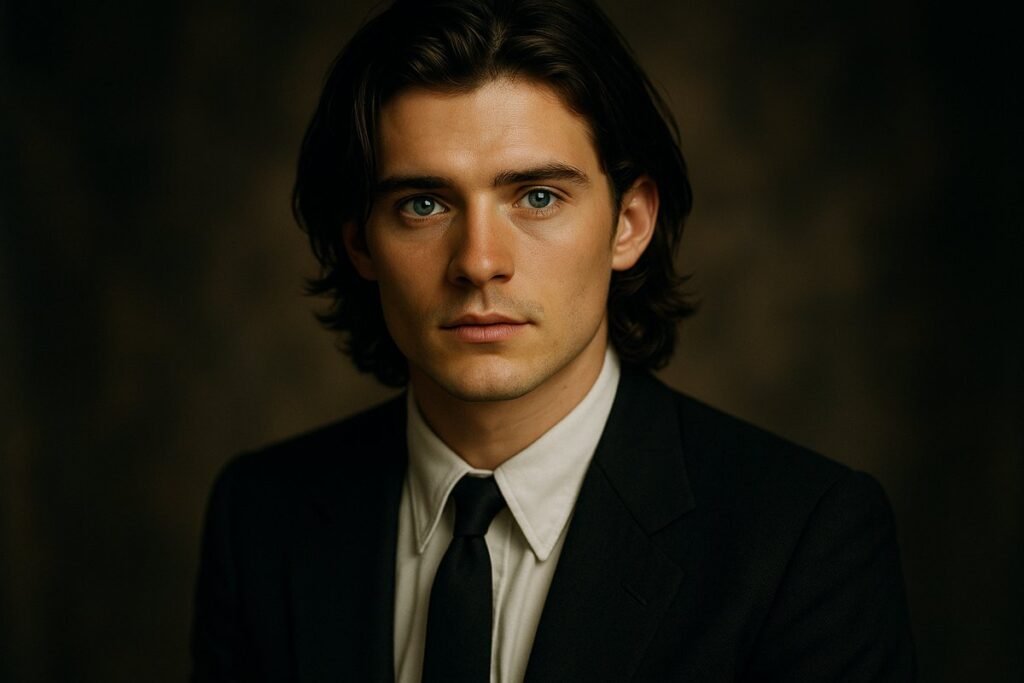
From Canterbury Roots to Childhood Dreams
In the historic city of Canterbury, England, a future star was born on January 13, 1977. Orlando Jonathan Blanchard Bloom’s journey began in a home brimming with artistic encouragement, thanks to his mother, Sonia, who ran a foreign language school and nurtured his creative spirit from the very beginning.
His childhood was profoundly shaped by his family’s unique story. For years, he looked up to his father, Harry Bloom, a renowned human rights activist and author who had bravely fought against apartheid in South Africa. Harry’s tragic death when Orlando was only four left an indelible mark on the young boy’s life.
A pivotal truth was revealed when he was thirteen; his mother shared that his biological father was Colin Stone, a close family friend who had been his guardian. Bloom embraced this complex reality with remarkable grace, later stating, “I was lucky, I had two dads.”
His path was not without obstacles. A diagnosis of dyslexia presented academic challenges, but it was through acting that he found his true calling. With his mother’s encouragement, he poured his energy into drama classes and local festivals, where his natural talent began to blossom, hinting at a future destined for the spotlight.
The Making of an Actor Through Adversity
Driven by his passion, a sixteen-year-old Orlando Bloom made the bold move to London, where he joined the esteemed National Youth Theatre. His dedication led him to further his craft at the British American Drama Academy and later at the prestigious Guildhall School of Music and Drama, honing the skills that would soon make him a star.
But his journey was almost tragically derailed. At twenty-one, a reckless moment of youthful bravado—climbing a drainpipe to a friend’s apartment—resulted in a terrifying three-story fall that broke his back. Doctors warned that he might never walk again, a devastating prognosis for a budding actor.
The road to recovery was grueling. After intensive surgery that involved bolting metal plates to his spine, Bloom faced a long and painful rehabilitation. It was during this dark time that a teacher’s words offered a glimmer of hope: “This is going to be the making of you.” And indeed, it was.
With extraordinary resilience, Bloom not only recovered but returned to his studies with a renewed sense of purpose. The harrowing experience forged in him a profound appreciation for life and an unshakeable determination to succeed, qualities that would become hallmarks of his burgeoning career.
The Breakthrough That Changed Everything
In a twist of fate that sounds like a Hollywood script itself, Orlando Bloom landed his life-changing role just two days before graduating from Guildhall in 1999. The call came from director Peter Jackson, who cast him in what would become one of the most successful film trilogies of all time: The Lord of the Rings.
While he had initially auditioned for the part of Faramir, Jackson had a different vision. He saw in Bloom the perfect embodiment of Legolas Greenleaf, the graceful yet formidable elf warrior. It was a decision that would forever link the young actor to the iconic character.
The role was physically demanding, requiring months of intense training in archery, sword fighting, and horseback riding. For Bloom, it was a challenge he embraced wholeheartedly, a testament to his recovery and renewed determination. The nearly two years of filming in New Zealand created an unbreakable bond among the cast, a fellowship immortalized by matching tattoos.
When The Fellowship of the Ring premiered in 2001, it became a cultural phenomenon. With his ethereal presence and striking looks, the young Orlando Bloom was instantly catapulted to global stardom, becoming a beloved icon for a generation of moviegoers.
Pirates, Troy, and Blockbuster Stardom
With the momentum from The Lord of the Rings, the young Orlando Bloom didn’t just enter Hollywood; he conquered it. In the summer of 2003, he captured hearts again as the earnest and dashing Will Turner in Disney’s smash hit, Pirates of the Caribbean: The Curse of the Black Pearl, holding his own alongside seasoned actor Johnny Depp.
His star continued its rapid ascent as he took on a series of blockbuster roles. He played the handsome prince Paris in the 2004 epic Troy and showcased his versatility with leading roles in Ridley Scott’s sweeping historical drama Kingdom of Heaven and Cameron Crowe’s heartfelt Elizabethtown in 2005.
The Pirates franchise proved to be a goldmine, with the 2006 sequel, Dead Man’s Chest, becoming his biggest financial success to date. By 2007, Bloom had the rare distinction of appearing in four of the top fifteen highest-grossing films ever made.
His dominance was undeniable. In 2006, he was the most searched male celebrity on Google News, a clear indicator that the young Orlando Bloom wasn’t just a movie star—he was a global phenomenon.
The Iconic Y2K Style Icon
It wasn’t just his acting that defined the era; the young Orlando Bloom also became a definitive style icon of the early 2000s. With his signature shoulder-length, tousled hair and an effortlessly cool demeanor, he embodied the very essence of Y2K fashion.
His red carpet appearances were a masterclass in laid-back sophistication. He effortlessly mixed casual and formal, pairing unbuttoned dress shirts with tailored blazers, or simple t-shirts with stylish coats. It was a look that felt both aspirational and refreshingly real.
This unique blend of boyish charm and a hint of rebellious spirit set him apart. His relaxed suiting and open collars weren’t just fashion choices; they were a statement. He helped craft the aesthetic of a generation, a look that remains a nostalgic touchstone of Y2K men’s style.
Today, his early outfits serve as a perfect time capsule of 2000s celebrity fashion, a reminder of a time when elegance and a bit of nonchalant cool reigned supreme.
Struggling with Fame in His Twenties
But the dazzling success came at a price. Beneath the confident exterior, the young Orlando Bloom was struggling with the immense pressures of his newfound fame. In an era just before the explosion of social media, he still found himself under a relentless public microscope, an experience he would later describe as “painful.”
The constant “heat and attention” became so overwhelming that he mastered the art of hiding in plain sight, all in an effort to preserve a semblance of a normal life. This was the reality behind the magazine covers that named him one of the hottest stars of his generation.
With the wisdom of hindsight, Bloom has offered poignant advice to his younger self: “You can’t take that stuff seriously.” He learned to navigate the treacherous waters of celebrity by appreciating the highs while recognizing the ephemeral nature of fame, wisely noting that “today’s newspaper is tomorrow’s fish and chip paper.”
This internal battle with fame during his twenties was a crucial, character-defining chapter. It taught him to find his identity outside the Hollywood bubble, a lesson in grounding that would prove invaluable in the years to come.
The Legacy of Young Orlando Bloom
The story of young Orlando Bloom is more than just a tale of a Hollywood heartthrob; it’s a narrative of resilience, talent, and perfect timing. His rise in the early 2000s left an indelible mark on pop culture, as he became the face of a new generation of leading men.
His journey was paved with significant personal victories. From overcoming the challenges of dyslexia to making a miraculous recovery from a devastating injury, his early life was a testament to his unwavering spirit. These formative experiences lent a profound depth to the characters he portrayed, making them all the more memorable.
Today, as a mature and respected actor, the lessons from his youth continue to inform his work. He stands as an enduring inspiration for the millions of fans who followed his journey from the very beginning, watching him evolve from a young star into a seasoned artist.
The legacy of the young Orlando Bloom, therefore, is not merely a collection of blockbuster films. It is a powerful and inspiring story of how perseverance in the face of adversity can transform a determined dreamer from Canterbury into a true Hollywood icon.
