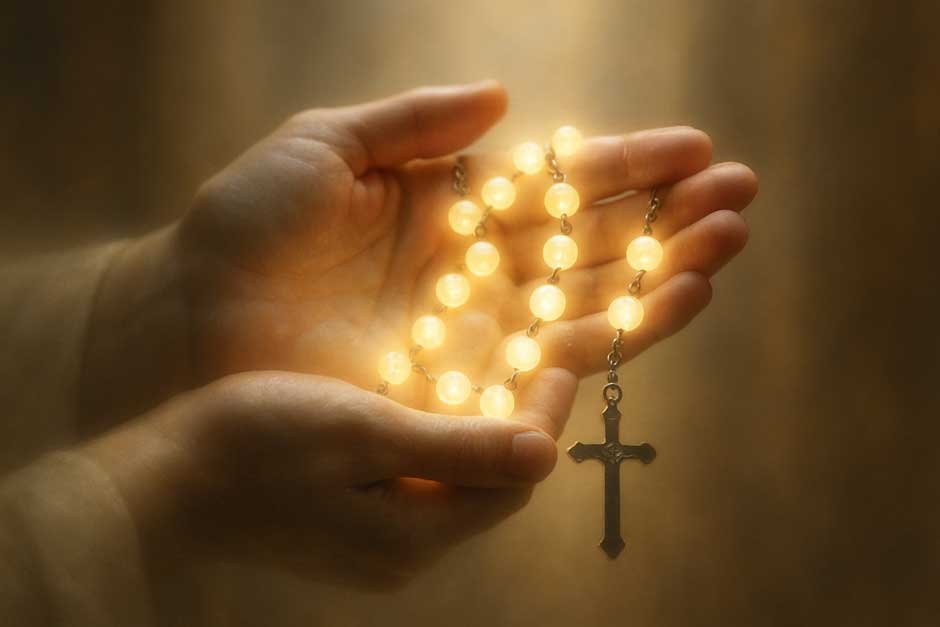
What is Rosary Thursday? Defining the Day of Light
Rosary Thursday is a cherished tradition within the Catholic faith, designating Thursday as the day to meditate upon the Luminous Mysteries of the Holy Rosary. This practice is not merely a routine but a profound spiritual journey that focuses the heart and mind on the public life of Jesus Christ.
The Rosary itself is a prayer divided into four sets of mysteries: the Joyful, Sorrowful, Glorious, and Luminous. Each set corresponds to a different phase of Christ’s life and is assigned to a specific day of the week, guiding the faithful through the entire narrative of salvation.
The Historical Context: A Gift from Pope St. John Paul II
For centuries, the Rosary consisted of only fifteen mysteries, with the faithful rotating through the Joyful, Sorrowful, and Glorious cycles. This ancient structure provided a deep and constant source of contemplation for generations of believers.
A significant change arrived in 2002 when Pope St. John Paul II, in his Apostolic Letter Rosarium Virginis Mariae, introduced the five Luminous Mysteries. This addition was a pastoral gift to the Church, intended to make the Rosary a more complete “compendium of the Gospel.”
The Holy Father recognized a gap in the traditional meditations, which largely skipped over the three years of Christ’s public ministry. By adding these Mysteries of Light, he invited the faithful to contemplate the moments when Jesus revealed his divinity and the core of his mission.
The Five Luminous Mysteries: Meditations on Christ’s Public Life
The Luminous Mysteries, or Mysteries of Light, illuminate the most significant events of Jesus’ ministry, where he manifested the Kingdom of God. They serve as powerful reminders of Christ’s presence and power in the world.
The Baptism of the Lord in the Jordan
This mystery marks the beginning of Jesus’ public ministry, where he is baptized by John the Baptist. It is a powerful moment of revelation, as the heavens open, the Holy Spirit descends like a dove, and the voice of the Father proclaims, “This is my beloved Son.”
Contemplating this event calls the faithful to reflect on their own baptismal promises and the grace of new life in Christ. It is a meditation on the mystery of the Holy Trinity and the call to holiness.
The Wedding Feast at Cana
The Wedding at Cana is the scene of Jesus’ first public miracle, performed at the request of his mother, Mary. By changing water into wine, Jesus revealed his glory and his power over creation.
This mystery highlights the importance of Mary’s intercession and the abundance of God’s grace. It encourages believers to trust in Christ’s power to transform the ordinary into the extraordinary in their own lives.
The Proclamation of the Kingdom of God
Throughout his ministry, Jesus traveled and preached, calling all people to repentance and faith. His message was simple yet revolutionary: “The Kingdom of God is at hand.”
This mystery focuses on the need for conversion and the boundless mercy of God. It is a call to actively participate in the building of God’s Kingdom through acts of charity and justice.
The Transfiguration
On a high mountain, Jesus was transfigured before Peter, James, and John, his face shining like the sun and his clothes becoming dazzling white. Moses and Elijah appeared, speaking with him.
The Transfiguration is a glimpse of Christ’s divine glory, strengthening the disciples’ faith before the trials of his Passion. It offers hope to the faithful, reminding them of the glory that awaits those who remain steadfast.
The Institution of the Eucharist
The final Luminous Mystery takes place at the Last Supper, where Jesus instituted the Sacrament of the Eucharist. He took bread and wine, transforming them into his Body and Blood, offering himself as the ultimate sacrifice.
This is the pinnacle of the Mysteries of Light, emphasizing the Eucharist as the “source and summit” of Christian life. It is a profound meditation on Christ’s enduring presence and his sacrificial love for humanity.
Why Thursday? The Connection to the Eucharist
The assignment of the Luminous Mysteries to Thursday is not arbitrary; it is deeply rooted in the liturgical calendar. Thursday has long been associated with the Institution of the Eucharist, which occurred on Holy Thursday.
Since the fifth Luminous Mystery is the Institution of the Eucharist, dedicating Thursday to this entire set of mysteries creates a beautiful thematic unity. It allows the faithful to honor the sacrament that is central to their faith on the day of its origin.
Praying the Luminous Mysteries: A Path to Deeper Contemplation
To pray the Luminous Mysteries on Rosary Thursday is to walk alongside Jesus during his most powerful moments on earth. The repetition of the prayers—the Our Fathers, Hail Marys, and Glory Bes—is meant to be a gentle rhythm that leads the mind into contemplative reflection.
The goal is not simply to recite the words, but to use each decade as a backdrop for meditating on the corresponding event in Christ’s life. By contemplating the “fruit” of each mystery, such as the “Grace of the Sacrament” for the Eucharist, the prayer becomes a transformative encounter.
The Enduring Significance of Rosary Thursday
Rosary Thursday serves as a vital anchor for a weekly spiritual life, offering a structured way to engage with the Gospel. It ensures that the faithful regularly contemplate the foundational truths of Christ’s identity and mission.
This devotion is a powerful tool for spiritual growth, fostering a deeper relationship with Jesus through the intercession of his mother, Mary. Whether prayed alone or with a community, the Luminous Mysteries offer light and guidance for navigating the complexities of modern life.
The call to prayer on Thursday is a gentle invitation to pause, reflect on the light of Christ, and allow that light to illuminate one’s own path. It is a practice that continues to enrich the lives of countless Catholics around the world.
