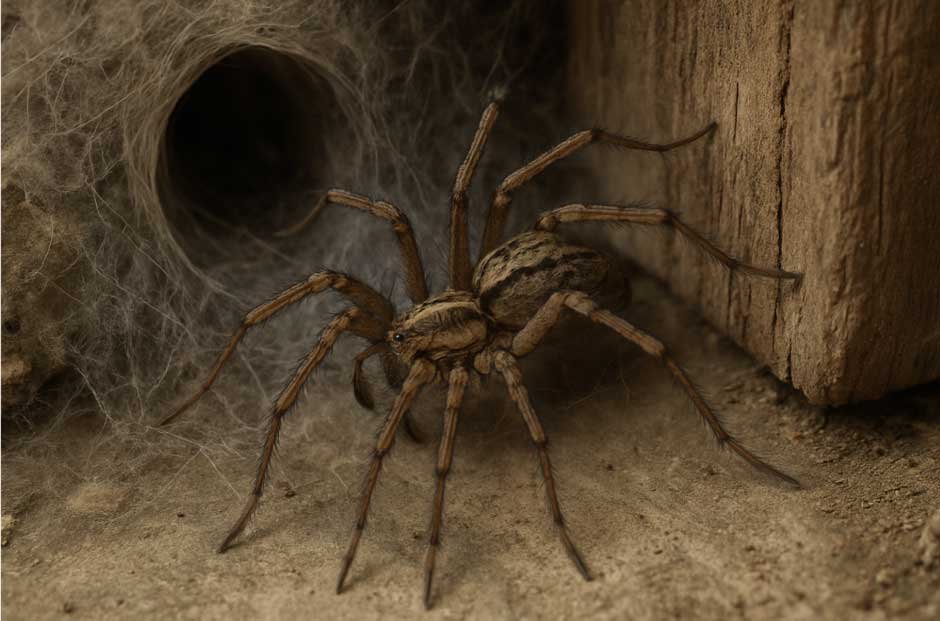
Introduction: The Familiar Funnel Weaver
Few sights are as universally familiar as a spider tucked away in a quiet corner of a home. This common eight-legged resident is often the **Domestic House Spider**, scientifically known as ***Tegenaria domestica***, a species that has masterfully adapted to life alongside us.
Despite being frequently misunderstood, this spider is a quiet, yet crucial, participant in the micro-ecosystem of any dwelling. It is a creature of predictable habit, choosing to stay out of sight while it meticulously tends to its intricate, silken trap.
A Tale of Two Names: Barn Funnel Weaver vs. Domestic House Spider
The common name for this species often shifts depending on the continent. In Europe, it is widely and simply known as the **Domestic House Spider**, a name that perfectly reflects its preferred habitat within human structures.
Across North America, however, it is more commonly referred to as the **Barn Funnel Weaver**. Both titles accurately describe its location and, more importantly, the distinctive shape of the web it constructs.
A Synanthropic Species
***Tegenaria domestica*** is classified as a synanthropic species, a term used for animals that benefit from their close association with humans and the structures we build. This is key to their success.
These spiders thrive in the stable, protected environments that houses, barns, and sheds provide. These spaces offer consistent temperatures and, crucially, a steady and reliable supply of insect prey.
Physical Characteristics and Identification
Identifying the Domestic House Spider is relatively straightforward once you know the key features to look for. They are medium-sized spiders with a generally unassuming, yet robust, appearance.
Their coloration is designed for camouflage, allowing them to blend seamlessly into the darker corners and crevices where they typically choose to build their webs.
Size and Coloration
The female *Tegenaria domestica* is typically the larger of the sexes, with a body length that can range from about 8 to 12 millimeters. The males are slightly smaller, usually measuring between 6 and 9 millimeters.
Their bodies display a muted palette of brown, beige, and gray, often accented by subtle, darker markings across the abdomen and cephalothorax. This natural coloring helps them remain unnoticed.
Distinguishing Features of Tegenaria domestica
A primary characteristic is their notably long, hairy legs, which can make the spider appear much larger than its actual body size—a common source of alarm for many people. They are members of the funnel-web family, Agelenidae.
Unlike some other house spiders, they have a somewhat stocky build, and their legs frequently feature distinct bands of lighter and darker rings, adding to their unique appearance.
The Intricate Funnel Web: A Masterpiece of Silk
The most unmistakable sign of a *Tegenaria domestica* presence is its characteristic web, a structure that serves as both a secure home and a highly efficient hunting apparatus.
This web is a quiet testament to the spider’s engineering skill, meticulously designed to maximize the capture of any unsuspecting insect that wanders too close.
Web Structure and Function
The web itself is a flat, sheet-like structure that tapers into a distinctive, silken funnel at one end. The spider rests patiently inside this funnel, waiting for vibrations to signal a potential meal.
The sheet is not sticky like a typical orb web, but its irregular, tangled nature is more than enough to trip, entangle, and disorient small insects that land upon it.
Hunting Strategy
The moment an insect stumbles onto the sheet, the spider is instantly alerted by the vibrations. It rushes out of the funnel retreat with surprising, almost startling, speed.
It quickly subdues the prey with a bite and then drags the catch back into the safety of the funnel to consume it, often taking the time to repair any damage to the web shortly afterward.
Habitat and Global Distribution
The widespread success of ***Tegenaria domestica*** is rooted in its remarkable adaptability, which has allowed it to colonize diverse environments across the entire globe.
While they can be found outdoors, their strong preference for sheltered, stable spaces makes them predominantly indoor residents.
Preferred Indoor Locations
Indoors, they seek out dark, quiet, and undisturbed areas. Basements, attics, closets, and the spaces behind large furniture are prime locations. They are also frequently found in sheds and barns, which explains their North American moniker.
These locations provide the necessary cover and stability for their webs, which are often built into the crevices of doors, window frames, or under floorboards.
Worldwide Presence
This species is certainly not confined to a single continent. It is well-established throughout Europe and has been widely introduced across North America, where it is now a very common sight.
Its global distribution is a direct consequence of its synanthropic nature, having been inadvertently transported around the world over centuries through human commerce and travel.
Diet, Behavior, and Ecological Role
The Domestic House Spider is, without question, a beneficial predator. It plays a vital and continuous role in controlling the population of small, unwanted insects within the confines of a home.
Their general behavior is timid and retiring, and they pose absolutely no threat to the human occupants of their shared space.
What They Eat
Their diet consists primarily of small insects and other arthropods that become hopelessly trapped in their funnel webs. This includes common pests like flies, mosquitoes, and occasionally even other small spiders.
They are not bloodsuckers and have no biological reason to bite a human. Their venom is exclusively used for subduing their insect prey.
A Non-Aggressive Presence
These spiders are inherently non-aggressive and will almost always attempt to flee when they are disturbed. Bites to humans are exceedingly rare and typically only occur if the spider is accidentally trapped or squeezed against the skin.
For the vast majority of people, a bite from ***Tegenaria domestica*** is medically insignificant, resulting in only minor, localized irritation, similar to a mosquito bite.
Life Cycle and Longevity
The life cycle of the Domestic House Spider is notable for a relatively long lifespan for a spider, a trait particularly true for the females of the species.
Their reproductive strategy is highly effective, ensuring the continuation of the species within their sheltered, indoor habitats.
Reproduction and Egg Sacs
Females are capable of producing several egg sacs throughout their lifetime, with each sac potentially containing up to 200 eggs. These sacs are usually carefully hidden within the funnel retreat or tucked away in a protected corner of the web.
The mother will guard the egg sac until the spiderlings hatch, at which point they disperse to build their own small, independent webs.
Lifespan Differences Between Sexes
Female ***Tegenaria domestica*** can enjoy a lifespan of several years, sometimes living for up to three or four years in a stable indoor environment where resources are plentiful.
Males, conversely, have a much shorter existence. They often die shortly after mating, especially after they have ventured out from their webs in search of a female partner.
Coexisting with Tegenaria domestica
Understanding the true nature of this common housemate can go a long way toward alleviating any unwarranted fear and promoting a more tolerant and peaceful coexistence.
They are, in the most practical sense, silent and unpaid partners in household pest control, working while we sleep.
Harmlessness to Humans
Despite their sometimes intimidating appearance—particularly the speed at which they can move—these spiders are fundamentally harmless to both people and household pets.
They are far more concerned with the small flies and pests that share the home than they are with its much larger human inhabitants.
Natural Pest Control
By actively preying on common household pests, ***Tegenaria domestica*** provides a natural, continuous, and chemical-free form of pest control. This ecological service is often overlooked.
Allowing them to maintain their webs in out-of-the-way areas can be a surprisingly beneficial strategy for naturally reducing the population of other, more bothersome insects.
Conclusion: An Unsung Housemate
***Tegenaria domestica***, the Domestic House Spider, stands as a fascinating and successful example of an animal that has seamlessly integrated itself into the human world. It is a true survivor.
From its intricate funnel web to its quiet, predatory role, it is a creature that deserves a measure of respect and understanding, serving as an unsung housemate in the delicate, ongoing balance of the indoor environment.
