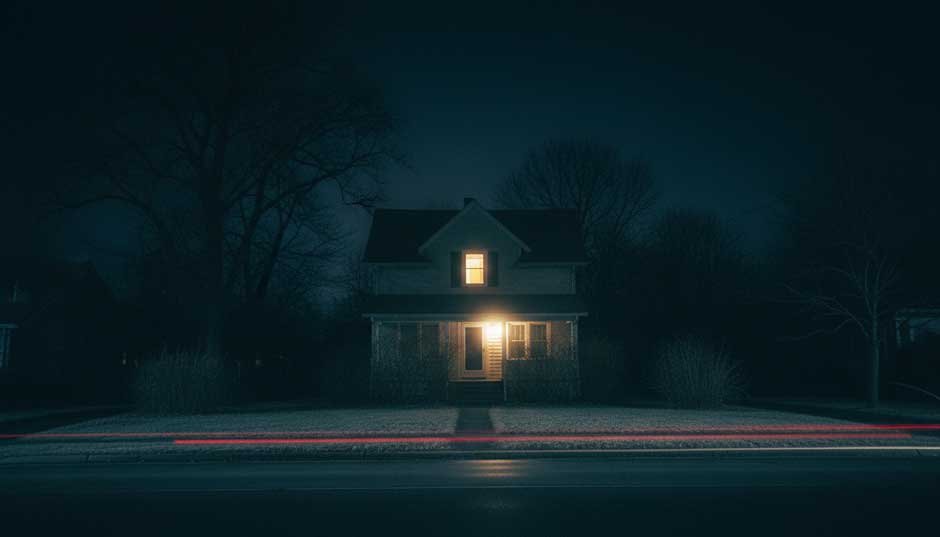
Todd Hido. The name itself conjures images of rain-slicked streets and the solitary, amber glow emanating from a distant window. But what exactly is it about these seemingly mundane scenes that has captivated the art world and cemented Hido’s place as a master of contemporary photography?
Is it the quiet melodrama, the sense of a story just out of frame, or the unsettling feeling that we are witnessing something deeply private? The answer lies in how Hido transforms the ordinary, overlooked spaces of American suburbia into profound psychological landscapes.
The Unsettling Familiarity: Hido’s Signature Nighttime Homes
Have you ever driven past a house late at night, the only light spilling from a single window, and wondered about the life unfolding inside? This moment of accidental voyeurism is the heart of Hido’s most iconic body of work, the “Homes at Night” series.
These photographs are not merely architectural studies; they are emotional blueprints. Hido captures the suburban home as a vessel for memory and longing, often shrouded in a thick, atmospheric fog or the deep blue of twilight.
The light, often a sickly yellow or a warm, inviting orange, acts as a beacon, drawing the viewer in while simultaneously emphasizing the isolation of the structure. It is an “unsettling familiarity,” a feeling that this could be any house, anywhere, holding any secret.
Hido achieves this distinct, painterly effect through his technical approach, primarily working at night and utilizing long exposures. This technique allows the available light to saturate the film, transforming the scene from a simple snapshot into a dramatic, almost theatrical tableau.
Memory, Melancholy, and the American Landscape
Hido’s work is deeply rooted in the themes of memory and melancholy, often drawing directly from his own experiences growing up in Ohio. He uses the landscape not just as a setting, but as a mirror for internal states.
The suburban sprawl he photographs is the backdrop to the American dream, yet Hido presents it with a sense of unease and quiet desperation. His images evoke a powerful sense of nostalgia, not for a perfect past, but for the complex, often messy, reality of memory itself.
Many critics have noted the “movie still” quality of his photographs. They possess a cinematic tension, as if the viewer has stumbled upon a single, crucial frame from a film noir or an early Alfred Hitchcock movie. This narrative ambiguity is intentional, inviting the viewer to project their own stories and anxieties onto the scene.
The roads, the empty fields, and the desolate houses become characters in a silent, ongoing drama. They speak of journeys taken, lives lived, and the vast, often lonely, expanse of the American landscape.
Beyond the Windows: Interiors and the Human Element
While the nighttime exteriors are his most recognized work, Hido’s exploration of interiors and his portraits of anonymous female figures offer a crucial counterpoint. These images move the viewer from the role of the distant observer to that of an intimate, though still uncertain, confidant.
His interiors, often featuring empty, slightly worn rooms or a solitary figure on a bed, maintain the same sense of isolation found in his exterior shots. They are intimate yet emotionally distant, suggesting a life that has just left the frame or is waiting to begin.
The portraits, frequently featuring young women in various states of repose or contemplation, are rarely direct. They are often obscured by reflections, shadows, or the soft grain of the film, preserving a sense of mystery. Hido uses these figures not to reveal a specific person, but to explore universal themes of vulnerability, longing, and the complex inner lives of his subjects.
This contrast between the desolate exteriors and the isolated, yet intensely personal, interiors creates a complete psychological space. It is a world where the outside reflects the inside, and the human element is always present, even when unseen.
The Palette of Isolation: Color and Mood
One of the most striking elements of Hido’s aesthetic is his masterful and deliberate use of color. He is not interested in documentary realism; instead, he uses color as a powerful emotional and dramatic tool.
The world Hido captures is often dominated by saturated, almost unnatural hues—deep, moody blues that suggest cold and distance, contrasted sharply with the hot, artificial yellows and oranges of interior lights. This palette transforms the mundane into the extraordinary.
These color choices function to heighten the sense of drama and isolation. The warm light from a window, which might normally signify comfort, is instead rendered as a stark, almost alien glow against the overwhelming darkness. It is a visual language that speaks directly to the subconscious.
His approach to color is often compared to painting, where the mood is built up through layers of tone and light. Hido’s photographs feel less like captured moments and more like carefully constructed emotional environments, where every shade contributes to the overall feeling of quiet dread or profound beauty.
The Legacy of Todd Hido: Influence and Recognition
Todd Hido has not only created a distinct and recognizable body of work but has also profoundly influenced a generation of photographers and visual artists. His ability to infuse the everyday with deep psychological resonance has secured his place in the canon of contemporary art.
His work is held in numerous major collections, including the Guggenheim Museum and the Whitney Museum of American Art. Through his influential books, such as House Hunting and Excerpts from Silver Meadows, Hido has shared his unique vision with a global audience.
Hido’s lasting contribution is his transformation of the suburban landscape from a symbol of conformity into a stage for human emotion. He taught us that the most compelling stories are often found in the places we drive past every day, hidden behind the glowing windows of the night. He is a photographer who doesn’t just take pictures of the world, but pictures of how the world feels.
The next time you see a solitary light in the darkness, you may find yourself pausing, wondering, and perhaps, seeing the world through the cinematic lens of Todd Hido.
