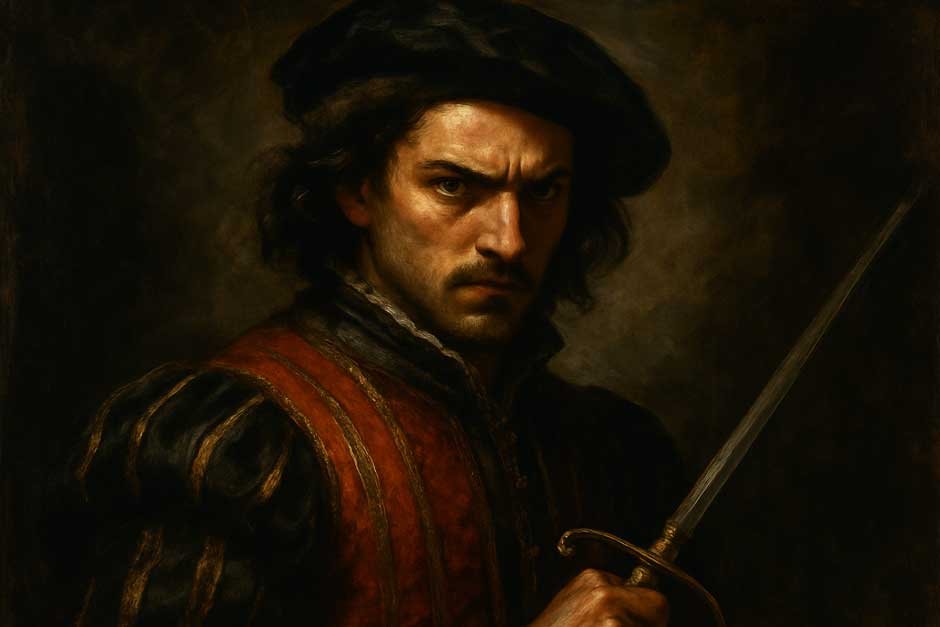
Introduction: The Prince of Cats
Tybalt Capulet is far more than a simple villain in William Shakespeare’s timeless tragedy, Romeo and Juliet. He is a force of nature, a volatile figure whose unwavering commitment to the Capulet name drives the play toward its inevitable, bloody conclusion.
His very nickname, “Prince of Cats,” is a telling detail. It links him to the feline character Tibert from the medieval fable *Reynard the Fox*, suggesting a personality that is quick, agile, and always ready to strike with lethal precision.
Tybalt’s Place in the Capulet Family
As Juliet’s cousin, Tybalt occupies a position of privilege and responsibility within the powerful Capulet household. He is a young man, likely still in his late teens, who takes the family’s reputation in Verona as a personal crusade.
He views himself as the primary defender of the Capulet honor. This self-appointed role is one he executes with an intensity that often borders on recklessness, even frustrating the more pragmatic Lord Capulet.
The Source of His Rage: Family Feud and Honor
Tybalt’s burning anger is not random or unfocused; it is entirely directed at the Montagues. He sees the ancient, bitter feud not as a tiresome social constraint but as a sacred, personal duty to uphold.
For him, the concept of honor is the only currency that matters. Any perceived insult, no matter how small, demands immediate and violent retaliation. This makes him a constant, unpredictable threat on the streets of Verona.
Character Traits: A Study in Fire and Steel
The core of Tybalt’s character is defined by his fierce aggression and his formidable skill with a weapon. He is a man of stark extremes, utterly lacking the patience or moderation that might have allowed him to survive the play.
He is the first to ignite a conflict and the last to consider a truce, standing in sharp, dramatic contrast to the peace-seeking efforts of Benvolio, who acts as his direct foil.
The Master Swordsman
Throughout the play, Tybalt is consistently portrayed as an exceptional duelist. He is a master of the rapier, a weapon that perfectly symbolizes the formal, yet deadly, nature of the feud that consumes the two families.
His reputation as a fighter is widely known, and his confidence in his own combat ability is absolute. This mastery of violence is precisely what makes him such a dangerous and pivotal figure in the unfolding tragedy.
Unwavering Loyalty and Hot Temper
His loyalty to the Capulet family is unquestionable, yet this deep devotion is ironically the very thing that fuels his destructive temper. He simply cannot tolerate any form of disrespect aimed at his kin or his house.
This hot-headedness completely blinds him to any possibility of reason or diplomacy. He operates purely on visceral, immediate reaction, a tragic flaw that ultimately seals his own fate and sets the stage for the deaths of the young lovers.
Tybalt’s Pivotal Role in the Tragedy
Tybalt’s most memorable appearances are those that directly transform the play’s simmering tension into a full-blown, irreversible catastrophe. He is the essential catalyst for the play’s darkest turning point.
Had he not been so relentlessly determined to find a fight, the central characters might have navigated the feud more successfully, or at least avoided the immediate, fatal consequences that follow his actions.
The Insult at the Capulet Feast
The first major flashpoint occurs when Tybalt recognizes Romeo’s voice at the Capulet’s masked ball. He instantly interprets Romeo’s uninvited presence as an unforgivable intrusion and a profound, public insult to the family’s hospitality.
Though Lord Capulet manages to restrain him, Tybalt’s wounded pride does not dissipate. He swears an oath of revenge, a promise he is absolutely determined to keep, which ominously sets the stage for the later, fatal violence.
The Fatal Duel: Mercutio’s Death
Tybalt’s quest for vengeance leads him to challenge Romeo in the streets. When Romeo, now secretly married to Juliet, attempts to de-escalate the situation, Tybalt dismisses his peace-making efforts as pure cowardice.
It is Mercutio who steps in to defend Romeo’s honor, leading to a tragic duel. Tybalt delivers the fatal blow to Mercutio under Romeo’s arm, an act of calculated aggression that leaves Romeo with no choice but to retaliate, resulting in Tybalt’s own death.
Conclusion: The Price of Pride
Tybalt Capulet’s brief, explosive presence in the play serves as a powerful, tragic testament to the devastating cost of unyielding pride and inherited hatred. He is the fire that consumes any hope of reconciliation between the two warring houses.
His legacy is not one of heroism, but of a tragic, self-fulfilling prophecy. He lived by the sword of family honor and ultimately perished by it, leaving behind a trail of grief that directly leads to the final, heartbreaking end of Romeo and Juliet. The “Prince of Cats” was ultimately undone by his own fierce, untamable nature.
