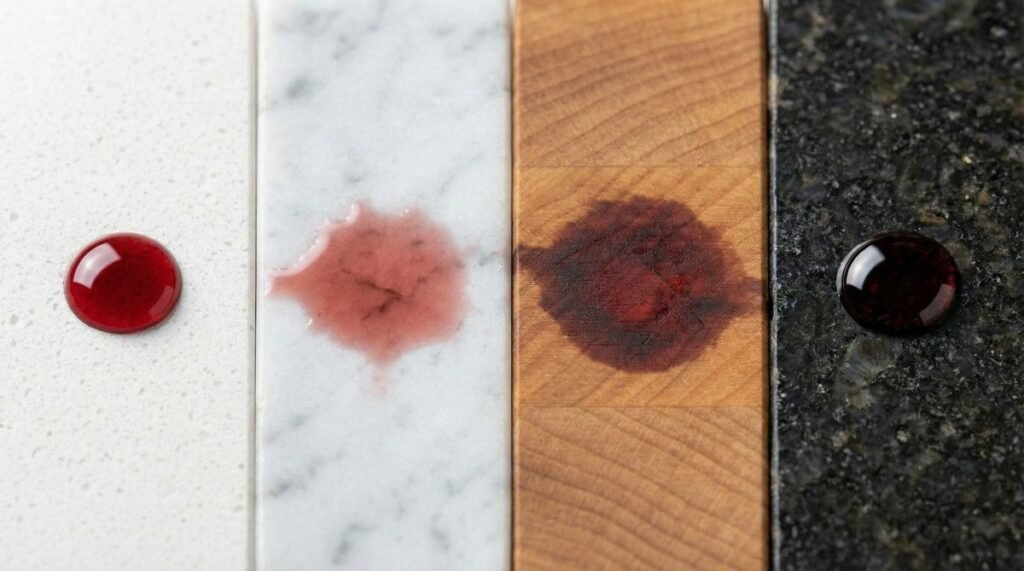
Quartz is the most stain-resistant countertop material available because it is an engineered stone composed of approximately 90 to 94 percent ground natural quartz and 6 to 10 percent polymer resins. This composition creates a completely non-porous surface that prevents liquids like red wine, coffee, and oils from penetrating the material, eliminating the need for periodic sealing.
Homeowners prioritizing a low-maintenance kitchen often find that engineered surfaces outperform natural stones in daily use. While natural materials like marble and granite offer timeless beauty, their porous nature makes them susceptible to permanent discoloration if not treated with extreme care. Choosing a non-porous material ensures that the kitchen remains a functional workspace rather than a source of constant maintenance anxiety.
The durability of a countertop is directly linked to its absorption rate, which measures how much moisture a material can soak up. Materials with an absorption rate near zero are considered the gold standard for stain resistance. Beyond quartz, modern innovations like sintered stone and high-quality solid surfaces have expanded the options for those seeking a permanent defense against common kitchen spills.
Why Non-Porous Materials Lead in Stain Resistance
Non-porous materials lead in stain resistance because they lack the microscopic pores and fissures found in natural stone, which typically act as channels for liquid contaminants to enter the slab. When a surface is non-porous, spills remain on the top layer where they can be easily wiped away with a damp cloth and mild detergent. This structural integrity provides a permanent barrier against bacteria and mold growth as well.
The science of stain resistance involves both the physical structure of the material and its chemical composition. Natural stones like granite and marble are formed over millions of years with internal voids that can trap pigments from food and drink. In contrast, engineered materials are manufactured under intense pressure and heat to remove these voids, resulting in a dense, uniform slab that is virtually impenetrable to common household liquids.
Understanding the difference between porous and non-porous surfaces is essential for long-term satisfaction with a kitchen remodel. While a porous surface can be protected with chemical sealers, these coatings are temporary and can fail if not reapplied regularly. A naturally non-porous material offers a lifetime of protection without the recurring cost or effort of maintenance treatments.
| Material Type | Porosity Level | Stain Resistance Rating | Sealing Required |
|---|---|---|---|
| Engineered Quartz | Non-Porous | Excellent | No |
| Sintered Stone | Non-Porous | Excellent | No |
| Solid Surface | Non-Porous | Very Good | No |
| Polished Granite | Porous | Good (if sealed) | Yes (Annual) |
| Marble | Highly Porous | Poor | Yes (Frequent) |
Engineered Quartz: The Gold Standard for Stain-Free Kitchens
Engineered quartz is the gold standard for stain-free kitchens because its resin-bound structure creates a surface that is harder than granite and completely impervious to moisture. Unlike natural stone, quartz does not have weak points or natural veins that can absorb liquids, making it the most reliable choice for busy households. It resists staining from acidic foods, dark pigments, and greasy residues without any specialized treatments.
The manufacturing process of quartz involves vibrating the mixture of stone and resin in a vacuum, which removes all air pockets. This density is what gives quartz its superior performance in the kitchen. Even light-colored quartz slabs maintain their brilliance over time, as the pigments are locked within the resin matrix and cannot be altered by external spills or cleaning agents.
While quartz is highly resistant to stains, it is important to note that it is not indestructible. High heat can damage the resins used to bind the stone, leading to discoloration known as thermal shock. However, for everyday spills like spilled juice or coffee, quartz remains the most forgiving material on the market, requiring only a quick wipe to restore its original appearance.
For homeowners who want the look of marble without the high maintenance, many quartz manufacturers offer designs that mimic the veining of natural stone. These products provide the aesthetic appeal of luxury materials while retaining the practical benefits of an engineered surface. This combination of beauty and utility has made quartz the most popular countertop choice for modern kitchen renovations.
Solid Surface and Sintered Stone: Modern Alternatives
Solid surface and sintered stone are modern alternatives that offer exceptional stain resistance through advanced manufacturing techniques that eliminate porosity. Solid surface materials, like Corian, are made from acrylic or polyester resins and minerals, creating a seamless and non-porous finish. Sintered stone is produced by subjecting natural minerals to extreme heat and pressure, resulting in a surface that is even denser than quartz.
Sintered stone has gained popularity due to its ability to withstand both stains and extreme heat, a combination that quartz sometimes struggles with. Because it contains no resins, sintered stone can handle hot pans directly on its surface without the risk of scorching or yellowing. Its compact structure makes it nearly impossible for any liquid to penetrate, even after prolonged exposure to harsh substances.
Solid surface countertops offer a unique advantage in their ability to be repaired. If a stain does manage to sit long enough to cause a surface mark, it can often be buffed out with a mild abrasive cleaner or fine-grit sandpaper. This renewability ensures that the countertop can look brand new for decades, making it a cost-effective choice for high-traffic areas like kitchen islands and bathroom vanities.
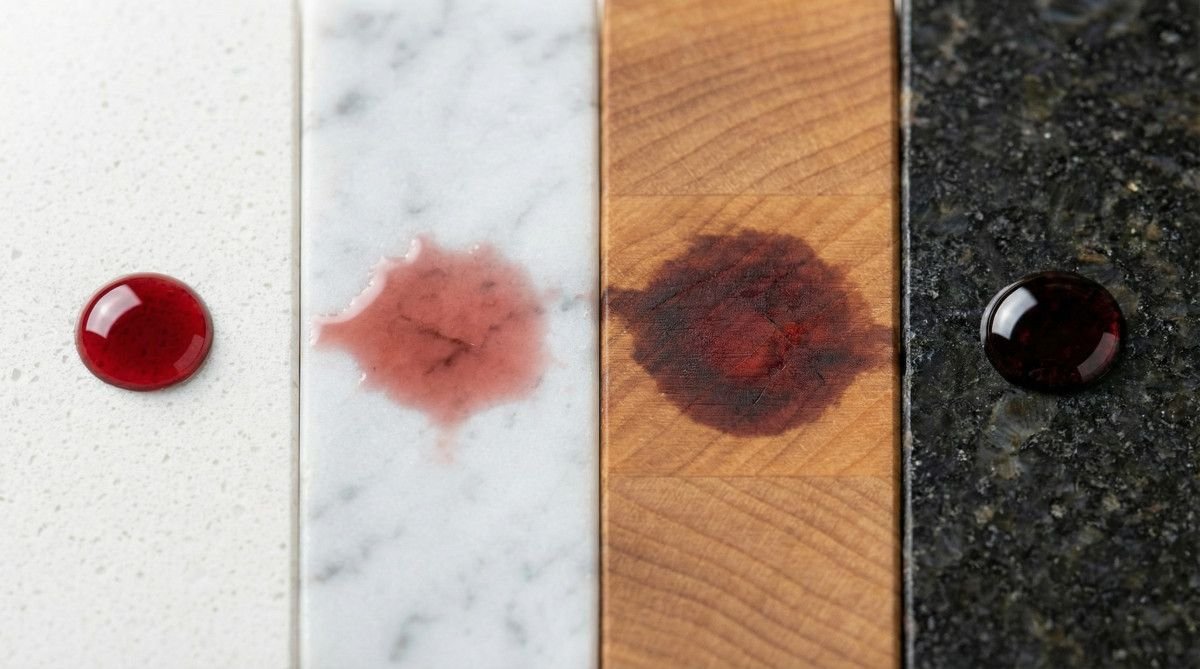
Both materials provide a wide range of design possibilities, from integrated sinks to curved edges that are impossible to achieve with natural stone. The lack of visible seams in solid surface installations further reduces the areas where grime and stains can accumulate. These materials represent the cutting edge of kitchen technology, prioritizing user experience and long-term durability above all else.
Natural Stone Options: Granite and Quartzite Maintenance
Natural stone options like granite and quartzite can be highly stain-resistant, but they require consistent maintenance in the form of chemical sealing to remain protected. Granite is a volcanic rock with varying levels of porosity depending on its mineral composition, while quartzite is a metamorphic rock that is naturally harder but still contains microscopic pores. Without a high-quality sealer, these stones will eventually absorb liquids and develop deep-seated stains.
The effectiveness of a natural stone countertop depends heavily on the quality of the initial and subsequent sealings. A sealer works by filling the pores of the stone with a transparent resin that repels water and oil. However, this barrier is not permanent and can be stripped away by acidic cleaners or worn down by daily scrubbing. Homeowners must perform a water test annually to determine if the stone needs to be resealed.
Quartzite is often confused with quartz, but it is a completely natural material that offers a unique crystalline appearance. While it is harder than granite, it is also more prone to etching from acidic substances like lemon juice or vinegar. This etching is a chemical reaction that dulls the surface of the stone, which can look like a stain but is actually a change in the stone’s texture itself.
| Natural Stone | Hardness (Mohs) | Maintenance Level | Best Use Case |
|---|---|---|---|
| Premium Granite | 6-7 | Moderate | High-traffic kitchens |
| Hard Quartzite | 7-8 | High | Luxury focal points |
| Soapstone | 2-3 | Low (Oiling) | Rustic or traditional styles |
| Marble | 3-4 | Very High | Baking stations only |
Materials to Avoid if You Prioritize Stain Resistance
Materials to avoid if you prioritize stain resistance include marble, limestone, and unsealed concrete, as these surfaces are highly porous and chemically reactive to common kitchen ingredients. Marble is composed of calcium carbonate, which reacts instantly with acids to create permanent dull spots and deep stains. Even with professional sealing, marble remains one of the most difficult materials to keep looking pristine in a working kitchen.
Limestone and travertine share many of the same vulnerabilities as marble but are often even softer and more prone to physical damage. These stones feature large pits and voids that can trap food particles and liquids, leading to bacterial growth and difficult-to-remove discoloration. While they offer a beautiful earthy aesthetic, they are generally better suited for wall applications or low-traffic bathroom areas rather than kitchen countertops.
Concrete countertops have become a popular choice for industrial-style kitchens, but they are naturally very thirsty materials. Without a heavy-duty topical sealer, concrete will absorb almost any liquid it touches, including water. These sealers can also be prone to scratching and peeling, which exposes the vulnerable concrete underneath to immediate staining from oils and pigments.
Wood and butcher block countertops also require significant upkeep to remain stain-free. They must be treated with food-safe mineral oil or wax regularly to prevent liquids from soaking into the wood fibers. If the finish is neglected, wood can easily harbor stains from berries, wine, and meat juices, which can be nearly impossible to remove without sanding down the entire surface.
Practical Tips for Maintaining a Stain-Free Surface
Practical tips for maintaining a stain-free surface include wiping up spills immediately, using cutting boards for all food preparation, and avoiding harsh chemical cleaners that can degrade protective sealants. Even the most resistant materials can be damaged by prolonged exposure to highly acidic or alkaline substances. Establishing a simple daily cleaning routine with pH-neutral soap and warm water is the most effective way to preserve any countertop.
Preventative measures are always more effective than reactive cleaning. Using coasters for glasses and trivets for hot pots protects the surface from both moisture rings and thermal damage. For natural stone, avoiding the use of vinegar, lemon juice, or ammonia-based cleaners is critical, as these substances can eat through the sealer and expose the stone to potential staining agents.
If a stain does occur, it is important to identify the type of substance involved before attempting to remove it. Oil-based stains often require a poultice made of baking soda and water to draw the oil out of the stone, while organic stains from food may respond better to a specialized stone cleaner. For engineered surfaces like quartz, a non-abrasive cream cleanser can often lift stubborn marks without scratching the finish.
- Clear the surface of all appliances and decor to ensure a thorough clean.
- Apply a pH-neutral cleaner or a mixture of mild dish soap and warm water to the entire area.
- Wipe the surface with a soft microfiber cloth in a circular motion to remove debris.
- Dry the countertop completely with a clean towel to prevent water spots and streaks.
- Perform a water bead test on natural stone surfaces to check the integrity of the sealer.
Frequently Asked Questions
What is the most stain-resistant countertop material?
Engineered quartz is widely considered the most stain-resistant countertop material because it is non-porous and does not require sealing. Its combination of natural stone and resin creates a dense surface that prevents liquids from penetrating. This makes it ideal for kitchens where spills are common and low maintenance is a priority.
How do I prevent stains on granite countertops?
Preventing stains on granite requires applying a high-quality impregnating sealer at least once a year to fill the stone’s natural pores. Additionally, you should wipe up spills immediately and avoid using acidic cleaners like vinegar or lemon juice. Using coasters and cutting boards also provides an extra layer of protection for the surface.
Can I remove stains from solid surface countertops?
Yes, stains can often be removed from solid surface countertops because the material is consistent throughout its entire thickness. Minor surface stains can be buffed out with a mild abrasive cleaner or a fine-grit sanding pad. This unique property allows the material to be renewed and restored to its original appearance if damage occurs.
Are recycled glass countertops durable?
Recycled glass countertops are very durable and highly resistant to stains, especially those set in a resin base. The glass itself is non-porous, and the resin binder provides a smooth, impenetrable surface. However, versions set in a cement base may require periodic sealing to prevent the cement from absorbing liquids and staining.
Do all stone countertops need sealing?
Not all stone countertops need sealing, as engineered stones like quartz are naturally non-porous. However, almost all natural stones, including granite, marble, and quartzite, require regular sealing to maintain their stain resistance. Some very dense granites may not need it, but it is generally recommended as a preventative measure for most natural materials.
Selecting a countertop material that does not stain easily is a long-term investment in the functionality and beauty of a home. By prioritizing non-porous engineered surfaces like quartz or sintered stone, homeowners can enjoy a high-end aesthetic without the burden of constant maintenance. While natural stones offer unique character, they require a commitment to regular care that may not suit every lifestyle. Ultimately, the best choice depends on balancing personal style with the practical realities of daily kitchen use, ensuring a surface that remains pristine for years to come.
