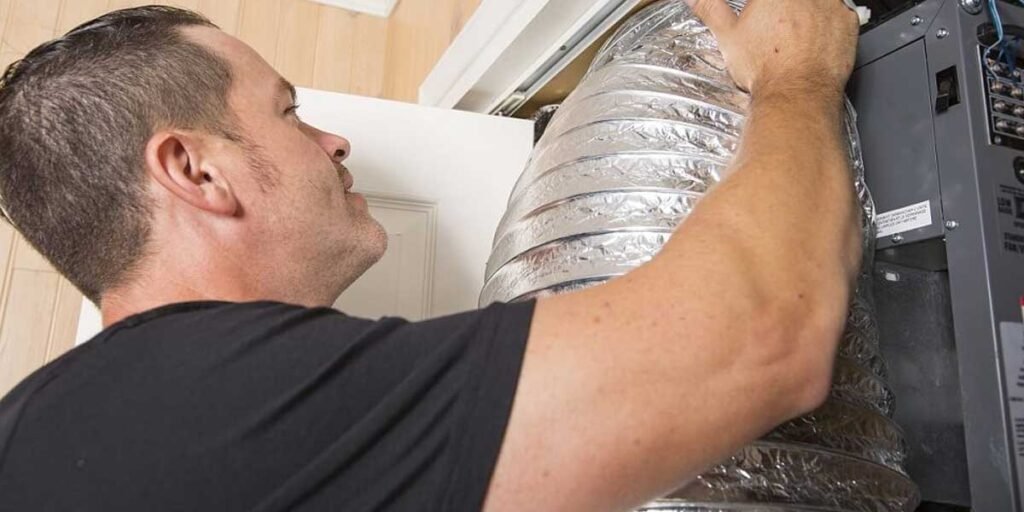
Replacing AC ductwork usually costs about $2,000 to $8,000 for many homes, while large or difficult jobs can climb from $10,000 to more than $20,000.
The honest answer depends less on the air conditioner and more on where the ducts live. A simple flex-duct swap in an open attic is a different job from removing old metal ducts in a tight crawlspace, rerouting returns, cutting drywall, and rebalancing airflow room by room. That is why two homeowners can ask the same question and get quotes thousands of dollars apart.
2026 AC Ductwork Replacement Cost at a Glance
Most AC ductwork replacement quotes fall into a few practical buckets: small repairs under $2,000, partial replacement around $1,500 to $4,500, and whole-home replacement around $4,500 to $12,000.
| Project type | Typical 2026 cost | What it usually includes |
|---|---|---|
| Minor duct repair or sealing | $300 to $1,500 | Sealing reachable leaks, replacing a short damaged run, reconnecting loose duct |
| Partial AC ductwork replacement | $1,500 to $4,500 | Replacing several branch runs, boots, registers, or damaged flex duct |
| Typical whole-home replacement | $4,500 to $12,000 | Replacing most supply and return ducts in an accessible attic, basement, or crawlspace |
| Complex whole-home replacement | $10,000 to $20,000+ | Hard access, multi-story routing, drywall repair, old metal removal, major redesign |
| New duct system where none exists | $8,000 to $25,000+ | Designing new trunks and branches, opening walls or ceilings, adding returns |
Current cost references line up with that wide spread. Trane puts HVAC duct system installation from about $1,500 to well over $20,000, while Homewyse lists basic duct installation starting around $15.55 to $18.63 per linear foot in May 2026. Those figures are useful anchors, but they do not replace a local bid because labor and access drive the final number.
What Changes the Price
The biggest cost drivers are access, material, home size, design changes, and whether the contractor is replacing ducts only or correcting airflow problems that were built into the old system.
Access is the quiet budget killer. Ducts in a walkable attic or open basement are faster to replace than ducts squeezed through a low crawlspace, buried above finished ceilings, or routed through a two-story chase. The harder it is for the crew to reach, remove, hang, seal, and insulate the duct, the more the labor portion grows.
Material also matters. Flexible insulated duct is usually cheaper and faster to install. Rigid metal duct can last longer and hold shape better, but it costs more to fabricate and hang. Fiberglass duct board sits somewhere in the middle in many markets. The cheaper option is not always worse; it is just less forgiving when the installer leaves sags, sharp bends, loose collars, or crushed sections.
| Cost factor | Lower-cost situation | Higher-cost situation |
|---|---|---|
| Access | Open attic, basement, garage, or mechanical room | Tight crawlspace, finished ceiling, wall cavities, multi-story routing |
| Duct material | Standard insulated flex duct | Custom sheet metal, specialty insulation, fire-rated assemblies |
| System design | Same layout, same register locations | New returns, resized trunks, relocated registers, airflow balancing |
| Removal | Old flex duct comes out cleanly | Old metal, damaged insulation, pest debris, possible asbestos concerns |
| Finishing work | No drywall or ceiling repair | Cutting and patching walls, ceilings, soffits, or flooring |
Energy loss is part of the decision too. ENERGY STAR says a typical home can lose about 20 to 30 percent of the air moving through the duct system because of leaks, holes, and poor connections. That does not mean every leaky duct system needs full replacement, but it does explain why a bad duct system can make a good AC unit feel weak. When air distribution is compromised, the primary cooling equipment must work significantly harder to maintain balanced temperatures throughout the house. Addressing these systemic leaks can improve general indoor comfort and manage daily power usage effectively. Homeowners often notice that simple performance issues can escalate if the underlying connections are left neglected before the peak cooling season. For residents experiencing weak airflow or sudden temperature imbalances, scheduling professional ac repair in Spring can identify whether a quick component fix or a broader ductwork adjustment is required to restore proper function.
Per-Linear-Foot Pricing and Whole-House Math
Per-linear-foot duct pricing is useful for checking a quote, but it can mislead badly if it ignores fittings, returns, demolition, insulation, balancing, and difficult access.
A basic replacement might look like $15 to $25 per linear foot when the job is clean and accessible. More involved residential replacement can run $25 to $55 per linear foot once branch runs, trunks, register boots, hangers, insulation, sealing, and labor are included. In rough crawlspaces or finished spaces, the effective price can climb higher.
Here is the simple math. If a house needs 150 linear feet of new duct at $30 per foot, the duct portion lands near $4,500. Add return improvements, registers, disposal, permits, testing, or drywall repair, and the final quote can move into the $6,000 to $9,000 range. For 250 linear feet at $40 per foot, the project can reach $10,000 before any major finish work.
| Example home | Likely duct length | Typical scenario | Possible quote range |
|---|---|---|---|
| 950 sq ft single-story home | 80 to 140 linear ft | Accessible attic flex duct | $2,000 to $6,500 |
| 1,500 sq ft home | 130 to 220 linear ft | Most ducts replaced, some return work | $4,500 to $9,500 |
| 2,000 to 2,500 sq ft home | 200 to 350 linear ft | Whole-home replacement with balancing | $7,000 to $14,000 |
| Large or multi-story home | 300+ linear ft | Hard access, rerouting, finished-space work | $12,000 to $25,000+ |
The rough edge in all of this is that contractors do not price only the shiny new duct. In practice, they price the day in the attic, the awkward crawl, the fittings, the transitions, the disposal pile, the second helper, and the risk that an old run does not come out neatly. That is where a suspiciously cheap bid can become expensive later.
Repair, Seal, or Replace?
Full replacement makes sense when ducts are crushed, badly undersized, contaminated, poorly designed, or falling apart. Simple leaks, loose joints, and a few damaged runs may only need repair or sealing.
Do not approve a full replacement just because someone says the ducts are old. Ask what failed. A careful HVAC contractor should be able to point to leakage results, static pressure readings, visible damage, disconnected runs, crushed flex duct, missing insulation, moldy material, or design problems that explain why repair is not enough.
| Condition | Usually enough | Why |
|---|---|---|
| One loose or torn branch run | Repair or partial replacement | The rest of the system may still be serviceable |
| Reachable leaks at joints | Mastic sealing and insulation repair | Sealing can recover airflow without replacing every run |
| Crushed, sagging, kinked flex duct throughout | Partial or full replacement | Airflow may stay poor even after spot repairs |
| Undersized trunks or returns | Redesign plus replacement | The layout, not just the material, is causing the problem |
| Wet, moldy, pest-damaged, or deteriorating duct board | Replacement of affected sections or full system | Cleaning may not fix damaged porous material |
The U.S. Department of Energy recommends sealing ducts with mastic and insulating ducts in unconditioned spaces to reduce losses. That advice matters because sealing is often the first serious option to price before replacing the whole system.
“And the static pressure is????? Oh, they didn’t test it? You’re being sold a bill of goods.”
– r/hvacadvice, March 2026
That quote is blunt, but the point is fair. A replacement recommendation should come with evidence. Static pressure testing, duct leakage testing, temperature split checks, and photos of problem areas are not fancy extras; they are how a homeowner separates diagnosis from sales pressure.
Reading an HVAC Ductwork Quote
A solid ductwork quote should describe the material, approximate duct length, returns, registers, insulation level, sealing method, testing, permits, cleanup, and what finish repairs are excluded.
The quote does not need to be a novel, but it should be specific enough that two contractors are bidding the same job. “Replace ductwork” is too vague. “Replace all accessible attic supply runs with R-8 insulated flex duct, seal collars with mastic, replace six register boots, add one return, balance system, haul away old duct” is the kind of scope that can be compared.
Quote Items That Should Be Clear
- Whether the quote is for supply ducts only, return ducts only, or both.
- The duct material and insulation level, especially in attics and crawlspaces.
- How many registers, boots, dampers, and returns are included.
- Whether the contractor will seal joints with mastic, approved foil tape, or both.
- Whether drywall, ceiling, soffit, or floor repair is included or excluded.
- Whether airflow balancing, static pressure testing, or duct leakage testing is included.
- Whether permits are required in your city or county.
- Warranty terms for labor and materials.
Get at least three quotes if the project is more than a small repair. Not because the lowest bid is automatically best, but because ductwork is easy to underdescribe. Three bids usually reveal whether one contractor is pricing a real redesign, one is only swapping flex runs, and one is adding a pain premium for a job they do not really want.
“I had my AC unit replaced in a 1500 SQ ft house and new ducts would’ve been an extra 7k.”
– r/HuntsvilleAlabama, April 2026
A $7,000 add-on for a 1,500-square-foot home can be reasonable if it includes most of the duct system and return work. It can also be high if the job is only a few short runs. The scope decides which version you are looking at.
Ways to Control Cost Without Buying Bad Work
You can often reduce ductwork replacement cost by narrowing the scope, keeping the layout simple, doing the job with other HVAC work, and asking for repair options before approving full replacement.
Start with testing. If leakage is the main problem, price sealing and targeted replacement first. If airflow is the problem, ask whether the issue is crushed duct, undersized returns, bad trunk sizing, or too many sharp bends. A cheap one-for-one replacement may leave the same comfort problem in place if the original layout was wrong.
Cost-Control Moves That Make Sense
- Replace only failed sections when the rest of the system is sound.
- Keep register locations when moving them would require drywall and paint work.
- Bundle duct replacement with an AC or furnace replacement if the crew is already opening the system.
- Ask for a sealing-only option when the ducts are accessible and structurally fine.
- Do your own safe prep work, such as clearing attic access, moving stored items, and confirming which rooms have comfort problems.
- Skip cosmetic upgrades that do not affect airflow, durability, or code compliance.
Be careful with DIY duct replacement. Reconnecting one loose run is one thing. Designing supply and return paths, sizing trunks, controlling static pressure, sealing joints correctly, and insulating in unconditioned space is real HVAC work. The mistake often does not show up as a dramatic failure. It shows up as one bedroom that never cools and a system that runs longer than it should.
FAQ
How much does it cost to replace ac ductwork?
It usually costs about $2,000 to $8,000 to replace AC ductwork in many homes, with complex whole-home jobs reaching $10,000 to $20,000 or more.
How much does it cost to replace AC ductwork in a 1,500-square-foot house?
Replacing AC ductwork in a 1,500-square-foot house often costs about $4,500 to $9,500, depending on access, duct length, material, and whether returns are replaced.
Is ductwork replacement worth it?
Ductwork replacement is worth it when damaged, leaky, undersized, or badly routed ducts are causing comfort problems, high energy use, or poor airflow that sealing cannot fix.
Can I replace only part of my ductwork?
Yes, partial ductwork replacement is common when only a few runs are crushed, disconnected, wet, moldy, or poorly insulated while the main trunk and returns are still usable.
Why are ductwork replacement quotes so different?
Ductwork quotes vary because contractors may include different materials, return work, testing, permits, access difficulty, drywall repair, balancing, and system redesign in the same-sounding job.
What is a red flag in a ductwork replacement quote?
A red flag is a full replacement recommendation with no photos, leakage test, static pressure reading, airflow diagnosis, or written scope explaining what failed and what will be replaced.
Final Take
The fair price to replace AC ductwork is the price that matches the scope. For many homes, that means a few thousand dollars for targeted work or roughly $4,500 to $12,000 for a whole-home replacement. When a quote lands far above that, slow down and ask for the diagnosis, the duct length, the material, the access assumptions, and the test results.
Good ductwork is not glamorous. It is sealed, insulated, supported, sized correctly, and boring in the best possible way. Pay for that, not for a vague promise that every old duct needs to disappear.
