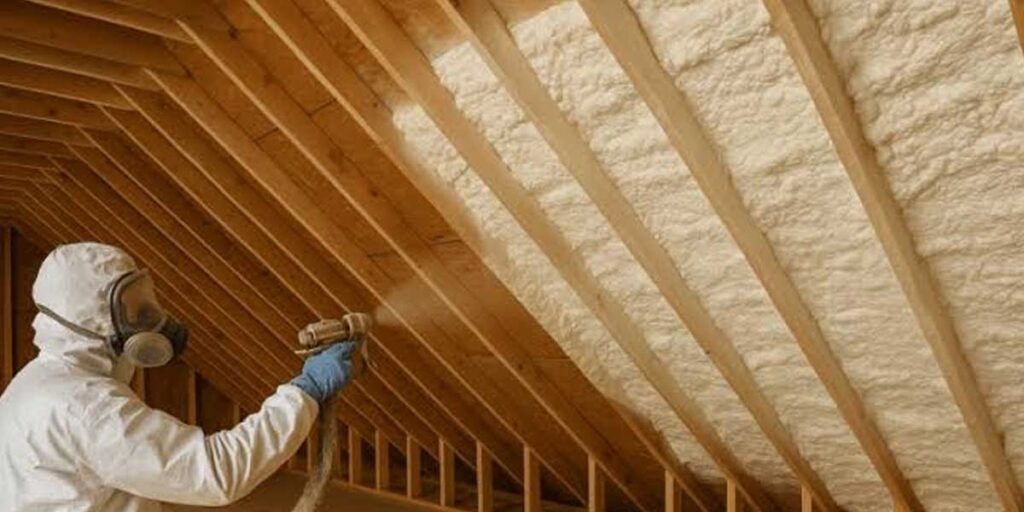
According to Redsail Property Management professionals, the best spray foam for homes is the type that fits the job, open-cell spray foam for a budget air seal and sound damping above grade, closed-cell spray foam for a denser, moisture-blocking, higher-R application and anything below grade, and a DIY kit only for small, simple, well-prepped work. Closed cell seals an opening at about an inch, open cell needs closer to three and a half, and that depth difference is where most selection mistakes start.
Written as a selection tool, the comparison below puts the spray foam types across use case, climate, durability, upkeep, cost factors, and failure risks.
It closes with a checklist for different homeowner profiles. If you are deciding which material to buy, the follow-through on the spray foam cost guide turns that choice into a budget you can plan around.
What makes spray foam the right choice for a home
Spray foam is right when its cell type matches your moisture and structural need and its depth suits the cavity. Decide first whether you need a vapor barrier and backing (closed cell) or a budget air seal with sound damping (open cell), then let the area narrow the choice.
The two types come from a cell-level difference. Closed-cell foam packs its cells tightly, so it does not expand as deep, can act as a vapor barrier, adds some structural backing, and seals tightly at around an inch. Open-cell foam has loose, varied cells, so it expands more, dampens sound, is less dense, does not form a vapor barrier, and seals at closer to three and a half inches. Below-grade work practically requires closed cell, because only it keeps ground moisture out.
Spray foam types compared by use case
Open cell suits above-grade walls and budget air sealing with some sound damping; closed cell suits structural, vapor-blocking, and below-grade work; and a kit fits only small, simple, well-prepped jobs. The matrix below maps each option against the conditions a buyer actually weighs.
| Option | Best fit | Air seal | Moisture | Structural | Sound | Cost factor | Main failure |
|---|---|---|---|---|---|---|---|
| Open-cell foam | Above-grade walls, budget | Yes at ~3.5 in | No vapor barrier | Low | Good damping | Cheapest per sq ft | Won’t stop ground moisture |
| Closed-cell foam | Structural, below-grade, vapor | Yes at ~1 in | Vapor barrier | Some backing | Moderate | Higher per sq ft | Wrong choice where airflow needed |
| DIY kit | Small simple cavities | Depends on type | Varies | Low | Varies | Lowest, but per-kit | Off-gassing, cure, coverage errors |
| Professional apply | Whole-home attic/walls | Best when air-sealed | Handled correctly | Best | As chosen | Labor + equipment | None if installed right |
The cell-type behavior above follows how the industry describes the two foams, and the application standards behind a correct job are set by the industry’s Spray Polyurethane Foam Alliance resources.
How spray foam fails and what upkeep it needs
Spray foam fails in a few predictable ways, choosing the wrong cell type for the moisture level, a kit applied at the wrong temperature or coverage, off-gassing during the cure, and poor surface prep.
Each shows up as a draughty or damp result before a visual check, and choosing the type for the conditions makes most of them disappear.
- Open cell below grade fails to stop ground moisture, so never use it there.
- Closed cell where airflow was needed can trap vapor if the space was not designed for it.
- Kit off-gassing during the cure needs ventilation and warm, clean surfaces.
- Coverage errors in a DIY kit leave thin or uneven thickness, cutting the seal.
- Poor surface prep lets the foam pull away and the air seal degrade.
Spray foam is low-maintenance once installed and does not settle like loose-fill, so the upkeep is mostly done at install time. Check the applied thickness for the seal depth you need, confirm the area is the right cell type for moisture, and give a kit the warm, clean, ventilated setup the chemistry requires.
Choosing the best spray foam for homes, profile by profile
Match the foam to how you live and where you are: a budget air-sealer takes open cell above grade, a moisture-prone or finished space takes closed cell, a small simple job can take a kit, and a whole-home or below-grade project is best left to a licensed applicator who follows the standards.
- Budget air-seal, above-grade walls: open cell, professional application.
- Below-grade, crawl space, or vapor need: closed cell, professional application.
- Sound damping between rooms: open cell, which dampens noise better.
- Structural or extra-rigid support: closed cell, which adds some backing.
- Small simple DIY project: a two-part kit on a clean, warm, well-prepped cavity.
- Whole-home attic or exterior walls: a licensed pro for a uniform air seal and correct depth.
Whichever type fits, get an itemized quote that names the cell type, the thickness, and the air-seal scope, then confirm the depth matches what your cavity needs. The budget side of that decision is covered in the spray foam cost breakdown, so you can compare the type against the price before you commit.
Questions homeowners ask about spray foam
Which type of spray foam is best?
Closed cell is best when you need a vapor barrier, structural backing, or below-grade coverage; open cell wins for a budget air seal on above-grade walls with some sound damping. The right choice depends on moisture and structural need, not R-value alone.
What is the strongest structural spray foam?
Closed-cell spray foam is the denser, stronger option and adds some structural backing along with its vapor barrier and higher R per inch. It is the choice where rigidity and moisture control matter more than cost.
Which spray foam has the highest R-value?
Closed-cell spray foam carries a higher R-value per inch than open cell, along with acting as its own air and vapor barrier. Open cell has a lower R per inch but costs less and dampens sound better.
What is the best DIY spray foam kit?
The best DIY kit for a small job is a two-part closed-cell kit sized to your cavity, applied on a clean, warm, well-prepped surface with the coverage the chemistry requires. Leave whole-home or below-grade work to a licensed applicator.
The savings side of choosing a type and installer is walked through in the spray foam cost guide, which gives an itemized budget so the selection and the price check land together.
The spray foam that fits your home
Choose the cell type by the moisture and structural need of each area, not by R-value alone, and confirm the depth and air-seal scope before you pay.
Measure the cavities, decide whether the space is below grade or needs vapor control, and let that set open or closed cell. Pick a kit only for a small simple job, and get a professional quote that names the type, thickness, and cost in one itemized line.
