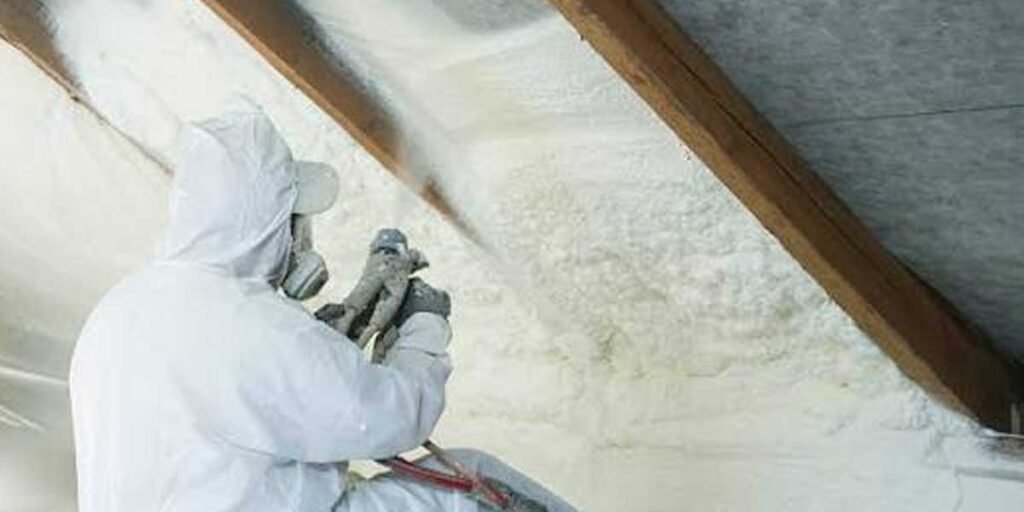
According to Relevate Property Guides solutions, the realistic spray foam cost in the United States runs roughly $0.50 to $3.00 per square foot for open-cell and $1.00 to $4.00 per square foot for closed-cell foam, installed, so a typical home spray-foam job lands near $2,000 to $6,500 depending on the areas covered and the foam chosen. No single national price exists, so the number that matters is your coverage area times an installed rate for your foam type, adjusted for your region, plus the hidden items a one-line quote usually hides.
Written as a cost-planning tool, the framework below breaks spray foam cost into material, labor, and the line items that quietly add up.
It builds one worked estimate, shows how coverage area and region shift the total, and gives a DIY-versus-professional threshold, so you can check any estimate against your own arithmetic. If you are comparing insulation materials rather than budgeting this one, the separate guide to fiberglass insulation covers that trade-off.
How spray foam cost is put together
A spray foam estimate is mostly arithmetic: the coverage area times a per-square-foot installed rate, with a different rate for open-cell and closed-cell foam, plus air-seal preparation, venting, and cleanup. Most published ranges bundle the spray and the labor; the line items show what is and is not inside that number.
Open-cell foam is lighter, cheaper, and lets vapor move, while closed-cell foam is denser, costs more per square foot, and acts as its own air and moisture barrier. Across multiple 2026 contractor guides, installed open-cell runs about $0.50 to $3.00 per square foot and closed-cell about $1.00 to $4.00, and a whole-home project typically lands from roughly $2,000 to $6,500 for a standard single-family house, with a 2,000-square-foot home quoted at $2,000 to $8,000. These are planning ranges, not a fixed national price, and they vary with local labor and application thickness.
A worked spray foam cost for a typical home
Here is the framework run for a typical home insulating an attic, a crawl space, and the rim board with professional closed-cell foam.
Roughly $3,800 total sits in the middle of a realistic plan range for that scope. Change the foam type, the coverage area, or the region and only the matching line below moves.
| Area | Coverage (sq ft) | Closed-cell rate | Line total | What it covers |
|---|---|---|---|---|
| Attic floor | 1,200 | $1.75 – $2.90 | $2,100 – $3,480 | Rim + floor, air-sealed |
| Crawl space walls | 700 | $1.50 – $2.60 | $1,050 – $1,820 | Wall band + edges |
| Rim board | 60 | $3.00 – $4.00 | $180 – $240 | Perimeter seal band |
| Subtotal | 1,960 | N/A | $3,330 – $5,540 | Coverage x rate |
| Air-seal, venting, cleanup | N/A | N/A | $400 – $800 | Prep + disposal + tidy |
| Total estimate | 1,960 | N/A | $3,730 – $6,340 | Planning midpoint, not a quote |
Watch what changes if you pick open-cell foam instead: at roughly $1.00 to $1.50 per square foot installed across the same area, the same job can drop toward $2,000 to $3,300 before the hidden items. That spread is why comparing only per-square-foot rates misleads, because the foam type and the coverage area move the total more than the brand does.
Spray foam cost by coverage area and region
Coverage area scales the total linearly, while region shifts the labor share.
A high-cost metro can run the same square footage up toward the top of the rate band, and a rural or low-cost area toward the bottom; the per-square-foot anchors are planning tools, and your local labor rate pins where inside that band your quote falls.
As a quick read on the PAA figures, 1,000 square feet of closed-cell foam runs roughly $1,500 to $2,900 installed, a 20-by-20 garage (about 400 to 800 square feet depending on walls versus ceiling) lands near $600 to $2,300, and a 30-by-40 shop works out to roughly $1,800 to $4,600 for a few hundred square feet, with the same foam-type and region caveats applied throughout. The arithmetic works for any footprint: multiply the square feet you plan to cover by your local installed rate, then add the hidden items.
Hidden spray foam costs that change the quote
The items that push a spray foam quote above the per-square-foot math are air-seal preparation, venting changes, cleanup and disposal, and any framing or wiring access needed.
A cheap per-square-foot rate usually hides these, so ask for each line explicitly rather than trusting a single number.
- Air-seal prep to close gaps and holes before the foam goes in.
- Venting or ventilation changes when a space or attic airflow must be rebalanced.
- Cleanup and disposal of overspray and foam drums after the job.
- Framing or access work where the foam must reach behind wiring or into a tight cavity.
- Regional labor and travel for the applicator, which varies by area.
- Warranty or inspection tied to the application standard.
Settle these against the coverage arithmetic before you compare vendors. A quote that omits air-seal prep and disposal can look a few hundred dollars cheaper per square foot and finish more expensive, which is why an itemized bid always beats a per-square-foot promise.
DIY versus professional spray foam
DIY spray foam kits are cheapest on materials, but they are a two-part chemical product that must be applied clean at the right temperature.
They suit small, simple, well-prepped jobs and stop making sense the moment coverage, access, or the cure is uncertain; professional application carries the air-seal, the equipment, and the standards the chemical really needs.
At roughly $0.35 to $1.00 per square foot for kit materials only, a small garage or a single wall can be an honest DIY project, with the caveat that the foam expands and cures fast, needs a warm space, and can off-gas during the cure. A whole-home attic, a crawl space, or any cavity that must be air-sealed correctly is best left to a licensed applicator who follows the SPFA application standards set by the industry’s Spray Polyurethane Foam Alliance. Weigh the material savings against the air-seal risk before you choose.
Questions people ask about spray foam cost
How much does it cost to spray foam 1000 square feet?
About 1,000 square feet of closed-cell spray foam runs roughly $1,500 to $2,900 installed, and open-cell less, depending on thickness and your local rates. Multiply your square footage by your local installed rate, then add air-seal and cleanup.
How much does it cost to spray foam a 20×20 garage?
A 20-by-20 garage with a ceiling runs roughly $600 to $2,300 for the ceiling area and a modest band of wall, depending on whether it is open- or closed-cell and your region. The quote scales with the square feet actually covered.
How much does it cost to spray foam a 30×40 shop?
A 30-by-40 shop works out to roughly $1,800 to $4,600 for a few hundred square feet of closed-cell foam, depending on the wall and ceiling coverage and local labor. Open-cell drops the total; closed-cell adds an air and moisture barrier.
How much does a 55 gallon drum of spray foam cost?
A 55-gallon drum of two-part spray foam chemistry costs several thousand dollars and covers a large area, but tank-system pricing varies by supplier and region. It is a professional-scale purchase, not a typical homeowner line item.
Once you know the number you need to plan around, the guide on spray foam best price: how to get the best value walks through negotiating and comparing installers so you do not overpay for the same coverage.
What your spray foam budget should be
Build your budget from coverage arithmetic, not from a per-square-foot promise: multiply the square feet you plan to cover by your local installed rate for the foam type, then add air-seal, venting, and cleanup to get a number you can take to any applicator. The worked table above is the template for that arithmetic.
Set a realistic planning range from the contractor-guide figures above, then get three itemized quotes on the same coverage and foam type. The right spray foam cost is the one that survives your own line-item math, not the cheapest headline rate.
