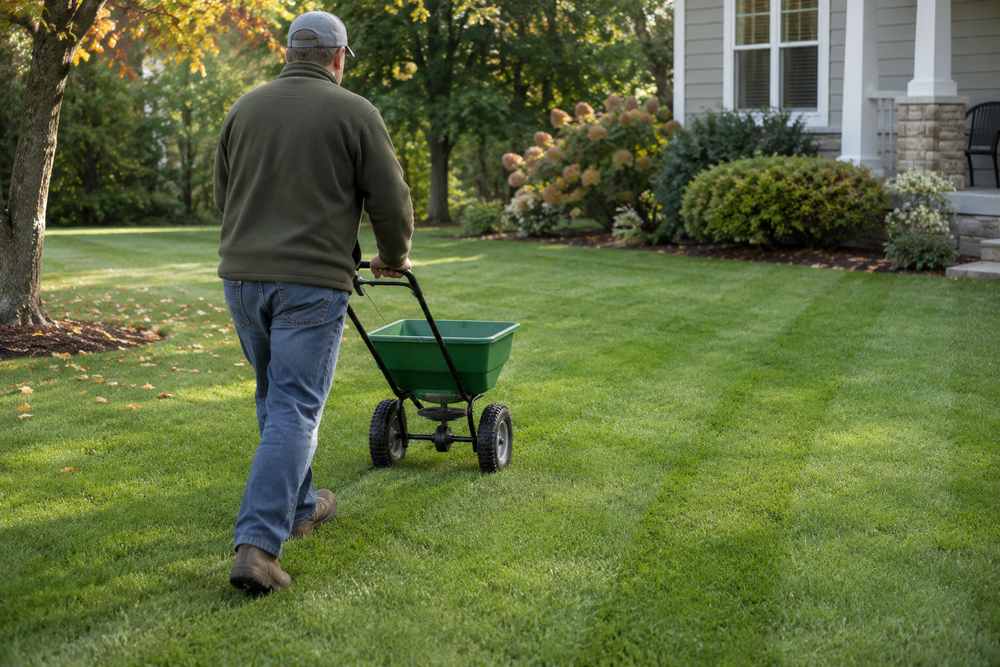
The fastest lawn fertilization schedule you can run is two feedings for cool-season grass, one in early spring and one in fall, and two to three feedings for warm-season grass from late spring through summer. Apply about one pound of nitrogen per 1,000 square feet per application, and skip any feeding when the lawn is dormant, drought-stressed, or waterlogged. Timing shifts by region and grass type, so the windows below are the framework and your local growing season sets the dates.
This schedule fits the common North American home lawn: Kentucky bluegrass, tall fescue, perennial ryegrass, or a mix in cooler climates, and bermudagrass, zoysia, St. Augustine, or centipede in warmer ones. If you live in the transition zone, you may have either family, and the calendar you follow depends on which one is actually growing in your yard. A soil test is the one check that changes everything else, because it tells you whether phosphorus and potassium are needed at all.
Most home lawns are over-fed and under-measured.
A schedule built on calendar dates alone fails for the same reason every year: the grass decides when it can use nitrogen, not the label on the bag. Read the lawn’s growth stage, apply the right amount, and the dates fall into place.
The One-Minute Lawn Fertilization Schedule
Cool-season grass takes fertilizer in early spring and fall, warm-season grass takes it from late spring through summer, and every application stays at roughly one pound of nitrogen per 1,000 square feet. The table below condenses the whole year into the windows that matter, so you can see your grass type’s season at a glance instead of reading product labels one bag at a time.
| Season | Cool-season grass (bluegrass, fescue, ryegrass) | Warm-season grass (bermuda, zoysia, St. Augustine) | Skip this feeding if |
|---|---|---|---|
| Early spring | Light feeding after growth starts and soil reaches the 50s F | Wait. Feed only after green-up, usually after two mowings | Soil still frozen, lawn still brown, or nights below freezing |
| Late spring | Optional light feeding for thin lawns; skip if you fed in early spring | First main feeding after full green-up | Drought-stressed or yellowing from heat |
| Summer | Skip or go very light. Cool-season grass slows in heat | Main feeding window, split into one to two applications | Brown or wilted turf. Water and recover first |
| Early fall | Main feeding. This is the most important window of the year | Skip. Warm-season grass is winding down | Lawn still recovering from summer drought |
| Late fall | Optional winterizer feeding about a week after the last mowing | Skip entirely | Ground frozen or grass fully dormant |
Two rules hold across every row. First, one pound of nitrogen per 1,000 square feet is the per-application ceiling for quick-release nitrogen, because more than that flushes growth and invites disease. Second, fertilizer is a tool for growing grass, not for reviving it. A lawn that is brown from heat or drought needs water and time, and feeding it while stressed makes the damage worse.
Match the Schedule to Your Grass Type
Grass type decides everything about timing because each family grows in a different season. Cool-season grasses grow fastest in the mild weather of spring and fall, so those are their feeding windows. Warm-season grasses grow fastest in summer heat, so they take their nitrogen from late spring through summer and rest in winter.
Cool-season lawns are common across the northern half of the United States and into the transition zone. Kentucky bluegrass, tall fescue, fine fescue, and perennial ryegrass all follow the same rhythm: they green up early, slow down in July and August, and recover through the fall. A fall feeding here builds root storage that carries the lawn through winter, which is why extension services call late summer to early fall the optimal window for a cool-season lawn.
Warm-season lawns dominate the Southeast, the Gulf states, and the Southwest. Bermudagrass, zoysia, St. Augustine, and centipede handle heat but go dormant and tan in winter. Their feeding season starts after spring green-up and runs through summer, and a winter feeding on dormant warm-season grass is wasted product at best.
| Grass family | Common types | Growth season | Best fertilization window | Avoid |
|---|---|---|---|---|
| Cool-season | Kentucky bluegrass, tall fescue, fine fescue, perennial ryegrass | Spring and fall | Early spring, then late summer to early fall | Mid-summer heat, frozen ground |
| Warm-season | Bermudagrass, zoysia, St. Augustine, centipede | Late spring through summer | After green-up through mid-summer | Winter dormancy, late-fall feeding |
Transition-zone lawns complicate this picture because both families can grow there, and many yards hold a mix. The honest test is observation: feed the grass that is actively greening and growing, not the grass that was in the bag you bought last year. If your lawn thins every summer and thickens in fall, you are caring for cool-season grass. If it tans in winter and explodes in July, it is warm-season.
The 4-Application Cool-Season Calendar
A full cool-season program runs four feedings a year: early spring, late spring for thin lawns, early fall as the main event, and a late-fall winterizer. Each application stays at about one pound of nitrogen per 1,000 square feet, and the fall pair matters more than the spring pair because cool-season roots do most of their storage work in autumn.
Spring feeding one, around the time the lawn first needs mowing, pushes green-up and early density. Use a product with mostly slow-release nitrogen so the flush of growth does not outpace the roots. Spring feeding two is optional and belongs on thin lawns only; a dense lawn fed in early spring does not need it, and a second dose of quick-release nitrogen in May is the classic cause of summer disease pressure.
Early fall is the anchor of the whole year. In central Illinois, the recommended window runs August 15 to September 15, and the pattern holds across the cool-season belt: late August to mid-September for most northern lawns, earlier in the far north and later toward the transition zone. This feeding rebuilds the root system, restores color after summer stress, and prepares the lawn for winter. If your soil is compacted, this is the week to do it, because the lawn aeration benefits show up most when the feeding and the aeration work on the same root zone.
The late-fall winterizer, roughly a week after the final mowing, supplies nitrogen and potassium for winter hardiness. It is the easiest feeding to skip and the one extension programs treat as optional, so treat it that way: a benefit for a healthy lawn, not a rescue for a struggling one.
How Much Fertilizer to Buy
Buy enough product to deliver one pound of nitrogen per 1,000 square feet per application, which means dividing one by the nitrogen percentage on the bag and multiplying by your lawn’s square footage. The first number in the N-P-K trio on the bag is the nitrogen percentage, and it is the only number you need for this calculation.
Illinois Extension’s method works as a homeowner formula. For a 15-0-10 fertilizer on a 7,000 square foot lawn, one pound of nitrogen divided by 0.15 gives 6.7 pounds of product per 1,000 square feet. Multiply 6.7 by 7,000 and divide by 1,000, and you get about 47 pounds of fertilizer for one application. That number assumes you are buying a single product; a soil test may tell you to skip phosphorus entirely, which is why the second and third numbers matter less than the first until you have test results.
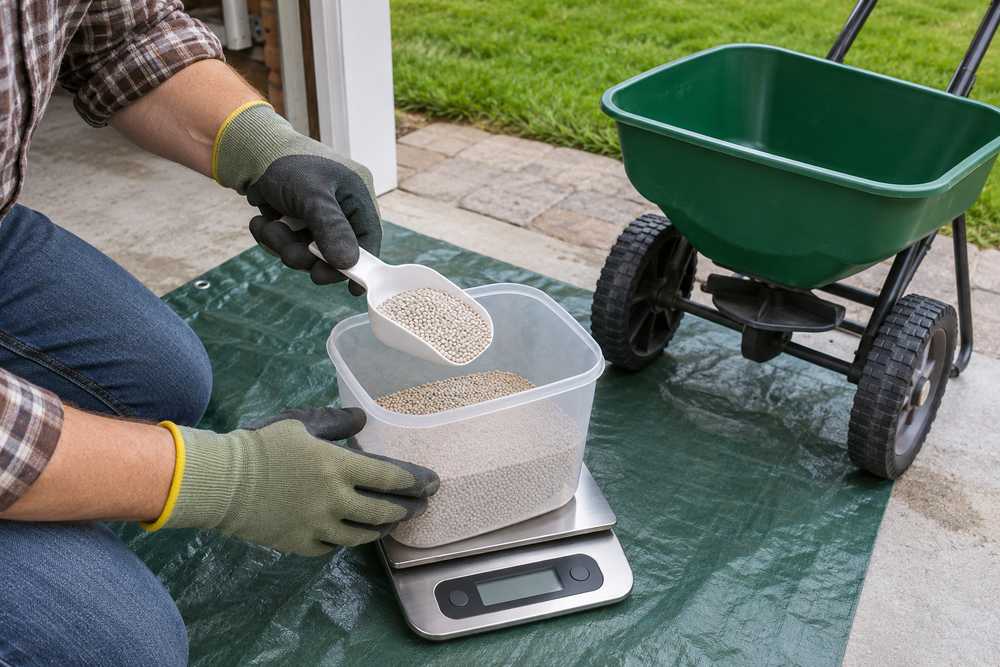
The Purdue Turf Fertilizer Calculator does this math for any bag and any lawn size, and it is the fastest way to check your arithmetic before you buy. The same page that explains the one-pound rule, Illinois Extension’s fertilizing guide, also covers slow-release versus quick-release nitrogen, which matters more than brand when you are standing in the fertilizer aisle.
A 47-pound bag on a 7,000 square foot lawn leaves almost nothing in the spreader, which is exactly the situation where lawns get over-fed. The leftover temptation is to finish the bag on the same pass. Do not. Store the rest or spread it thinner next time, because the one-pound cap is a cap, not a suggestion.
Fertilizing Mistakes That Break a Schedule
Four mistakes undo more schedules than any calendar error. Feed stressed grass, water the product off the lawn, skip the measurement, or fertilize weeds instead of grass, and the dates stop mattering.
Feeding a brown lawn is the most expensive mistake. Drought-stressed or heat-stressed grass cannot use nitrogen, the product sits on the surface, and the next rain carries it toward the street or the storm drain. Water first, wait for recovery, then feed.
Not watering after a feeding is the second. Most granular fertilizers need water to move nitrogen into the root zone, and a dry week after application leaves the product exactly where you dropped it.
The exception is products labeled for watering-in, which expect the rain to do the job.
Measuring by eye is the third. A lawn that needs 47 pounds does not get it from a handful, and a lawn half that size needs about half a bag. The Purdue calculator or a cheap scale ends the guesswork.
Weeds complicate the fourth. Spring weed-and-feed products pair a pre-emergent with fertilizer at a compromise date that is often wrong for one of the two jobs, and fall is the real window for broadleaf weed control. If weeds are the actual problem, a lawn weed control guide separates the two jobs instead of forcing one product to do both.
Lawn Fertilization Schedule FAQ
What months should you not fertilize?
Skip fertilizing in the months your grass is dormant: winter for warm-season grass and mid-summer for cool-season grass. Also skip any week the soil is frozen, the lawn is brown from drought, or the turf is waterlogged. Fertilizer only works on grass that is actively growing.
Do you fertilize grass before or after you cut it?
Fertilize after mowing, not before. Mowing right after a feeding sweeps granules into the catcher or pushes them off the lawn, and fresh-cut grass takes up water and nutrients more evenly. If you must fertilize first, wait at least a day before mowing.
Should I water immediately after fertilizing?
Most granular lawn fertilizers need about half an inch of water within a day or two to move nitrogen into the soil, so watering after application is usually correct. Check the bag first, because some products are labeled for watering-in while slow-release blends work fine with rain alone. Never water so much that runoff carries the product away.
What lawn fertilizer to use in September?
Use a fall blend high in nitrogen and potassium and low in phosphorus, such as a 32-0-10 or 24-0-12, unless a soil test says otherwise. September is the main feeding window for cool-season lawns, and the potassium supports root growth and winter hardiness. Warm-season lawns do not need a September feeding.
The lawn is the base layer of the yard, and once the feeding schedule is set, the same logic of scale and season applies to what you add after dark. The outdoor lighting cost depends on how many fixtures and which type you choose, which is why the outdoor lighting pros and cons deserve a look before you buy, and the types of outdoor lighting range from path lights to floodlights. More lawn and garden projects are collected under the Gardening guides hub.
Feed the lawn twice a year in the right amount, skip the weeks it cannot use nitrogen, and you will outperform most schedules that are longer on paper. The fall feeding is the one to protect; everything else is adjustment.
