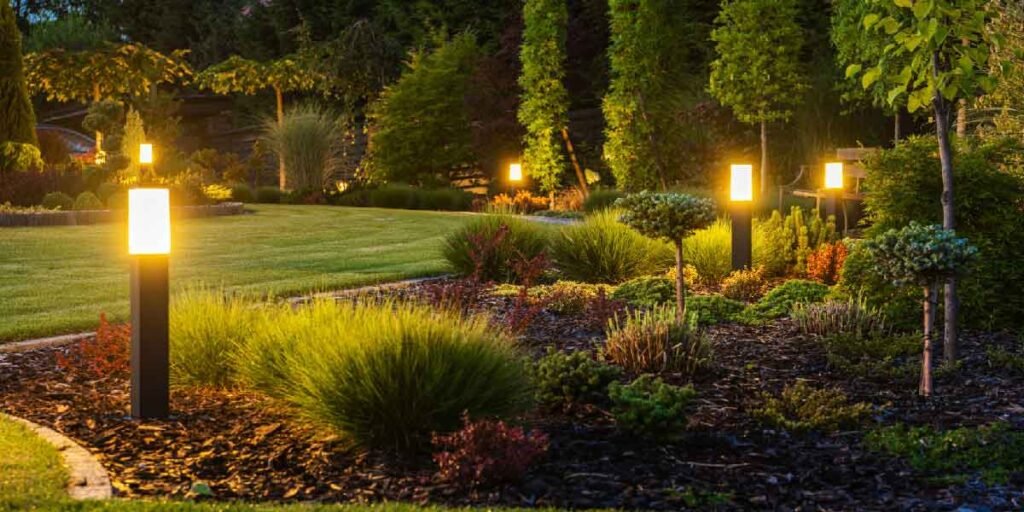
Types of outdoor lighting sort by power source before style.
The four common types of outdoor lighting each set their own limits on reach, brightness, and what an inspector will accept. Start with the architecture that suits the wiring already at the property, and the fixture list narrows to a workable handful.
Two numbers drive most of the disappointment. One is the voltage at the last fixture on a low-voltage run. The other is the current a low-voltage transformer can legally deliver. Both get checked before anything is bought.
How Types of Outdoor Lighting Split by Power Source
Four architectures supply outdoor lighting: 120-volt line voltage, low voltage at 12 or 24 volts, self-contained solar, and cord-and-plug units. Each answers three things differently: how far a light can sit from power, who may install it, and how far the system can grow later.
Solar and cord-and-plug sit at the easy end of installation and the narrow end of capability. Both deserve a look before the low-voltage route gets priced, because either can remove a trench from the job.
Solar and battery units
A solar fixture carries its own panel, cell, and control circuit, so it needs no power supply, no trench, and no licensed trade. The panel has to see sun, which rules out the north face of a building, deep shade under a mature canopy, and any spot where a shrub will grow over the panel within two seasons.
Output follows daylight. A short winter day charges a smaller reserve than a June day, and leaf litter or snow on the panel cuts it further. Fixtures with a separate panel on a cable do better than all-in-one units, because the panel can face the sun while the head faces the walk.
Service life is set by the battery, not the LED. Cell chemistry degrades with every cycle, and a sealed pack that sees a daily full discharge is the first component to need attention.
Cord-and-plug units
Plug-in units borrow an existing outdoor receptacle. The 2023 National Electrical Code requires at least one outdoor receptacle at the front and one at the back of a one-family dwelling (210.52(E)), and it requires GFCI protection at dwelling outdoor outlets supplied by single-phase circuits rated 150 volts or less to ground and 50 amperes or less (210.8(F)).
Lighting outlets are exempt from that GFCI rule under Exception No. 1. The receptacle a string-light transformer plugs into is not.
Older homes often have no outdoor receptacle, or one that predates GFCI requirements. Extending a circuit to reach a new outdoor spot is electrician work. Swapping a factory cord and plug for a listed outdoor unit stays within reach of a homeowner.
Line Voltage: Permanent Fixtures and Two Labels to Check
Line-voltage fixtures do the permanent jobs: entry sconces, post lights, soffit downlights, and floodlights. They wire into a box and a switch, deliver the highest output of the four types, and can be controlled by a wall switch, a timer, or a photocell. Outdoor Lighting wired at line voltage stays where the cable ends; a low-voltage run can be extended later by adding fixtures to the same transformer.
Two labels matter more than the finish. The first is the moisture rating. Under UL 1598, a damp location sees condensation but no direct liquid, and a wet location is one where liquid can drip, splash, or flow onto the equipment. A sconce under a deep roof overhang may qualify for a damp-location listing. Anything in the open, or within reach of a sprinkler head, needs a fixture marked for wet locations.
The second label is the listing itself. A fixture marked for wet locations has passed rain and spray testing. A box that says weather-resistant has passed nothing in particular.
Output on the spec sheet is quoted in lumens, not watts. Entry and wall fixtures commonly land in the 400 to 1,200 lumen band, and a driveway flood runs higher. The number that counts is delivered lumens after any lens or shield, since a decorative cage can cut output by a third.
Placement decides more than raw output at an entry. A sconce that spreads light over the approach and down onto the lock covers a doorway better than a brighter fixture aimed at a driveway. Most of the creative outdoor lighting ideas for enhanced home security come down to that same aiming question, plus a shield that keeps light off a neighbor’s window.
Low Voltage: The 30-Volt Rule and Voltage Drop
Low-voltage systems run at 12 or 24 volts and cover most path, step, plant, and hardscape lighting. Article 411 of the National Electrical Code caps the operating voltage at 30 volts AC or 60 volts DC, and drops that ceiling to 15 volts AC or 30 volts DC where wet contact is likely.
The same article governs every one of the types of outdoor lighting that runs on a step-down supply. The system has to be listed, either as a complete assembly or as an assembly of individually listed parts. That requirement separates a system an inspector will pass from a pile of parts that happens to light up.
Two current limits follow: each secondary circuit may not exceed 25 amperes, and the primary branch circuit may not exceed 20 amperes. A 12-volt, 300-watt transformer lands exactly on the secondary limit, since 300 divided by 12 is 25. Most residential kits stop at 300 watts for that reason. A 24-volt supply of the same wattage draws half the current and leaves room to grow.
Voltage drop is the real design constraint
Voltage drop is the difference between the voltage at the transformer and the voltage at the last fixture on the run. Manufacturers publish a cable constant for each wire gauge, and the standard estimate multiplies the one-way length by the total volt-amps on the run, doubles it, and divides by that constant.
A worked case: a single 100-foot run carrying 100 volt-amps on 12-gauge cable. The constant for 12-gauge is about 7,500, so the drop is two times 100 feet times 100 volt-amps, divided by 7,500, which comes to 2.67 volts. On a 12-volt tap, the last fixture sees roughly 9.3 volts, below the 10-volt floor most manufacturers set. Moving the same run to 10-gauge, with a constant near 11,920, cuts the drop to about 1.7 volts and lifts the last fixture to 10.3 volts.
Three fixes exist: heavier cable, shorter runs with fewer fixtures on each, or a higher transformer tap. Multi-tap units offer 12, 13, 14, and 15 volts for exactly that reason. A 24-volt system cuts the drop to roughly a quarter of the 12-volt figure at the same load, which is why larger properties often skip 12 volts altogether.
Two more rules come from the same article. Low-voltage fixtures stay at least 10 feet from a pool, spa, or fountain edge unless Article 680 permits otherwise, and buried cable follows the burial-depth table in 300.5 using listed cable. Confirm the last fixture with a voltmeter before covering a trench, since the calculation is an estimate and the meter is not.
Fixture Types, Sorted by the Job They Do
Fixture types fall into five working categories: guiding people along a path, lifting a facade or a tree, throwing light down from above, lighting steps and hard surfaces, and lighting water. Each category carries a typical mount and a short list of specifications that decides whether the fixture performs.
| Job | Typical fixture | Mount and placement | What to check first |
|---|---|---|---|
| Guiding a walkway | Path or spread light | Staked at the edge of the walk, head roughly 12 to 24 inches above grade, offset from a straight line | Distribution pattern and aiming range, so the pool of light lands on the walk and not on a neighbor’s window |
| Marking steps and level changes | Step or deck light | Recessed into a riser or stringer, or surface-mounted under a rail | Glare control at eye level, wet-location marking, and how the cable is protected inside the framing |
| Lifting a facade or tree | Uplight or accent | Set at the base and aimed up the face, angle adjustable | Beam angle and a shield, since upward spill is the part neighbors notice |
| Lighting an entry | Wall sconce or wall washer | Flanking the door, clear of the door swing | Damp against wet listing, and enough downward light on the lock and the step |
| Lighting a seating area | Downlight or tree-mounted moonlighting | High mount aimed down through branches | Glare control and service access, because a fixture high in a tree is hard to reach |
| Lighting a water feature | Submersible or sealed water light | Inside the basin or on the coping, fed from a listed source | IP68 with a stated depth and duration, plus the 10-foot clearance rule |
Color temperature: 3,000K is the ceiling
DarkSky International, formerly the International Dark-Sky Association, has required a correlated color temperature of 3,000K or lower for its Fixture Seal of Approval since 2014, along with zero upward light output. Cooler white light scatters more in the atmosphere and adds to skyglow, and the American Medical Association has flagged blue-rich white light at night as a health concern.
For residential work, 2,700K reads warm without tipping toward orange, and it sits close to the older bulbs a street or a neighboring porch may still run. One warm fixture beside a cool one is the color mistake most visible from the curb, and it shows up at dusk before anything else does.
IP ratings and wet-location listings are separate tests
An IP code comes from IEC 60529 and holds two digits: the first covers solids, the second covers liquid. For outdoor luminaires the first digit is nearly always 6, so the second digit carries the information. IP65 resists a 6.3-millimeter water jet at 12.5 liters per minute for three minutes. IP66 steps up to a 100-liter-per-minute jet. IP67 covers 30 minutes at one meter of immersion, and IP68 covers continuous immersion at a depth and duration the manufacturer states.
Those ratings cover different conditions and none contains the others. IP66 handles a pressure jet but not immersion. IP67 handles immersion but not a pressure jet. Full sealing also traps heat, so a tightly sealed fixture may need a driver rated for the higher internal temperature.
Separately, UL 1598 certifies safety in a wet location through rain, sprinkler, and immersion testing, with the sprinkler test running four hours at 20 psi while the lamp cycles on and off. That listing says nothing about how long a finish survives, and UL has no salt-spray standard, since salt does not affect electrical safety. Coastal properties need corrosion resistance checked against the manufacturer’s own data.
What Fails First, and Where the Work Changes Hands
The LED package is rarely the first failure. Gaskets, drivers, and battery packs go before the diodes, and rated life describes something narrower than most shoppers assume.
Rated lumen maintenance life is the elapsed operating time at which an LED source still produces 70 percent of its initial output, known as L70. The ENERGY STAR luminaire specification requires an in-situ L70 of at least 35,000 hours for outdoor luminaires, against 25,000 hours for indoor ones, documented through IES LM-80 test data and a TM-21 projection. That 35,000-hour figure works out to roughly 9.6 years at ten hours a night, and it says nothing about whether the housing still keeps water out.
Materials decide how the outside holds up. Die-cast aluminum with a powder coat handles most climates, copper and brass resist corrosion for decades at a price, and 316 stainless suits coastal air. Composite and resin housings cost less and chalk under ultraviolet exposure. A scratched coating starts corroding at the scratch on any of them.
Connections fail where moisture collects. Every splice in a low-voltage run needs a connector listed for direct burial, and the transformer tap should sit above the grade line, not in a low spot.
Where the work changes hands
Four jobs belong to a licensed electrician: adding a 120-volt circuit, installing or replacing a box or a GFCI device, running buried line-voltage cable under paving, and any wiring within 10 feet of a pool, spa, or fountain. Panel work belongs on that list as well.
Code adoption varies. The 2023 NEC is a model document, and states amend it. Iowa, for one, deleted the outdoor-outlet GFCI provision in 210.8(F), so the local inspector’s reading settles the question on a specific property.
Inside a listed low-voltage kit the work is different. Connecting a plug-in connector, staking a path light, aiming a fixture, and replacing a lamp module are homeowner tasks, and so is the annual pass that clears debris off solar panels and checks every connection for corrosion.
FAQ
What is the best type of lighting for outdoor use?
Low-voltage LED covers most residential needs, because it runs from a listed transformer and adds fixtures without new circuits. Step up to 120-volt line voltage for a driveway flood, a hardwired entry light, or anything that needs a wall switch.
What are the five types of outdoor lighting fixtures?
Path and spread lights guide walkways, wall sconces light entries, post lights mark driveways, floodlights cover open ground, and step or hardscape lights handle level changes. Submersible water lights form a sixth group for fountains and ponds.
What are the different types of outdoor recessed lighting?
Outdoor recessed fixtures divide into two groups: downlights set into a soffit or eave, which need a damp or wet location rating depending on exposure, and small step or deck lights set into a riser or a rail. Both get chosen on beam width, glare control, and whether the LED module can be reached for service.
How far can a 12-volt run go before the light dims?
Run length depends on the load and the wire gauge, not on a fixed maximum. On 12-gauge cable, a 100 volt-amp load holds its last fixture above 10 volts for about 75 feet. Dropping to 10-gauge stretches that to roughly 120 feet, and halving the load doubles either figure.
What color temperature should outdoor lighting be?
Between 2,700K and 3,000K for a home. DarkSky International treats 3,000K as the upper limit for its fixture seal, and cooler white light adds skyglow while leaving a warm-lit street looking uneven.
Before a low-voltage run goes into the ground, measure the voltage at the last fixture. If it sits below 10 volts, one of three changes fixes it: a larger cable, a shorter run, or a higher transformer tap.
