Artificial grass pays off on upkeep, not on heat or drainage. Those two measures decide the practical version of the artificial grass pros and cons, since the material changes the maintenance bill and leaves the site conditions untouched.
The artificial grass pros and cons that decide an outcome rarely come down to the blades. The material earns its keep where mowing, watering, and mud are the recurring chores, and it loses that argument where summer surface heat, pet waste, or heavy clay run the site.
Two decisions carry the rest: how the base gets built, and how hot the ground gets. Get an itemized quote for the first one, take a midday temperature reading for the second, and most of the uncertainty resolves on its own.
Where Artificial Grass Wins
Artificial grass removes three recurring jobs: mowing, watering, and mud management. It returns the most value on small, heavily used yards in dry regions, and it keeps a play surface usable through wet winters. It does not remove maintenance, and it does not cool anything.
Water is the clearest case. The EPA’s WaterSense program puts outdoor use at roughly 30 percent of average household consumption, and that share climbs in dry climates where irrigation restrictions bite first. Replacing a lawn removes that line from the budget entirely, which is why water agencies in drought-prone regions have paid conversion rebates on a per-square-foot basis.
The mud argument gets less attention than it deserves. A short dog run on a living lawn turns to bare soil and paw prints by February, while the same strip in synthetic grass stays usable year round.
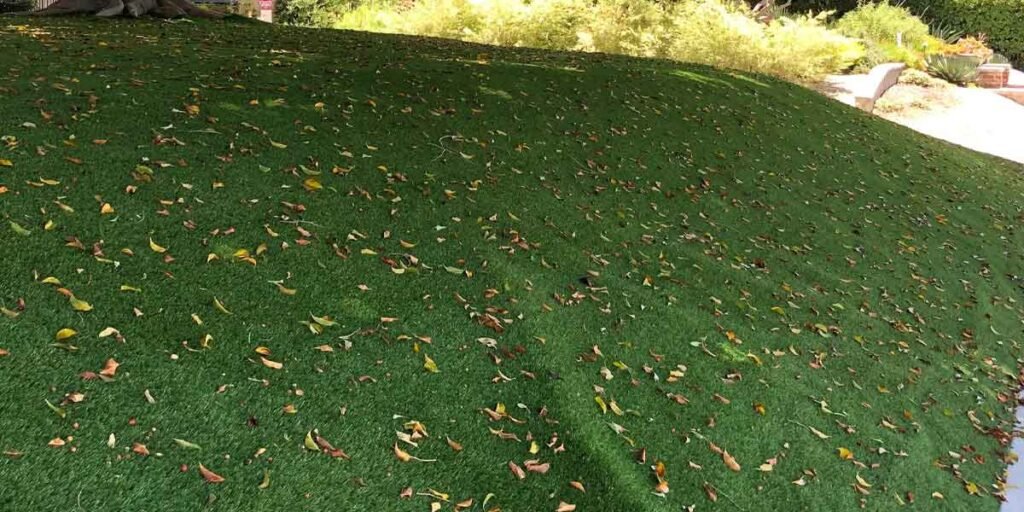
Maintenance drops rather than disappearing. Leaves still collect, debris still has to come off, and the pile still has to be brushed upright once or twice a year so the infill stays level. That is a fraction of a mowing season, and it is the part of the pitch that holds up best.
Mowing season simply ends.
What a Realistic Price Looks Like
Installed prices in U.S. quotes run from about $5 to $35 per square foot, and the spread has almost nothing to do with the turf itself. Base depth, drainage, hauling, and seaming separate a $7 bid from a $30 bid on the same yard.
Four jobs explain the distance between those numbers:
- Removal and disposal. Tearing out sod, or worse, concrete edging and old pavers, plus the cost of hauling it away.
- Base aggregate. Excavation to two or four inches, then crushed stone, then compaction in lifts.
- Drainage and grade. Correcting fall away from the house, and adding a French drain or dry well where the soil will not take water.
- Seams and edging. More than one roll means seaming, and seaming is the part that fails first when it is done badly.
The arithmetic on the base surprises people. A 1,000-square-foot yard with two inches of compacted aggregate needs about eight tons of stone moved, spread, and packed. That tonnage is why the material is rarely the biggest line on a quote, and why a bid listing only turf, sand, and labor is usually a bid for a shallow base. Cheaper stone, thinner lifts, or a skipped compactor pass all show up later as movement underfoot.
Ask for tonnage and lift depth rather than a thickness estimate over the phone. A quote naming the aggregate type, the compactor, the seam layout, and the disposal method can be compared against another quote. A single per-square-foot number cannot.
Cheap installs fail in a predictable order: waves appear first, then standing water at the low corner, then seams open.
Life expectancy falls in the eight-to-twenty-year band described further down, so the honest way to judge a price is annual cost. Divide the installed figure by the years the surface actually serves, then set that against what mowing, irrigation, fertilizer, and weed control cost each year.
Rebates exist but rarely close the gap. Water agencies that pay for lawn conversion do it per square foot, and the payment moves the payback period, not the base cost.
Heat, Rain, and Drainage
Synthetic turf runs hotter than living grass by 20 to 50 degrees Fahrenheit, and peak field readings have approached 200 degrees. Rain passes through a correctly built base, while compacted clay can shed the same storm off the surface without soaking it in.
Researchers at Penn State’s Center for Sports Surface Research recorded that 20-to-50-degree gap, with surface readings at times matching asphalt pavement. The practical version of the number is a slide, a trampoline mat, and a dog’s paws at two in the afternoon in August.
Wetting the surface drops the temperature for a short window, and that is why the Synthetic Turf Council’s guidance for installations in hot climates includes irrigation for sanitation and comfort. A yard sold as water-free can end up needing a hose, or a sprinkler zone, on the hottest afternoons.
Drainage determines whether the surface stays usable or becomes a puddle with fiber on top. A properly built system is perforated backing over a compacted subgrade, with a stone layer sized so water leaves faster than it arrives. On sand, that happens almost by default; on clay, it has to be designed.
Clay soils, flat lots, and yards that already pool after a storm are where that system gets expensive, because the water has to go somewhere: a dry well, a French drain, or a connection to a storm line. Improper grading pushes water at the foundation, and a repair like that has cost more than the original install on projects I have walked through.
Stormwater rules in some jurisdictions treat covered ground differently from planted ground when they calculate runoff fees or permit limits. That belongs in a call to the local building or water department, not in a guess.
Heat and drainage are the two expenses buyers underestimate most.
Pets, Kids, and Surface Feel
Dogs and children use a lawn harder than adults do, and that is where synthetic turf exposes its two real weaknesses: urine odor that has to be rinsed away, and a surface firmer than soil. Both can be managed, and neither one manages itself.
Urine does not break down the way it does in living soil, so ammonia collects in the backing and the infill. Owners who rinse the area and use an enzyme cleaner keep the smell down. Owners who skip it end up replacing sections, and drainage quality determines how bad the problem gets before that point.
The surface is harder than it looks. Compaction and a firm base leave less give, and friction burns on bare knees are a real complaint on thin, cheap products. Modern backing and pad layers have softened the landing, and the infill used on most residential jobs today is silica sand or a coated version of it rather than crumb rubber.
One upside for families is what never happens on the surface: nothing gets sprayed, mowed, or trampled into bare soil where the swing set stands. Parents with a toddler and a dog tend to rate that above the heat problem, at least until August.
Set the schedule around the surface temperature, not the air temperature.
What Breaks Artificial Grass Down
Two failures end a synthetic lawn’s life: the fibers wear or fade, and the base stops draining. A ten-year color and binder warranty is a common term, while critics put real-world life closer to eight years. Weeds show up where drainage has failed, not where the grass has aged.
The three age markers are separate, and a warranty covers only some of them. Color fades under ultraviolet light. Fibers flatten under traffic and mat down in the middle of a dog run. The base settles or clogs, and once water stops moving, moss and shallow-rooted weeds move in.
Reflected sunlight is the failure few buyers hear about. Low-emissivity windows and some double-glazed units concentrate enough solar energy to melt or distort fibers in front of them, and that damage is typically excluded from warranty coverage.
Chemicals take their share: gasoline spills, a fertilizer pile left sitting, and concentrated pool chlorine all leave marks that do not wash out. Leaf litter left through a wet winter is a different problem, since it keeps moisture against the backing and feeds growth in the infill.
The end of life stage is the one the industry handles worst. Manufacturers describe recycling, and in practice most removed turf goes to a landfill, because separating fiber from backing and infill is not economic in most markets.
Regulators have moved on the infill side of that. The European Union’s 2023 microplastics restriction phases out intentionally added microplastic infill for sports fields over an eight-year window. The U.S. Consumer Product Safety Commission’s 2008 testing of artificial turf found generally low lead exposure risk for children and advised hand washing after play, and state health agencies added a precaution for heavily worn or dusty fields: replace them. Residential products have largely shifted away from crumb rubber toward sand-based infill.
The fibers are rarely the reason a lawn gets replaced.
Where DIY Stops, and Which Yards to Skip
Four jobs push a synthetic lawn past a weekend project: excavation, hauling, compaction, and seaming. Utility locating comes before all of them. Yards under heavy shade, on clay, in front of reflective glass, or governed by unclear rules should skip the material.
Start with what is buried. Call 811, the national utility locating service, before a shovel goes in, because irrigation lines, yard lighting circuits, gas service, and old electrical runs sit exactly where the base has to be dug. Cutting into a live line turns a routine dig into an emergency, and the locating service is free.
Material volume sets the second boundary. Even a modest yard means several tons of stone and soil moved twice, once out and once in, plus a plate compactor rented and run in lifts. That is a labor problem before it is a skill problem.
Hard surfaces raise the stakes. Cutting concrete or old pavers releases crystalline silica dust, which calls for water suppression and respiratory protection, and any electrical or gas line in that excavation turns a homeowner project into an electrician’s or a utility’s job.
Seams are the skill boundary. Where two rolls meet, the fibers have to be matched and joined so the line disappears and stays closed underfoot. Installers who do this daily describe it as the hardest part of the trade, and a bad seam opens within a season.
Hand the work to a professional when the site needs new grading, a drainage system, or a connection to storm infrastructure, when the layout requires several seamed rolls, when demolition includes concrete, or when the rules that govern the property are unclear.
The yards to skip are easier to list than the yards to choose.
| Site condition | Why synthetic turf struggles there | What works better |
|---|---|---|
| Heavy shade under deciduous trees | Foliage stays wet against the backing, and moss and algae stain the fibers | Ground cover, mulch, or a shade-tolerant planting mix |
| Tight clay or a low spot that already pools | Water has nowhere to go, and base failure follows within a few seasons | Drainage work first, or keep the ground planted |
| Low-emissivity glass facing the lawn | Reflected heat can melt or distort fibers, usually outside the warranty | Shade the glass, or keep living ground in that strip |
| Two large dogs and no rinse routine | Ammonia builds up in the backing and the infill | A gravel run for the dogs, or a weekly wash-down that actually happens |
| Rental property or a planned move within five years | Installed cost recovers over the life of the surface, not over the hold period | Keep mowing and defer the project |
| Association or municipal rules that restrict coverage | Approval problems and possible removal costs after installation | Get written confirmation before ordering materials |
| Vegetable beds or pollinator habitat on the wish list | Nothing grows in the base, and the surface offers no habitat | Raised beds and mixed planting around the lawn |
Read each row as a tradeoff rather than a defect. The artificial grass pros and cons shift with the site, and none of them turns on product quality alone. Resale tilts the calculation too, since a low-upkeep surface transfers with the property, and buyers weighing a dated house tend to treat yard upkeep the way they treat renovation work. The same arithmetic appears in navigating the fixer upper market pros and cons, where the question is how much unfinished work a buyer will accept in exchange for price.
Artificial Grass alters the upkeep bill, and it leaves shade, soil, and drainage exactly as they were. Two tests settle most of the uncertainty: pour a bucket of water on the proposed area and time how long it takes to disappear, then watch the site at midday in July to measure both direct sun and reflected heat.
Artificial Grass Pros and Cons: Common Concerns
Is artificial grass cheaper than a real lawn?
Installed cost runs several times the price of sod, so the honest answer is no, at least until break-even. The savings arrive later, as the years of mowing, watering, and fertilizing that no longer happen, and how long break-even takes depends on the surface’s service life and local water prices.
Why are people getting rid of artificial grass?
Heat buildup, odor in pet areas, and base drainage that stopped working are the three reasons surfaces come out early. Color fade and matted fibers follow close behind. Damage from reflected window light also forces replacement ahead of schedule, and that failure is usually not covered by warranty.
What are the downsides of artificial grass?
The artificial grass pros and cons reported most often by owners are surface temperatures 20 to 50 degrees Fahrenheit hotter than living grass, a firmer surface underfoot, no soil or wildlife benefit, limited recycling at end of life, and an upfront cost that only makes sense over a long hold. Maintenance drops, and it does not vanish.
Does rain drain through artificial turf?
Yes, when the base was built for it. Perforated backing and a compacted aggregate layer move water quickly on sandy ground. On tight clay or a flat lot, drainage is a designed system rather than a property of the turf, and without that design the surface ponds.
What destroys artificial grass?
Ultraviolet light, concentrated reflected sunlight, traffic that flattens the fibers, chemicals such as gasoline or pool chlorine, and a base that stops draining. Pet urine speeds up the decline in the areas dogs use most.
The site settles this one. Time how fast the ground takes water, note how much sun and reflection the surface will collect, and the choice usually stops being close.
