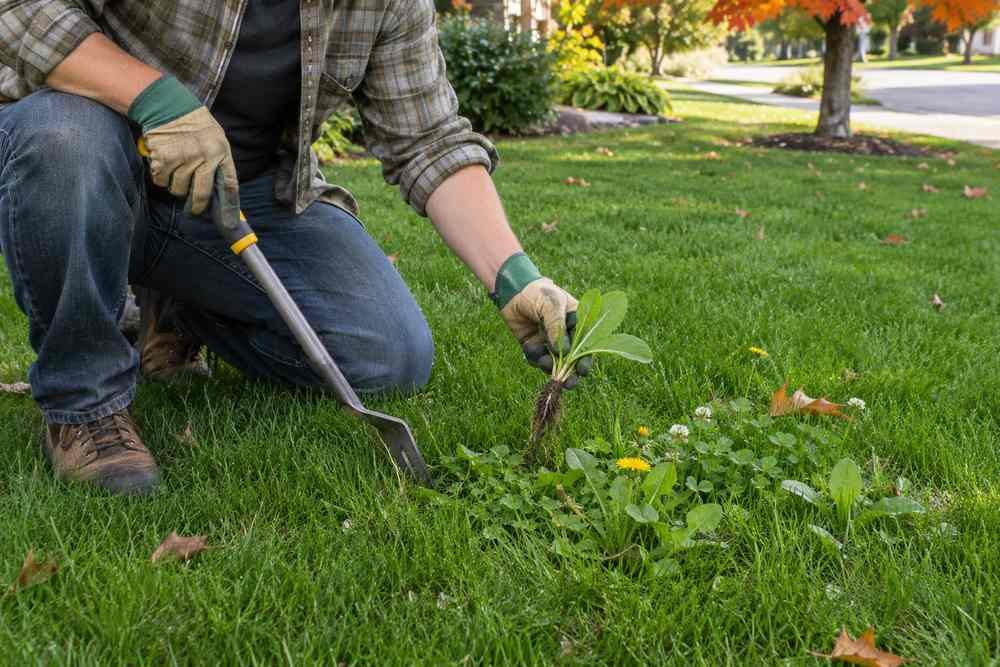
Weed control starts with a dense, healthy lawn, not with herbicide. Identify the weed first, then pick the method: hand-pull or spot-treat when there are few weeds, apply a selective post-emergent for broadleaf weeds in fall, and use a pre-emergent in spring to stop annual grasses like crabgrass. Most home lawns need one well-timed selective treatment plus fixing the mowing, watering, and feeding habits that let weeds in.
The practical lawn weed control guide for a home lawn starts with the grass you already have: bluegrass, fescue, ryegrass, bermuda, or zoysia across most of North America. It does not cover full lawn renovation, insect control, or commercial turf programs, and it treats regional timing as a range you adjust to your local growing season. The order matters as much as the product: identify, prevent, treat the few, then treat the many.
Weeds are a symptom, not the disease.
University turf programs have been saying this for years, and it is the most useful sentence in weed control: weeds fill a void, they do not create one. The University of Florida turf program states it directly in its weed management guide for lawns: thin turf lets light reach the soil, and weed seeds germinate in exactly that light.
The One-Minute Lawn Weed Control Plan
Match the weed type, how many there are, and the season to one action. Broadleaf weeds like dandelion and clover are easiest to kill in fall with a selective post-emergent; annual grasses like crabgrass are stopped in spring with a pre-emergent; sedges need their own treatment because standard lawn herbicides miss them.
| What you see | How many | Season | Action |
|---|---|---|---|
| Broadleaf weeds (dandelion, clover, plantain, chickweed) | A handful | Any | Hand-pull with the root, or spot-spray a selective broadleaf herbicide |
| Broadleaf weeds | Scattered across the lawn | Early fall | One full-lawn selective post-emergent application; this is the single most effective treatment of the year |
| Annual grasses (crabgrass, goosegrass, annual bluegrass) | Any | Spring, before germination | Pre-emergent herbicide timed to soil temperatures near 55-60 F |
| Sedges (yellow and purple nutsedge) | Clumps or patches | Late spring to summer | Sedge-specific herbicide; ordinary broadleaf products do not control nutsedge |
| Anything, everywhere, lawn mostly weeds | More than half the yard | Fall | Renovation: kill everything, fix the soil, then seed or sod |
Two rules hold across every row. First, timing beats product: a correctly timed fall broadleaf treatment outperforms three summer sprays of a stronger chemical. Second, the best herbicide application is the one you almost do not need, because prevention already fixed the lawn.
Identify the Weed Before You Treat It
Weeds fall into three groups that need different controls: broadleaf, grassy, and sedge. Broadleaf weeds have net-veined leaves and often showy flowers, grassy weeds have hollow round stems with parallel veins, and sedges have triangular solid stems you can feel when you roll them between your fingers.
Identification decides which product is safe for your lawn. A selective broadleaf herbicide kills dandelion and clover while leaving grass alone, but the same product does nothing to crabgrass or nutsedge. Spraying the wrong class is the most common reason a treatment fails and the lawn still looks weedy.
| Weed class | Examples | How to recognize it | What controls it |
|---|---|---|---|
| Broadleaf | Dandelion, clover, plantain, henbit, chickweed, spurge | Net-veined leaves, broad blades, often a flower | Selective broadleaf herbicide (fall best) or hand-pulling with the taproot |
| Grassy | Crabgrass, goosegrass, annual bluegrass, dallisgrass | Hollow, round stems; parallel leaf veins; looks like turf grass | Pre-emergent in spring for annuals; some perennials need spot treatment or digging |
| Sedge | Yellow nutsedge, purple nutsedge | Solid, triangular stems; rolls like a triangle between fingers; grows faster than turf | Sedge-specific herbicide; repeat applications over the season |
A good photo and a county extension office identify most weeds for free. State land-grant universities publish weed guides for their regions, and the identification step is where the whole program gets cheaper: you stop buying products that cannot work on what you actually have.
Prevention Comes First
A dense lawn crowds out weeds by shading the soil and leaving no room for seeds to establish. The University of Florida turf program puts it plainly: weeds fill a void, so the cheapest weed control is turf that leaves no void. Mowing, watering, and feeding to keep grass thick is the foundation of every weed program.
Mow at the right height and never remove more than one-third of the leaf blade at a time. Cool-season grasses generally want about 2.5 to 4 inches, warm-season grasses about 1.5 to 2.5 inches, and cutting lower than your grass type prefers stresses the turf and opens the canopy to weeds. Keep blades sharp, because torn leaf tips invite disease and thin the stand.
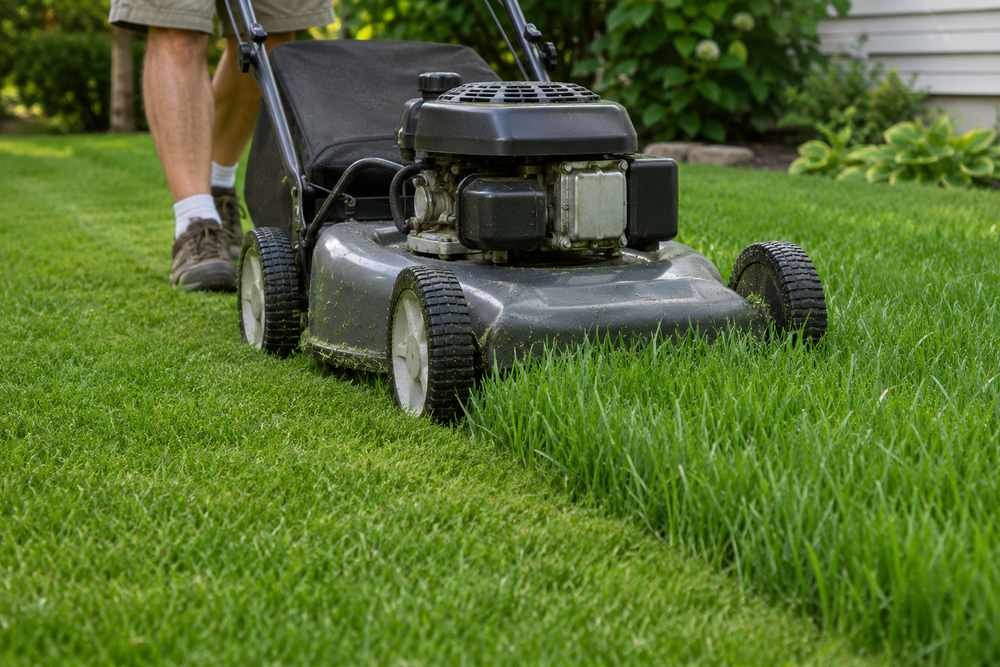
Water deeply and less often so roots grow down instead of spreading shallow. The UC IPM weed management guide recommends about an inch of water per week in longer, less frequent sessions rather than daily sprinkling, and compacted soil that cannot drain is a standing invitation to goosegrass and annual bluegrass. If your soil is compacted, the lawn aeration benefits show up here, because aerating relieves the compaction that weakens turf.
Feed the lawn on a schedule that keeps it dense without pushing a flush of growth you cannot mow. A lawn fertilization schedule matched to your grass type supplies nitrogen when the turf can use it, and dense, well-fed turf is the least weedy lawn you will ever have.
Non-Chemical Control First
Hand-pulling works when there are few weeds, and it is the cheapest option that never fails. Pull after rain when the soil is soft, and get the root, because dandelion and plantain regrow from any taproot left behind. For a handful of weeds across a small lawn, a weeding tool beats a sprayer.
Mowing itself suppresses weeds when done right. Keeping the canopy dense and cutting before weeds set seed reduces next year’s seed bank, and bagging clippings while weeds are producing seedheads stops them from spreading through the mower. Smothering with mulch or plastic works in beds and paths but not over living turf, and boiling water is for cracks in pavement, not for lawn grass, because it kills the grass too.
Organic options have a place and a limit. Corn gluten meal is a pre-emergent that reduces crabgrass germination when applied before it sprouts, though it is less consistent than synthetic pre-emergents and doubles as a nitrogen source you must account for. Vinegar-based sprays kill the tops of young broadleaf weeds but rarely the roots, which is why the weeds come back. The UC IPM and UF/IFAS guides treat these as supplements to good turf management, not replacements for it.
Chemical Control Done Right
Herbicides split into two pairs: pre-emergent versus post-emergent, and selective versus non-selective. Pre-emergents stop seeds from germinating and are for annual grasses like crabgrass in spring; post-emergents kill plants that are already growing and are for established broadleaf weeds, best applied in fall. Selective products spare turf grass; non-selective products kill everything they touch.
The fall broadleaf application is the one treatment most homeowners should not skip. Dandelions, clover, and plantain are storing energy for winter in their roots in early fall, and a selective post-emergent translocates to those roots when applied then. University programs consistently time the strongest broadleaf window to late summer and early fall, and one good fall application does more than a spring and summer of spot spraying.
“Lawn is littered with all types of weeds and I missed the season to nuke it. Is there anything I can do to turn this around? Edit: thanks for the reply’s! I have weed and feed. I’m going to cut my lawn and then spray it down after a few days.”
— r/lawncare, April 2026 (253 upvotes)
That homeowner missed the spring pre-emergent window, and the fall broadleaf window is the recovery route for the same reason: timing is the part of weed control that actually gets missed. A spring pre-emergent applied before crabgrass germinates, when soil temperatures are trending through the 50s toward 60, stops the season’s crabgrass crop before it exists. Apply it in the South as much as a month earlier than in the North, and check the product label for the exact soil-temperature trigger.
Read the label before every application, because the label is the law and the dose is not a suggestion. Spray on calm days when the forecast is dry, keep the spray off desirable plants, and do not apply a pre-emergent within weeks of overseeding, because it will stop the new seed from germinating too. Non-selective products belong in paths, cracks, and renovation, never as a blanket treatment over a lawn you want to keep.
Mistakes That Keep Weeds Coming Back
Four mistakes repeat in almost every weedy lawn, and each one is fixable. Mow too low and you thin the turf. Spray the wrong class of herbicide and the weeds survive. Treat in the wrong season and the timing passes. Never fix the soil and the same weeds return every year.
Mowing too low is the quiet one. The lawn looks tidy for a week, then the canopy opens and crabgrass germinates in the light that reaches the soil. Raise the mower to the grass type’s recommended height and the weed pressure drops on its own.
Spraying the wrong product wastes a season. Broadleaf herbicide on nutsedge is the classic example: the nutsedge ignores it, and by the time you buy the right product the weed has spread. Identify first.
Weed-and-feed products look convenient and often compromise both jobs. The fertilizer and the herbicide rarely share an ideal timing window, which is why separate applications on their own schedules control weeds better than a combined product.
Soil that stays compacted or waterlogged keeps producing the same weeds no matter what you spray. Fix the drainage, aerate the compaction, and the weed seed bank loses its welcome mat.
Lawn Weed Control Guide FAQ
What is the best thing to kill weeds but not grass?
A selective post-emergent broadleaf herbicide kills dandelion, clover, and similar weeds while leaving turf grass unharmed, and it works best in early fall. For grassy weeds like crabgrass, use a pre-emergent in spring instead, because no single product safely kills every weed class in a lawn.
What is the most effective way to control weeds in my lawn?
The most effective program is prevention plus one well-timed treatment: keep the lawn dense with correct mowing, watering, and feeding, then apply a selective broadleaf herbicide in fall. A thick, healthy lawn crowds out weeds, and the fall application removes the survivors.
How can I get rid of a lawn that is completely full of weeds?
When weeds cover more than half the lawn, renovate: kill everything with a non-selective herbicide, remove the debris, fix soil compaction and drainage, then seed or sod after the product’s re-entry interval. Spot treatments will not recover a lawn that is mostly weeds.
What do professionals use for weed control in lawns?
Professional programs use pre-emergents in spring for annual grasses, selective post-emergents in fall for broadleaf weeds, and sedge-specific products for nutsedge, all timed to soil temperature and growth stage. The same products are available to homeowners; the professional advantage is timing and consistent application.
Can I get rid of weeds in my lawn with vinegar?
Household vinegar kills the tops of young broadleaf weeds but not the roots, so most weeds regrow within weeks, and it burns turf grass on contact. It suits cracks and paths, not lawn-wide weed control, where a selective herbicide or hand-pulling works better.
The lawn is the base layer of the yard, and once the weeds are under control the same seasonal logic applies to what you add after dark. The outdoor lighting cost depends on how many fixtures and which type you choose, which is why the outdoor lighting pros and cons are worth weighing before you buy, and the types of outdoor lighting range from path lights to floodlights. More lawn and garden projects live under the Gardening guides hub.
Identify the weed, fix the turf, and treat the survivors once, in the right season. That sequence is the whole lawn weed control guide in practice, and the fall broadleaf application is the one step to protect; everything else is maintenance.
