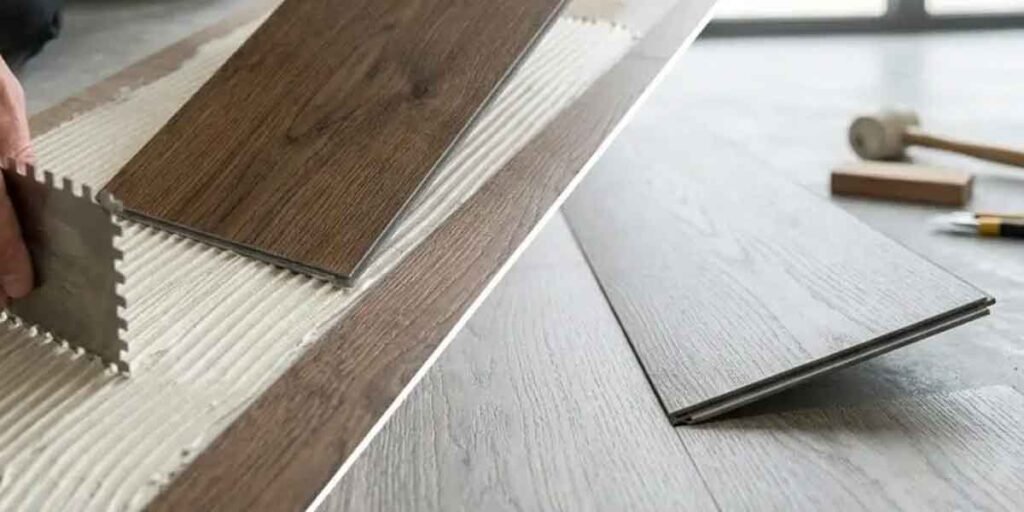
Wear layer, core, and subfloor decide which types of vinyl flooring works in a room.
Sheet goods, planks, and tiles get the attention, and the format is the last question worth asking. Two floors that look identical on a shelf can differ threefold in the clear layer that takes the abuse, and one of them belongs in a basement while the other does not.
The order that keeps a purchase from going wrong: the clear layer first, the shape second, the core third, and the surface underneath before any of it. Then the places where a homeowner should put the tools down.
The Wear Layer Is the Spec You Compare First
The wear layer is the clear top coat, measured in mils, or thousandths of an inch. It has nothing to do with how thick a plank feels in the hand, which is measured in millimeters and mostly reflects the core.
Three ASTM specifications split the market, and each one uses the wear layer to sort products into grades.
- ASTM F1303 covers sheet vinyl with backing. It sorts products by Type, based on PVC binder content, and by Grade, based on wear layer thickness. Grade 3 is the residential tier; Grades 2 and 1 reach into light commercial and commercial work.
- ASTM F1700 covers solid vinyl tile and plank in modular formats, split into Class I, II, and III by how the pattern is built into the product. It sets no minimum wear layer, so the mil figure on the carton is the only durability number a buyer gets.
- ASTM F3261 covers rigid-core plank, which is where WPC and SPC live. It defines Grade 1 Commercial at a minimum wear layer of 0.020 inch, which is 20 mil. That line is where the habit of calling 20 mil commercial grade comes from.
Wear layer thickness is measured optically under ASTM F410. The ranges manufacturers publish line up with each other: 6 to 8 mil for closets and guest rooms, 12 mil for bedrooms, rentals, and ordinary family traffic, 20 mil for kitchens and households with pets, and 28 mil and above for spaces that see commercial use. Metroflor, which sells all of them, argues 12 mil covers most homes and calls 20 mil overkill for residential work. MSI Surfaces and LX Hausys draw the line higher, at 12 to 20 mil for a single-family home.
The coating counts as much as the number. An aluminum oxide or ceramic-bead finish on a 12 mil layer outlasts plain urethane on a thicker one.
Sheet, Plank, and Tile Are Three Shapes of One Product
Sheet vinyl comes in rolls 6 or 12 feet wide, so a bathroom or laundry room can often be covered in one piece with no seams to seal. That width is also the format’s constraint: a 12-foot roll does not bend around a hallway, and a repair means patching a large area. Sheet goods carry the F1303 grades, and inlaid construction, where the pattern runs through the full thickness of the wear layer, holds up better than printed sheet.
Planks and tiles are the same family of product cut into different shapes. Luxury vinyl plank (LVP) is the elongated wood-look format; luxury vinyl tile (LVT) is square or rectangular with a stone or ceramic look. Individual pieces come up and get replaced without disturbing the rest of the floor.
Peel-and-stick tile is the self-adhesive version, and it fails at the edges when the subfloor is dusty or uneven, because the bond does all the work and nothing else holds the seam. Vinyl composition tile (VCT) is the commercial product that needs wax and periodic stripping, and it answers to a maintenance schedule.
“Luxury” appears on 6 mil goods, and LVP and vinyl plank name one product. The standard printed on the carton and the mil figure beside it are the parts worth comparing.
The Core Decides Dent Resistance and How the Floor Sounds
Rigid-core planks sell under two sets of letters, and the middle layer is the difference. SPC, or stone polymer composite, is roughly 60 percent limestone powder bound with PVC and no foaming agent, which is why it is dense at about 1.8 to 2.1 grams per cubic centimeter and 3.2 to 7 millimeters thick. WPC, or wood plastic composite, is foamed, and the closed cells make it thicker, 5.5 to 8 millimeters, at a third of that density or less.
That density gap sets the trade. SPC resists dents from a refrigerator foot or a rolling chair and moves less with temperature, on the order of 0.01 to 0.08 percent per degree Celsius, which is what fits it to sunrooms, basements, and slabs with radiant heat. WPC feels warmer underfoot and absorbs more sound, and its softer core dents under a point load from a piano or a bookcase that sits in place for years.
Neither letter beats a thicker wear layer. A 20 mil WPC outlasts a 12 mil SPC at the surface, whatever the core does underneath.
The Surface Under the Floor Fails More Often Than the Floor
Over a concrete slab, moisture testing is the step that keeps the floor from coming up. ASTM F710 sets the limits manufacturers build on: no more than 3 pounds of vapor per 1,000 square feet per 24 hours by the calcium chloride test, ASTM F1869, and no more than 75 percent relative humidity inside the slab by the in-situ probe test, ASTM F2170.
The probe numbers are the ones to specify. ASTM F2170 places sensors at 40 percent of the slab’s depth, they need at least 24 hours to equilibrate, and the first 1,000 square feet needs three of them, plus one more for each additional 1,000. IFTI, the flooring installation group, treats the in-situ test as the more defensible of the two because it measures the moisture inside the slab itself.
I laid a click-lock float over a slab without testing once, because the surface felt dry and the room had been empty for a month. Eighteen months later a corner lifted, and the plank I pulled up had a dark ring on the back. The slab had been reading above the limit the whole time.
In glue-down work the adhesive sets the moisture limit. IFTI’s published figures run 75 to 80 percent relative humidity for standard pressure-sensitive acrylic, 85 to 90 percent for high-moisture-tolerant acrylic, and up to 95 percent for premium systems. A floating floor removes the adhesive from that equation, but it also seals the slab surface, so the same limits apply.
Wood subfloors fail differently: the vinyl follows whatever the deck does. A floor laid this way telegraphs every seam, nail head, and dip underneath, and the prep list for that deck runs longer than the plank list. If the work is yours to do, the sequence in vinyl flooring how to install is the part that decides whether the floor stays flat.
Where the Decision Stops Being Yours
Two federal rules turn a floor-removal project into licensed work, and both key off the age of the house you are flooring.
Asbestos in Vinyl Made Before the 1980s
Vinyl tile, sheet vinyl, and the mastic under them made before the 1980s can contain asbestos. Federal rules under the asbestos NESHAP, 40 CFR Part 61 Subpart M, classify that material as Category I non-friable, which means it becomes regulated asbestos-containing material the moment it is sanded, ground, cut, or abraded. State codes carry the same prohibition: Massachusetts 454 CMR 28.11(4) bars sanding, dry sweeping, dry scraping, sawing, and mechanical chipping of asbestos floor tile and mastics. Removals above 160 square feet, 260 linear feet of pipe, or 35 cubic feet also require written notice to the state or local air agency 10 working days ahead. OSHA treats floor tile and sheet flooring removal as Class II work under 29 CFR 1926.1101.
At the tool level that means no dry-scraping old tile, no floor grinder or high-speed burnisher over it, and no bagging a suspicious 1960s vinyl as ordinary trash. Have a sample tested first. A positive result on anything more than a small repair goes to a licensed abatement contractor.
Lead Paint in Pre-1978 Housing
The EPA’s Renovation, Repair and Painting rule, 40 CFR Part 745, covers paid work that disturbs painted surfaces in housing built before 1978, and floor replacement is named among the covered activities. The threshold is more than 6 square feet of interior painted surface per room, or more than 20 square feet outside; demolition and partial demolition are covered at any size. The firm must be certified, a certified renovator has to direct the job, and the EPA’s 2024 guidance puts civil penalties at up to $48,512 per violation. Several states run their own programs, so the certifying agency depends on where the house sits.
An owner working on their own home is outside the RRP rule. Prying baseboards off a pre-1978 wall still throws lead dust into the room, and the work practices the rule describes, plastic containment, HEPA vacuuming, wet cleanup, are the reason to care even where the rule does not reach.
Requirements differ by state, and the local air agency or health department covering the address has the final word. A licensed inspector’s site assessment is the practical next step for any material that might be asbestos.
Water, Steam, and What Waterproof Does Not Cover
“Waterproof” on a vinyl carton describes the core. The seams and the subfloor underneath sit outside that promise.
Flooded Floors
The flood repair handbook published by FEMA and the American Red Cross, FEMA P-234, says tile, vinyl, and linoleum flooring should be removed if it is warped, loose, or sitting on a foam rubber pad, and that most soaked floor coverings should be thrown away. Federal cleanup guidance is time-based: anything wet with floodwater that cannot be cleaned and dried within 24 to 48 hours comes out. Flood-recovery material supported by FEMA Region 6 adds the vinyl-specific point, that waterproof plank should be lifted off the subfloor so the deck underneath can dry, because the plastic that keeps water out also keeps it in.
Water from a supply line is a different case from water from a flood. Sewage, groundwater, and storm surge are the categories where restoration contractors take the floor out and replace it, since contamination gets under the joints where no mop reaches.
Steam Mops and Vinyl Warranties
Shaw, Mohawk, COREtec, Karndean, and Mannington list steam mops among the things not to use on their vinyl, alongside wax and abrasive scrubbers. COREtec’s answer to a customer asking about steam was that doing so is at your own risk and may void the warranty, and the maintenance section of Timeless Designs’ Nautical LVT warranty states it flatly: do not use steam mops. Steam arrives at 200 to 250 degrees Fahrenheit, which hazes the wear layer, softens the adhesive under glue-down plank, and pushes vapor into the locking joints.
Indoor air is the other part of the label. Vinyl is not a formaldehyde product the way laminate cores are, and CARB Phase 2, the rule often cited for flooring emissions, governs composite wood. What vinyl carries is phthalate plasticizers and other VOCs. FloorScore, run by the Resilient Floor Covering Institute with SCS Global Services against the California Section 01350 method, caps total VOCs at 0.5 milligrams per cubic meter. GREENGUARD Gold from UL Solutions caps them at 0.22. Both certify specific products, not companies, and both require annual retesting, so a certificate without a current date proves nothing.
Which Types of Vinyl Flooring Fit Which Room?
Match the room’s water and traffic first, then the mil: sheet vinyl or 20 mil rigid plank for bathrooms and laundry, 12 mil plank for bedrooms, SPC where slabs, sunlight, or heavy furniture enter the picture, and 20 mil or better below grade.
Bathrooms and laundry rooms get sheet vinyl when the floor is flat, because one piece means the fewest seams to fail. An uneven room or a preference for replacing a single damaged square points to 20 mil SPC tile instead, with the caveat that water reaching the plank edges still gets below the floor.
Bedrooms and living rooms are where a 12 mil plank in a WPC core earns its price, on comfort and quiet.
Kitchens run on 20 mil SPC. Chair legs, dropped pans, and a leaking dishwasher are point loads and water events.
Basements and slabs want SPC at 20 mil or better, and only after the slab passes the moisture test. A basement floor that fails on moisture fails from underneath, invisibly.
Sunrooms and rooms over radiant heat fit SPC, which moves less with temperature. Check the manufacturer’s temperature limit for the heat system before buying, because both glued and floating vinyl have one.
Rentals and households with pets want 20 mil plank; peel-and-stick tile is the format to skip. The one that fails first in a rental is the one whose edges lift when a tenant mops.
Subfloor condition rules out formats first, water rules out the ones that fail at their edges, and traffic sets the mil.
Vinyl Flooring FAQs
Which type of vinyl flooring is best?
The room decides. Sheet vinyl with an inlaid wear layer wins in a full bathroom on seams, 20 mil rigid-core SPC plank wins in a kitchen or basement on dent resistance and repairability, and 12 mil plank is the sensible default for a bedroom in a house without pets.
What are the different types of vinyl flooring?
Three formats and two rigid cores. The formats are sheet vinyl in 6- or 12-foot rolls, luxury vinyl plank in wood-look strips, and luxury vinyl tile in squares that copy stone. The cores are SPC, a dense limestone-and-PVC composite, and WPC, a foamed composite. Peel-and-stick tile and commercial VCT sit alongside them.
What are the different types of sheet vinyl flooring?
Sheet vinyl splits by construction. Inlaid sheet carries the pattern through the wear layer and holds up better under traffic; printed, or rotogravure, sheet prints the design under a clear layer and costs less. ASTM F1303 grades both by Type, from PVC binder content, and Grade, from wear layer thickness.
Is LVP the same as vinyl plank flooring?
Yes. LVP stands for luxury vinyl plank, and vinyl plank flooring is the same product under a shorter name, so both phrases point to one category. The labels that separate real products are the standard on the carton, ASTM F1700 for flexible plank or ASTM F3261 for rigid core, and the wear layer in mils.
