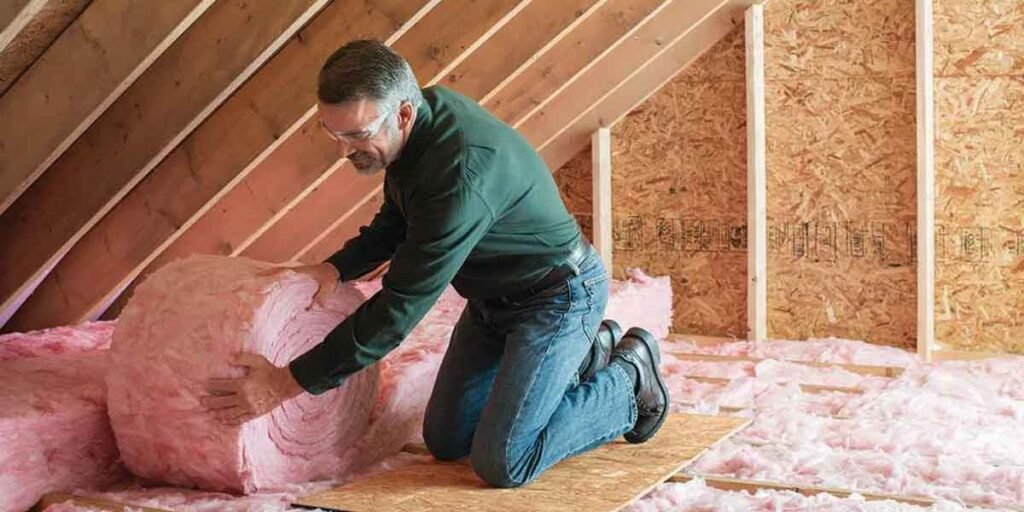
The best attic insulation for your home is not a brand or a per-inch ranking.
It is the material that works over the layer already on the attic floor, around the wiring that passes through it, and under the roof vents the house depends on. Ranking materials by thermal performance puts the decision in the wrong order, because fit is what fails first.
Fiberglass, cellulose, and mineral wool all land inside the same narrow band per inch, so the label separates them less than the space they are about to fill.
What Separates the Best Attic Insulation for Your Home
ENERGY STAR lists fiberglass, cellulose, and mineral wool at about 3 to 3.5 R-value per inch, which makes thickness, not brand, the number that sets your R-value. Closed-cell spray foam buys more R per inch, and the cost of that is permanence: it bonds to the deck or the joists, and taking it out later means demolition.
That trade-off is the entire comparison. One group of materials lets you add depth in a weekend with a rented blower. The other buys depth inside a cavity too shallow for anything else, and asks you to live with the outcome.
The payback question, optimizing your home the best attic insulation for energy efficiency, is worked out separately from fit and only pays off after the material matches the space.
Four Checks That Narrow the Field
Four conditions in your own attic narrow the choices faster than any comparison chart: the depth and condition of the existing layer, moisture and roof ventilation, the electrical hardware sitting in the insulation, and access for later maintenance. Any one of them can eliminate a material outright.
Read the existing layer
Measure the depth of the insulation and multiply by three. ENERGY STAR gives that shortcut directly, because the common types run about 3 to 3.5 per inch, so depth in inches times three estimates the R-value already in place.
Then look across the open floor. Where the insulation sits at or below the top of the floor joists, the attic needs more.
I measured one spot near the hatch the first time I did this and stopped there. Six inches at the hatch turned into two inches across the far half of the attic, where stored boxes had compressed the batts for years. One reading is not a measurement. Take three or four across the space and work from the lowest.
Check the moisture and ventilation story
Wet or compressed insulation does not deliver its rated R-value, and burying a damp patch under fresh material hides the cause instead of repairing it. Stained roof sheathing, rusted fasteners, or dark rings on the joists point to a leak that has to be fixed first. Attic-floor insulation also has to leave the vent path open, and soffit baffles, which carry air from the eaves up into the attic, cannot disappear under blown material. If the plan buries them, the roof deck stays damp and the insulation becomes the smaller problem.
Clear the electrical hardware
Recessed lights and old wiring set hard limits on what can be covered. The National Electrical Code requires thermal insulation to be kept at least 3 inches from a recessed luminaire’s enclosure, wiring compartment, and driver unless the fixture is listed as Type IC, which identifies it for contact with insulation, and a cooler LED lamp inside an older housing does not change the housing’s rating. Knob-and-tube wiring is a separate stop sign, because NEC 394.12(5) forbids loose, rolled, or foamed insulation from enveloping concealed conductors that were built to shed heat into open air. In prewar attics the two problems show up together, and both belong to an electrician rather than an insulation crew.
The fourth check is unglamorous: how someone reaches the far corners in ten years. An attic with no flooring and a low ridge is a place where added material gets walked on and shifted, and shifted material gives back less than the R-value on the bag.
Material by Material: What Fits and What Fails
Attic Insulation buyers compare materials and prices; the attic decides which of those comparisons matter. The table maps each condition to the material that survives it, and the third column is the maintenance story that rarely comes up at the counter.
| Material | Fits best when | Watch for |
|---|---|---|
| Fiberglass batts and rolls | The attic floor is open, dry, and fairly level, and the work is done by the owner | Compression and gaps; batts cut around pipes and joists leave uninsulated bridges |
| Blown-in cellulose | An uneven floor, obstacles, or an existing loose-fill layer needs covering | Settling, and soffit baffles buried by a careless pass with the hose |
| Blown-in fiberglass | The same retrofit work, where a lighter material is preferred | Less R-value per inch than cellulose at the same depth, so it needs more material |
| Mineral wool | Damp-prone spots, masonry, or anywhere fire resistance earns its price | Highest material cost of the batt and loose options; still needs full coverage |
| Closed-cell spray foam | Rafter or roof-deck cavities too shallow for anything else | Permanent once cured; changes how the roof has to vent; needs mixing equipment |
| Open-cell spray foam | Air sealing a vented attic where there is room to build thickness | Lower R per inch than closed cell, in the same range as fiberglass and cellulose; needs a covering where it stays exposed |
Adding over an existing layer is standard practice rather than a shortcut. The exceptions are the ones that force removal: material saturated by a leak, nesting or droppings from rodents, and vermiculite, which the EPA says to treat as asbestos.
Durability in an attic is mostly about air and water. Batts that someone walked across lose thickness for good; cellulose settles in the first season and should be installed above the target depth to compensate; foam holds its shape but can hide a leak until the sheathing behind it rots. Homes without an attic floor move the whole question: in a cathedral ceiling the insulation sits against the roof deck, and the choice becomes a rafter cavity where rigid board, spray foam, or mineral wool fit better than a compressed batt.
Where DIY Stops
Four situations end owner work in an attic: vermiculite insulation, widespread mold, a non-IC light fixture or knob-and-tube wiring that would be buried, and two-part spray foam. Each boundary exists for health or fire reasons rather than paperwork.
Vermiculite is the one to check before touching anything. A mine near Libby, Montana supplied over 70 percent of the vermiculite sold in the United States between 1919 and 1990, according to the EPA, and that material was contaminated with asbestos. The agency’s advice is to assume vermiculite insulation contains asbestos and leave it undisturbed, which rules out do-it-yourself removal. Its guidance also keeps boxes out of an attic with exposed vermiculite, keeps children from playing there, and asks owners to seal cracks around light fixtures, ceiling fans, and the hatch so dust cannot sift into living space.
Mold is a water problem wearing an insulation costume. Where joists or sheathing show more than a small patch of growth, the leak and the ventilation both need attention before any material decision, and contaminated material comes out rather than getting covered.
Spray foam goes to a contractor for a different reason. Two-part foam is mixed and applied with equipment that holds the chemicals at controlled ratios, and the isocyanates involved are a respiratory hazard during application. The small canisters sold for sealing around a rim joist are not the same job as coating a roof deck.
The physical work is the last boundary. Unfloored joists, summer attic heat, and a hatch entry on a ladder turn a two-hour task into a fall risk, and no R-value justifies that trade. Where the old layer turns out to hide a non-IC fixture or knob-and-tube wiring, the material question stays closed until an electrician has been through the attic.
Code editions differ by state and city, and the local authority having jurisdiction settles which clearance rules apply at a given address. Asbestos work belongs to an abatement professional certified in the state where the house stands.
Frequently Asked Questions
What type of insulation is best for an attic?
In most open, vented attics the best attic insulation for your home is blown-in cellulose or blown-in fiberglass over the existing dry layer, since those return the most R-value per dollar. Spray foam wins only where cavity depth is too shallow for loose material or batts.
Should I remove old attic insulation before adding new?
In most attics the sound, dry layer can stay and new material goes on top. Remove it when it is saturated, contaminated by rodents, or made of vermiculite, which the EPA treats as asbestos and leaves to a certified professional.
Is R-19 or R-30 better in an attic?
R-30 performs better wherever the framing allows that thickness, because thermal performance rises with R-value. R-19 fits where joist depth or a low roof pitch caps the cavity, and it is a compromise rather than a target.
Can I insulate an attic myself?
Yes for blown-in cellulose, blown-in fiberglass, and unfaced batts in a clean, dry, unfloored attic, with a respirator and a rented blower. Hire out for vermiculite, mold, non-IC light fixtures, knob-and-tube wiring, and spray foam.
