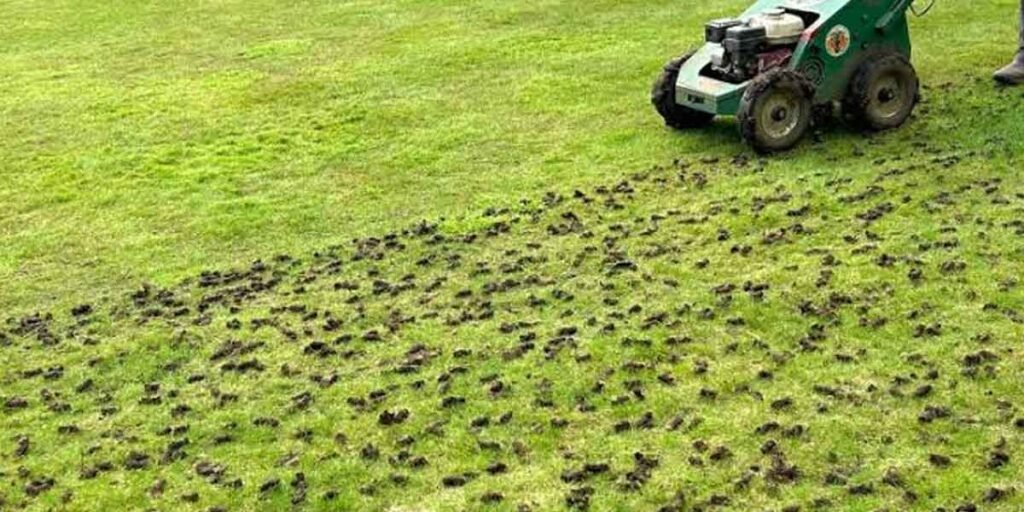
Lawn aeration benefits all trace back to one change: compacted soil opens up, and air and water reach grass roots again. That single mechanism is the whole of it, and it only matters where the soil has actually closed up.
Those benefits are real on a compacted lawn and close to zero on a loose one, so the first useful move is to pull a single plug out of your own yard and look at it. A core that holds together at two or three inches deep, with roots running down its length, is soil that will respond to the treatment. A core that crumbles into a wet smear, or stops an inch down, tells you the machine is not your problem.
What Core Aeration Actually Changes in the Soil
Core aeration removes small cylinders of soil with hollow tines, cutting open the compacted layer. Extension turf programs put a useful hole at half an inch to three quarters of an inch wide, two to four inches deep, and 20 to 40 holes per square foot, a density that one pass with a rental machine almost never reaches.
Topsoil is roughly half pore space by volume. Those pores hold the oxygen grass roots respire with and the water that carries dissolved nutrients downward, and the largest pores collapse first under foot traffic, mower wheels, a parked truck, and rain landing on bare ground. Once they are gone, water sits on the surface and runs toward the street.
Hollow tines cut through that layer and lift the soil inside them up to the surface. The depth of the hole left behind matters more than the number of passes, because roots follow the channel down and a deeper hole stays open longer. Virginia Cooperative Extension suggests watering about an inch two days ahead of the work, so the tines penetrate and the cores fall out clean.
Lawn Aeration Benefits You Can Verify in One Season
The lawn aeration benefits that show up first are water soaking in where it used to puddle, roots reaching deeper, and fertilizer staying in the root zone. On genuinely compacted ground they arrive in that order, and the third one is the hardest to see.
Infiltration is the easiest change to confirm. Grass that puddled twenty minutes into a sprinkler cycle usually stops puddling within a season of core aeration, because the holes give surface water somewhere to go that is not the storm drain or the driveway.
Roots follow the same channels. Grass grows roots into whatever space is open to them, and a top two inches packed hard keeps the entire root mass shallow. That is the difference between a lawn that browns out in the first dry week of July and one that keeps color through it.
Fertilizer behaves the same way, since nitrogen that never gets below the surface leaves with the next hard rain. Water still has to arrive evenly for any of that to matter. A sprinkler zone with a slow leak or a pressure drop at the far heads leaves dry pockets that no amount of hole punching fixes, and the benefits of professional plumbing inspections start with the parts of the system nobody looks at: the valve box, the line under the walkway, the connection that has been buried since the house was built.
Thatch thickness decides whether aeration alone is enough. Thatch is the mat of dead stems and roots that builds up between the soil and the green blades, and it repels water once it gets thick enough to act like a roof. PennState’s turfgrass program and North Dakota State’s extension guidance put the problem point at half an inch and one inch respectively, and you can settle the question for your own yard with a ruler pushed down to the soil line. A thin layer is no obstacle to core aeration. A mat an inch thick is a dethatching job, with aeration following it.
Where Aeration Stops Working
Core aeration relieves compaction in the top three or four inches of soil, which is as deep as a walk-behind machine reaches. It does not fix shade, drainage structure, disease, or salt burn from dogs, and it carries costs that the pitch for it skips, including a conflict with pre-emergent weed control.
Wet soil is the most common way the work goes wrong. Saturated ground plugs the hollow tines, cores come out as smeared clods that sit on top of the holes they were meant to open, and the machine’s weight on soft turf presses the soil tighter than it started. Clemson’s home and garden center describes aerating wet soil as messy and prone to making compaction worse, and Iowa State’s turf program notes that tines clog in wet soil and will not bite in dry soil. The window between those two states is wider than most people assume: squeeze a handful of soil, and if it holds shape without dripping, you are in it. If soil sticks to your shoes, wait three days.
Aeration also does not change soil pH, though it does help lime or sulfur do their work sooner by getting the material down to the root zone where the reaction happens.
Overseeding is where aeration pays back twice, and it is where the schedule can collide with weed control. Pre-emergent herbicides work by stopping germinating seed, and they do not tell your new grass seed apart from crabgrass. Colorado State’s extension writers make the point directly, and university guidance puts the wait at three to four months on typical spring application rates, with product labels listing longer intervals for high rates and southern programs. The label on the product you own is the only authority worth following.
Two active ingredients, mesotrione and siduron, are labeled as safe to use around seeding, and whether a specific product qualifies is a label question rather than a brand question. If the arithmetic pushes seeding past your fall window, the sequence belongs with your local extension office or a licensed applicator. Missing one overseeding season costs less than paying for seed that never germinates.
Open holes are indifferent about what grows in them. The seed-to-soil contact that makes overseeding work also favors weed seed already sitting in the profile, so a lawn with a crabgrass history can look worse for a season before it looks better.
Matching the Machine to the Job
Hollow-tine core aerators are the only common type that removes soil. Spike and solid-tine machines open a hole by displacing soil sideways, which presses neighboring particles closer together, and extension programs list them as a source of added compaction.
Slicing aerators sit in the middle. Rotating blades cut channels through the turf and leave the soil in place, so they create a path without the plug removal that gives core aeration its staying power. Spiked sandals strapped over your shoes do a small amount of good over a small patch and very little anywhere else.
The spec sheet matters more than the brand name on the machine. Deeper tines win on heavy clay, two to three inches of spacing between holes is common on rental units, and hitting the 20 to 40 hole target takes two to four passes in different directions. K-State Research and Extension suggests three to four passes before overseeding.
Renting is reasonable on open, flat ground with sprinkler heads set flush to the turf. A walk-behind aerator is awkward on slopes and unforgiving around valve boxes and shallow irrigation line, so large properties, steep grades, or a lawn full of irrigation hardware are the cases where hiring a lawn care crew costs less than repairing what the machine took out.
Timing, Frequency, and the Moisture Window
Cool-season grasses recover best from aeration between late August and mid-September, and warm-season grasses from late spring into early summer. Both windows fall inside active growth, which is what lets the grass close the holes, and roughly four weeks of growing weather should remain afterward. A dormant lawn should not be aerated at all.
Frequency follows the soil, not the calendar. North Dakota State University’s extension guidance puts the interval at once every one to five years, citing a 2000 University of Wisconsin guide on aeration and topdressing, with heavy clay and high-traffic lawns on the short end of that range. A plug pulled from a yard that has never been aerated answers the same question as one pulled two years after the last pass.
Walk the lawn before deciding. The strips beside the gate, along the driveway edge, and in front of the back door harden first, and a hollow tine pushed into one of those strips tells you in ten seconds what the open middle of the yard will not.
Aftercare is mostly about water and seed. Leave the cores where they land; they break down in about two to four weeks, and mowing speeds that along once they have dried. Overseed and fertilize in the same week when the timing allows, keep new seed damp, and stay off the lawn for a few days while the surface settles.
Lawn Aeration Questions
What are the downsides of aerating?
The main downsides are clogged tines on wet soil, mud and tire marks on soft ground, and a conflict with pre-emergent weed control when overseeding is part of the plan. Cores left on the surface look untidy for two to four weeks, and a dormant lawn should not be aerated at all.
Does aeration really help a lawn?
Yes where soil is compacted, and very little where it is not. North Dakota State’s extension guidance says almost every lawn benefits and most lawns do not need it, with heavy foot traffic, thatch over an inch, and heavy clay soils making up the group that does.
When should you aerate?
Late August through mid-September for cool-season lawns, and late spring into early summer for warm-season lawns. Both sit inside natural growth periods, when grass can fill the holes.
Is October too late to aerate a lawn?
October is late for most northern lawns. Grass needs about four weeks of growing weather to recover, and holes that stay open into winter do nothing for a lawn that has stopped growing.
Pull one core before scheduling anything, and pull another after the next hard rain. A plug that holds together at two inches and shows roots down its length is soil that will take water. A smear of wet soil on the tine is money spent pressing the lawn closed.
