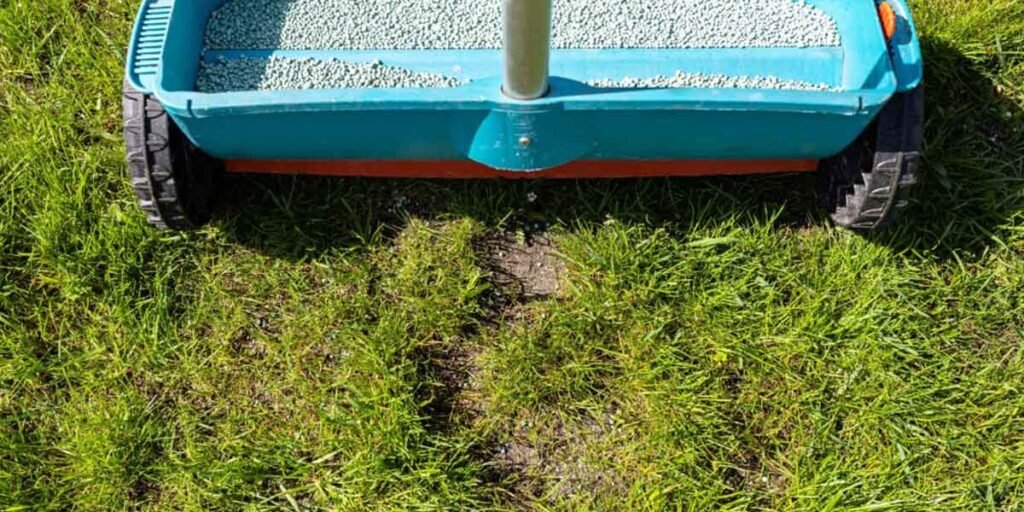
Test, measure, calibrate, apply, inspect. Lawn care fertilization in that order survives a wet spring and a dry August.
A schedule built on month names breaks the first time the weather skips a season.
These five moves apply to a home lawn the owner treats himself, with general-use granular products and a spreader from the garage. For-hire application, phosphorus rules, and restricted-use products sit behind separate law, and that boundary gets drawn near the end.
Start With a Soil Test and One Honest Area Number
A soil test decides whether phosphorus and potassium belong in the plan at all, and a rough measurement decides how much product to buy. Guessing at either one wastes money in both directions: a bag of phosphorus the lawn did not need, or a rate spread thin across an area larger than the driveway math suggested.
University of Illinois Extension tells homeowners to focus on nitrogen unless a soil test shows a deficiency in something else, and that is the cheapest correction available, since one lab result replaces three seasons of trial and error. Most land-grant universities run soil labs for their own state, and the local extension office lists current options with the sampling instructions that match its methods.
Area matters because everything downstream is priced per 1,000 sq ft. Walk the property or trace it on a map, then subtract the house, the driveway, the patio, and the beds. A 7,000 sq ft lawn and a 12,000 sq ft lawn take the same product at rates that differ by 70 percent.
One habit belongs in this step too. Leave the clippings on the turf. University of Wisconsin-Madison Extension counts clippings as part of the season’s nitrogen budget, which makes them the rare input that costs nothing.
Turn the Bag Into a Number You Can Weigh
Divide the nitrogen rate you want by the nitrogen percentage on the bag, and you have pounds of product per 1,000 sq ft. At a one-pound nitrogen target that works out to 6.7 lb of a 15-0-10 product, 5.0 lb of a 20-0-10, or 3.3 lb of a 30-0-10.
Illinois Extension walks that arithmetic through a full example: one pound divided by .15 gives 6.66, rounded to 6.7, then 6.7 multiplied by 7,000 sq ft and divided by 1,000 comes to 46.9, or about 47 lb of product for the whole lawn. Rutgers NJAES gives the mirror version, with a 20 percent nitrogen product landing at 5 lb per 1,000 sq ft.
The ceiling that gives the number its meaning is one pound of nitrogen per 1,000 sq ft in a single quick-release application. Rutgers NJAES notes that soluble nitrogen is normally held to that rate, while slow-release products can be applied heavier without the same burn risk.
| Bag analysis (N-P-K) | Product per 1,000 sq ft at a 1 lb nitrogen target | Product for a 7,000 sq ft lawn |
|---|---|---|
| 15-0-10 | 6.7 lb | 47 lb |
| 20-0-10 | 5.0 lb | 35 lb |
| 30-0-10 | 3.3 lb | 23 lb |
| 46-0-0 (urea) | 2.2 lb | 15 lb |
A controlled-release nitrogen fertilizer is a product whose nitrogen becomes plant-available over weeks instead of days, which is why Illinois Extension points homeowners toward it for most applications: less surge growth, less burn risk, less nitrogen lost to air and water. Fast-release urea, ammonium sulfate, and ammonium nitrate keep one advantage, since they work in cold soil early and late in the season when microbial release has slowed to nothing.
The annual total sits behind the per-application cap. Illinois Extension suggests about three pounds of nitrogen per 1,000 sq ft per season for a full-sun lawn, split across two to four feedings, and roughly half that in shade.
Calibrate the Spreader Before the First Pass
The dial setting is a starting point, not a rate. Weigh what the spreader actually delivers over a measured strip, adjust, and repeat until the catch matches the target within about 5 percent, the tolerance UMass Extension uses for a calibrated rotary spreader.
Penn State Extension lays out the test: measure the swath, mark a strip 50 to 100 ft long, catch the product in a pan or weigh the hopper before and after, walk at the brisk pace you will use on the lawn, and open the hopper at the start line and close it at the end. On a drop spreader, the swath is the hopper width as much as the distance between the wheels, which University of Arizona Extension flags as the mistake that leaves narrow unfertilized bands on a lawn that looked covered from the porch.
Why does the dial lie? Because the release rate does not rise in a straight line with the setting number. Arizona Extension makes that point directly, and it means one notch can change output by more than the arithmetic predicts. A setting that worked on last year’s bag has no claim on this year’s.
Two features of spreader design decide the pass pattern. Drop spreaders are accurate and demand passes sitting exactly next to each other, like strips of wallpaper, with wheel tracks overlapping so no gap opens between them. Rotary spreaders throw in a bell-shaped pattern that is heaviest at the center, and Purdue’s turf team puts the correct overlap at about 50 percent, so the thin edge of one pass lands on the wheel track of the last. Purdue traces striped athletic fields to pass spacing wide enough that those thin edges never meet.
Working in halves is the technique Penn State and UMass Extension both recommend. Set the spreader to deliver half the target rate, then cover the lawn twice, the second pass at a right angle to the first. For a 30-0-10 product at a one-pound nitrogen target, each pass carries 0.5 lb of nitrogen: 0.5 divided by 0.30 gives 1.6 lb of product per 1,000 sq ft. Over a test strip 3 ft wide and 100 ft long, 300 sq ft, the catch should weigh about 0.5 lb, or 8 ounces.
Lawn Care Fertilization, Applied: Passes, Edges, and Water
Set the spreader to half the target rate, cover the lawn in two perpendicular passes at a steady pace, and close the hopper through every turn. Then water the granules off the blades with about a quarter inch of irrigation or rain, because a granule that dissolves on the leaf feeds nothing and can burn the tissue underneath it.
Kansas State University Extension puts the water-in amount for common cool-season products at a quarter inch, enough to wash the granules into the root zone. Products that combine fertilizer with a herbicide are the exception. Kansas State notes that watering within 24 hours of a crabgrass preventer reduces its effectiveness, so those applications go down when rain is not in the forecast, and Purdue Extension puts the general water-in deadline at 24 hours.
Keep the pace constant, and keep the hopper closed while the spreader is stopped or turning. Granules discharged during a paused turn pile into a band you can see from the doorway.
After the second pass the lawn looks unchanged. Grey pellets sit on the surface, denser along the driveway turnaround, thinner under the maple where the walking slows down. Nothing has happened yet.
The habits around lawn care fertilization decide how much of it the grass keeps. Mowing height, watering depth, and the timing of both are handled in professional tips for maintaining a lush and healthy lawn. Sweep the driveway, the sidewalk, and the street edge once the passes are done.
The Checkpoints: Week Two, Week Four, and Whether to Feed Again
Two weeks after a feeding, read color evenness and how fast the turf is growing. Four weeks in, read density, recovery, and any stripes. Those readings set the date of the next application, since a chart on the wall cannot see the lawn in front of you.
Four things are worth watching on the walk-around.
- Mowing volume. More clippings per cut, or a full bag where there used to be half, means the nitrogen landed and the grass is using it.
- Color evenness. Uniform, slightly pale turf usually wants its next scheduled feeding, while dark patches against pale ones point at coverage and the spreader.
- Stripes. Straight light bands mean skipped rows. Dark bands mean doubled ones, which is the failure the Purdue overlap rule exists to prevent.
- Footprint recovery. Grass that stays flat where you walked is talking about water and root depth long before it says anything about fertilizer.
Write the numbers down on the day you apply: date, product analysis, dial setting, and the catch weight from the calibration strip. I keep mine taped inside the hopper where I cannot lose it, and the note from last fall is what tells me whether a spring feeding is worth the trip.
Timing follows the grass, with two anchor points worth naming. University of Wisconsin-Madison Extension treats late spring and early September as the most valuable windows for a cool-season lawn and suggests waiting until the lawn has been mowed twice before the first spring feeding. Warm-season grasses such as bermuda and zoysia want their nitrogen from late spring into summer, when the soil stays warm and the turf is growing hard.
Skip any feeding when the lawn is dormant, drought-stressed, or waterlogged. Fertilizer is not a rescue tool, and nitrogen applied to turf that cannot grow ends up in the soil, the air, or the nearest storm drain.
Failure Points, and the Rules That Outrank Your Plan
Drought-stressed turf, quick-release nitrogen in mid-summer heat, doubled corners, and rain within hours of application account for most failed feedings. Phosphorus restrictions, seasonal blackout windows, and applicator licensing override any schedule you build, and those are the points where homeowner work stops.
Five failures that come back every season
- Feeding a lawn that is brown from heat or thirst. Water and time come first; nitrogen waits for growth to resume.
- Using fast-release urea in summer heat on a cool-season lawn, which pushes tender growth straight into disease pressure.
- Doubling the corners by overlapping at every turn instead of closing the hopper.
- Applying ahead of a forecast carrying a heavy storm, which moves product off the lawn and into runoff.
- Reaching for a weed-and-feed to save a trip. Illinois Extension describes the timing conflict plainly: the spring crabgrass pre-emergent window arrives earlier than the ideal fertilizer window, so a combination product compromises one job to do the other.
Where homeowner work stops
Phosphorus is the clearest example of a rule that changes the product, not just the timing. Minnesota Statutes 18C.60 bans phosphorus fertilizer on turf statewide, with three narrow exceptions: a soil or tissue test from the last three years showing a deficiency, new turf during its first growing season, and golf course use under a certified person. The same statute makes a violation a petty misdemeanor, and a companion law preempts most local turf-fertilizer rules, so the state text is the one to read.
Florida took a different route. State law directs counties and cities toward a model ordinance that caps phosphorus at 0.25 lb of P2O5 per 1,000 sq ft per application, and 0.50 lb per year, unless a soil or tissue test documents a need. A UF/IFAS publication, EDIS AE534, counts at least 36 Florida counties and 98 additional municipalities with adopted urban fertilizer ordinances, some of which add blackout periods when nitrogen and phosphorus products cannot go down at all. The same publication reports that phosphorus fertilizer sales in Florida fell 70 percent between 2003 and 2017, from 70,000 tons to 21,000 tons, citing EPA data.
Application for hire is the second line. Indiana requires a license for fertilizer spread on someone else’s property for money, with turf work sitting under the category 3b exam, and the state chemist’s office states that charging for mowing while applying fertilizer at no extra charge still requires it. Wisconsin counts weed-and-feed and fertilizer-insecticide mixes as pesticide applications, which brings licensing and record-keeping along with them. Florida requires a limited commercial fertilizer application license, built on the UF/IFAS Green Industries BMP training, for a business hired to fertilize lawns.
Restricted-use products carry the hardest line. A restricted-use pesticide is a product the EPA classifies as carrying enough risk to require a certified applicator, and under FIFRA it may be applied only by that applicator or by someone working under direct supervision. Most bagged homeowner fertilizer is not restricted, which is why a homeowner treating his own property with general-use products generally needs no certification at all. The job belongs to a licensed applicator once any of these apply: for-hire work on another person’s property, ground that slopes into a water body or a storm drain, sites large enough to need a commercial spreader, or any product carrying a restricted-use label. The label on the bag is the current legal text for the product in your hand, and the county extension office knows which state and local rules were adopted most recently.
Questions That Come Up Before the First Bag
Should lawn care fertilization happen before or after mowing?
Apply it after mowing, once the blades are dry. Granules landing on long or wet grass stick to the leaf and dissolve there instead of reaching the soil, which concentrates nitrogen where it can burn tissue. Kansas State University Extension puts the water-in step at about a quarter inch of irrigation or rainfall once the product is down.
When should you fertilize your lawn?
Fertilize while the grass is actively growing, which for a cool-season lawn means a light spring feeding and the heavier work in late summer and early fall. University of Wisconsin-Madison Extension puts the season’s total for a full-sun lawn at about three pounds of nitrogen per 1,000 sq ft and holds any single application to one pound. Warm-season lawns take their nitrogen from late spring into summer.
What is the best fertilizer for my lawn?
The best fertilizer is the one your soil test calls for, and for most home lawns that means nitrogen first. Illinois Extension recommends ratios such as 3:0:2 or 4:0:2 with a controlled-release nitrogen source for most applications, and leaves phosphorus out unless a test shows a deficiency or you are starting new turf.
What is the best way to fertilize my lawn?
Calibrate the spreader to half the target rate, then cover the lawn twice in perpendicular directions at a steady pace. Penn State Extension and UMass Extension both recommend that split-rate method, because two lighter passes even out the pattern and cut down on the stripes a single heavy pass leaves behind. Water the granules in afterward.
