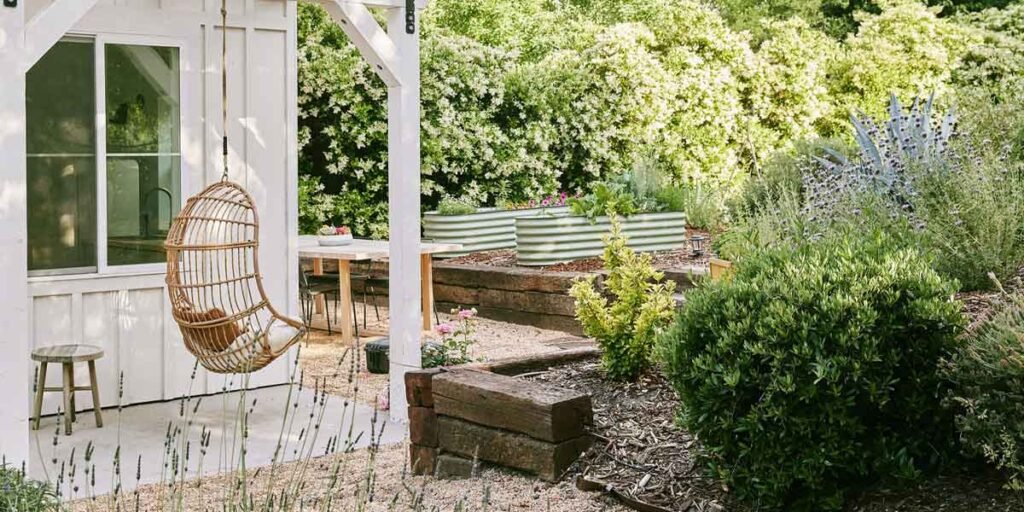
Good garden design ideas start with sun, water, and upkeep. Style, color, and plant lists get chosen inside those three answers, and the order is what keeps a yard from turning into a weekend obligation.
The failure mode is predictable.
A border planted for afternoon shade loses its best plants the first summer the tree comes down, and a zone that mixes thirsts keeps everything either too dry or too wet. A plan built on the wrong sequence cannot be rescued with better plants.
The three constraints a garden plan answers to
Sun hours, water access, and weekly upkeep time bound what a garden can be. Plant selection, paths, and bed shapes get decided inside those limits, and a plan that ignores one of them fails within two seasons.
A border with six hours of midday sun in June may get two in December, and a shrub sold as full sun can coast for a season on stored energy before it thins out.
Water access decides the shape of the planting.
Every zone has to reach a spigot, a valve, or a hose bib, and the distance and elevation between them set what the irrigation can deliver.
Upkeep hours decide scale. A border of shrubs and ground cover takes one afternoon of mulch and pruning twice a year.
A bed of annuals takes that same afternoon every month from May through September. That gap is the one most garden design ideas skip over, and it is the one that decides whether a yard still looks tended in August.
University extension horticulture programs teach the underlying rule under a short name: right plant, right place, which makes the plant list the last decision in the process.
Reading the site before anything is drawn
A site read answers four things: how many hours of direct sun reach each area, how quickly the soil drains, where water and buried lines run, and which way the ground falls. It takes a weekend, a shovel, and one phone call.
Walk the yard four times in one day, around 9 a.m., noon, 3 p.m., and an hour before sunset, and note where the light lands. Four photographs from those hours will map the shade pattern better than any chart.
Drainage comes next.
Extension programs describe a percolation check that needs only a shovel: dig a hole about a foot deep and a foot wide, fill it, let it drain, fill it again, and time the second fill. Water that disappears within a few hours means the soil drains; water still standing the next morning means that ground needs plants that tolerate wet roots or a raised bed built on top of it.
What runs underground counts just as much. Call 811 a few days before digging so the locate service can mark gas, electric, drinking-water, and communications lines.
The call is free, state law requires it before excavation, and the notice window differs by state.
Strike a gas line and the project stops. Leave the area, keep everyone away, and call 911 and the gas utility from a safe distance.
Service lines are repaired by the utility, never by a yard owner with a wrench.
The site read is the least glamorous step in the process, and it is where garden design ideas either hold up or fall apart.
Slope ends the read. Runoff moves downhill, and grading that pushes it toward a foundation, a septic drain field, or a neighbor’s lot is a permitting question before it is a weekend’s work.
What each major choice locks in
Lawn, planted borders, and paving trade work in different places. Grass asks for mowing and edging through the growing season, borders ask for mulch and pruning, and paving asks for sweeping and joint repair. Pick the mix that matches the calendar you actually have.
Lawn is the cheapest option to install and the most repetitive to keep.
A small lawn wrapped in deep borders takes less seasonal work than a large lawn with thin borders, so shrinking the turf area usually buys back the most time.
Planted borders cost more at installation and less every season, once the shrubs are sized to the space. Crowding is the mistake that shows up late: a shrub sold in a two-gallon pot can double its width in three years, and a border laid out at its nursery spacing becomes a hedge by year four.
Paving shapes how the whole yard reads. Unit size and layout do most of that visual work: the same logic behind 2×4 tiles vs 2×2 tiles size design and placement choices applies outdoors, where long units read as one continuous plane and small squares read as a grid.
Raised beds buy control of soil mix and drainage and pay for it in material and fill. A 4-by-8-foot bed filled a foot deep takes a bit more than a cubic yard of blended soil, and the frame has to hold that weight without bowing.
Containers are the thirstiest choice in the yard.
A twelve-inch pot in full sun can need a soak twice on a hot day, and eight of them are a problem to leave for a week.
The practical test is a Saturday count. Two free hours a week cover a small lawn, a shrub border, and one mulch refresh each year; a vegetable bed adds weekly weeding and a daily watering check from June through August.
That second number is the one to argue with honestly, because garden design ideas matched to two hours a week look better in August than a garden planned for eight.
Irrigation belongs in the first draft
Most garden irrigation ideas come down to one move: group plants by how much water they need, then give each group its own valve. Grouping by thirst beats grouping by color every time a timer gets set.
A zone that mixes lawn with lavender, rosemary, and hydrangeas can be programmed for one of them. The rest either drown or dry out, and the damage shows up as root rot in one corner and scorched leaves in another.
Sun exposure belongs in the same grouping.
A border in six hours of afternoon sun loses water faster than an identical border on the shaded side of a fence. Two beds that look alike often need separate valves.
What a drip zone contains
A drip zone is five parts in order: a backflow preventer at the tap, a filter, a pressure regulator, the supply tubing, and the emitters. Each part protects the one after it.
A garden drip irrigation design starts at the emitter and works back toward the tap.
Most 0.5 to 2 gallon-per-hour emitters call for 150 to 200 mesh filtration, which is 100 to 75 microns, and a 150-mesh screen covers most residential layouts.
Screen filters need cleaning more often than any other part of the assembly, which is why extension irrigation guides put them where you can reach them.
A regulator holds line pressure at a set number, usually 25 psi for drip, and it can only hold it when the inlet pressure stays at least about 5 psi higher than the setting. A spigot that drops to 20 psi while two other taps run will starve the zone, and no emitter choice fixes that.
Emitter output runs from about 0.5 to 2 gallons per hour at each plant. Pressure-compensating emitters hold their rated flow across a slope, which matters because every foot of rise or fall shifts line pressure by roughly 0.43 psi.
Run length has a working limit too: about 100 feet of half-inch tubing per zone keeps pressure loss in a range the emitters can absorb.
Turning emitter rates into run times
Emitter flow rates convert into run times with one division: total gallons per hour across the zone, divided into the gallons the planting needs. A 4-by-8-foot bed with half-gallon emitters spaced a foot apart puts down roughly 0.4 inch of water in half an hour.
The arithmetic is short. Thirty-two half-gallon emitters deliver about 16 gallons an hour.
Half an hour of that spreads roughly 8 gallons across a 4-by-8-foot bed, which works out to four-tenths of an inch.
One inch a week, rain included, is the long-standing extension guideline for established lawns and most shrubs. At that output a full inch takes about 75 minutes of run time, and doubling the emitter rate halves it.
Raised beds and containers
Raised beds drain faster than the ground around them, so they need shorter, more frequent cycles. Inline tubing spaced about a foot apart, or drip tape matched to the row spacing, delivers at the root zone without wetting leaves.
A 4-by-8-foot bed takes two to four runs depending on crop spacing, and the emitters go at the base of each plant, not between rows. Seedlings with shallow roots want the same volume more often; established tomatoes and peppers want a longer soak every few days.
Containers are a different problem. One 0.5-gallon-per-hour emitter per pot covers a twelve-inch container, and a pot in full sun may need two short cycles a day in a heat wave.
Hand watering every morning does the same work. A garden drip irrigation system design that skips the containers puts the hardest watering job back in your hands every day of July.
Controllers, and what they save
Automated controllers and soil moisture sensors cut run times that a fixed clock schedule would repeat whether or not the ground needed it. Weather-based models use local evapotranspiration data to decide, and soil moisture-based models read the root zone directly.
The EPA’s WaterSense program states that replacing a clock-based timer with a WaterSense labeled weather-based irrigation controller can save an average home nearly 7,600 gallons a year, and it credits soil moisture-based controllers with more than 15,000 gallons.
Those figures are averages: an industry analysis presented at the Irrigation Show in 2012 noted that the studies behind them leaned toward households that were already overwatering.
Savings land nearer 15 percent on an average schedule and far higher on a yard that was drowning.
Local rules decide what goes in at the tap. Many utilities require an approved backflow assembly wherever irrigation ties into the drinking-water supply, and some require a permit or a licensed installer for that connection.
The utility’s cross-connection program states which assembly fits.
Almost every set of garden design ideas comes down to one of four ways of getting water to plants, and each of those fails in a predictable place.
| Method | Best for | What it takes | Where it fails |
|---|---|---|---|
| Hand watering | Containers, new plantings, corners drip misses | A hose, a wand, and time every few days | Missed days in July and wet foliage that invites disease |
| Soaker hose | Short runs in borders and vegetable rows | A spigot connection and, on household pressure, a regulator | Uneven output along the run and clogging as the pores fill |
| Drip tubing with emitters | Borders, raised beds, containers, slopes | Backflow preventer, 150-mesh filter, regulator, tubing, emitters | Clogged emitters and dry bands where spacing is too wide |
| Micro-spray heads | Dense ground cover and tight mixed plantings | The same head assembly as drip, on taller stakes | Wind drift, overspray onto paths, wet leaves |
Maintenance is where garden design ideas get graded
Clogged emitters are the first failure in a drip zone, followed by dry bands where spacing was too wide and split fittings after a freeze. A monthly walk through the zones during the growing season catches all three while they are cheap to fix.
Emitters clog with sediment, algae, and roots. Flushing the lines at the end caps once a season and cleaning the filter more often prevents most of it.
A zone that has lost half its output usually reads as one wet streak and one dry stretch, which is easier to spot than a wilting plant.
Sandy soil holds the wetting front close to each emitter, so emitters a foot apart leave dry bands between them. Clay spreads water wider and can leave it wet too long.
By mid-July the front border is a shade darker than the lawn at eight in the morning and gray by two. The mulch has bleached to the color of cardboard. Tubing still drips under it, and the far end of the same zone has dried to a crust.
Freezing splits another group of parts. Tubing, fittings, and valves hold water, so lines get drained and end caps come off before the first hard frost, and the controller comes indoors.
Where a compressor is used to blow lines clear, the pressure stays low, and that step is often handed to someone with the right regulator.
Mulch carries the routine. Two to three inches, held a few inches clear of trunks and stems, suppresses weeds and slows evaporation from the soil.
Piled against bark, mulch keeps the trunk damp and invites rot and rodent damage.
Pruning follows the plant’s calendar, not the gardener’s mood. Spring bloomers get cut after flowering and summer bloomers in late winter.
A shrub cut in the wrong month either loses the season’s flowers or spends the year growing wood to replace what was removed.
Pests and disease mark the edge of what a yard owner handles alone. Identification comes first, then the label, and state extension offices answer both questions without charge.
Anything involving fumigants, restricted-use products, or treatment across a whole property belongs to a licensed applicator.
Where DIY stops
Buried electric, gas service, retaining walls past the local height limit, and any tie between irrigation and drinking water cross into permitted work. Each has a trade attached to it and an inspector who signs off on the result.
Outdoor receptacles and lighting circuits that run at 120 volts need ground-fault protection under the National Electrical Code, and new circuits go to a licensed electrician.
Low-voltage 12-volt fixtures that run off a plug-in adapter stay within reach of a careful beginner.
Gas lines are locate-and-avoid work. If one is damaged, the utility makes the repair, and the correct move at the moment of damage is to clear the area and call from a distance.
Retaining walls draw permits at a height the local building department sets, often around three to four feet measured from the bottom of the footing. Past that line, most jurisdictions want an engineered design and an inspection.
A wall that fails can push soil toward a structure or a neighbor.
Tree work that involves climbing, or any limb within reach of an overhead conductor, goes to a utility crew or an insured arborist. Falling wood and energized lines are the two hazards that turn a yard project into an emergency.
One boundary catches people late. Wiring an irrigation system into the household supply can trigger a backflow requirement, and the assembly has to match the hazard level the utility assigns.
That is a plumbing permit question before it is a garden question.
Short answers to common sticking points
Five points come up often enough to answer on their own, and each answer holds without the sections above. They cover layout, plant grouping, the rule of three, raised beds, and small yards.
How do you plan a garden layout?
Map sun hours, drainage, and water access first, then group plants with similar needs, then set paths wide enough to push a wheelbarrow. The layout follows the site and the time you have for upkeep, so it gets drawn after the site read.
What does the rule of 3 mean in a planting plan?
The rule of three is a design convention, not a code: odd-numbered groupings of three, five, or seven plants read as intentional where pairs read as accidental, and borders are often built in three tiers of height. Irregular counts hide the grid that even spacing creates.
Are there nine golden rules for garden design?
No single authority publishes a nine-rule standard. The points that carry the most weight in extension material are site assessment, right plant right place, repetition over variety, believable proportion, drainage, water planning, maintenance time, and safety.
Does drip irrigation work in raised beds?
Drip suits raised beds better than sprinklers because the tubing delivers at the root zone instead of wetting the leaves. A 4-by-8-foot bed usually takes two to four runs of inline tubing spaced about a foot apart, and the walkways and outer soil edges stay dry.
Do simple garden design ideas work in small yards?
Small yards reward simple plans because everything is visible at once. One repeated planting, one clear path, and two or three container groups read better in a narrow space than a collection of single specimens, and they cost less to keep.
What is trending in garden design?
Trend lists rotate every season. The change with staying power is water-wise planting: borders grouped by how much water they need, more ground cover where turf used to be, and irrigation sized to the planting instead of the other way around.
The sequence outranks the ideas. Read the site, count the weekly hours, plan the water, and the planting list becomes the easy part.
